
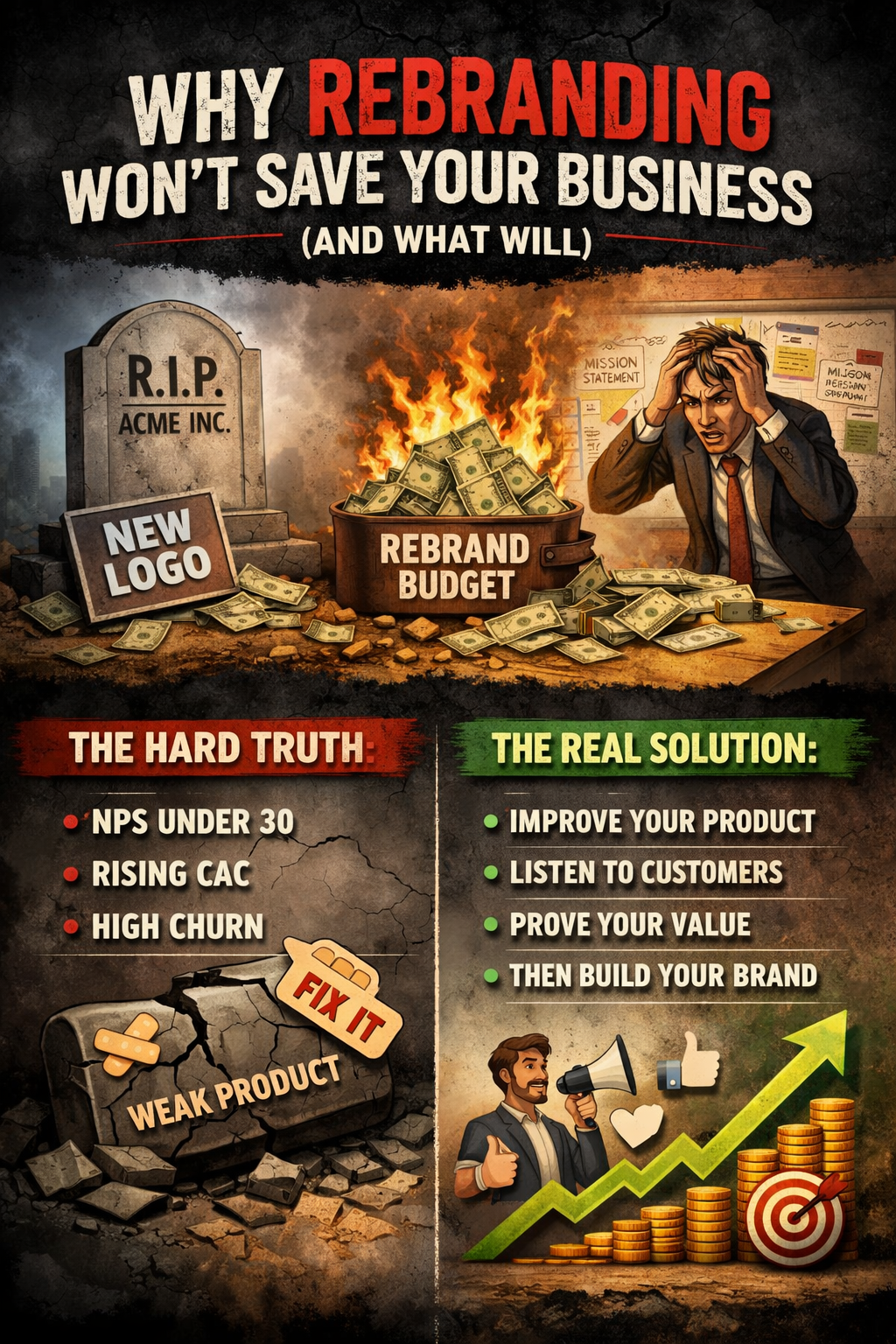
Your revenue is bleeding out and your board just approved a mid-five-figure rebrand. You’re not saving the business. You’re decorating its coffin.
Rebranding is the most expensive way founders avoid admitting their product isn’t good enough. It feels like strategy. It produces deliverables. It gives everyone something to point at in investor meetings. And it changes absolutely nothing that matters.
The Pattern That Kills Companies
Month 1: Sales plateau. Founder panics.
Month 2: Board meeting. Someone says “brand refresh.”
Month 3: Hire brand strategy firm. Mid-five-figure retainer signed.
Month 4–6: Workshops. Mission statements. Competitor analysis. Logo concepts.
Month 7: New brand identity launches. Press release. Internal all-hands.
Month 8: Sales still flat. Maybe declining.
Month 9: Founder realizes the rebrand changed nothing.
Month 10: “We didn’t market the rebrand well enough.”
Month 11–12: New agency. Same cycle.
This isn’t brand strategy. This is organizational therapy disguised as marketing. You’re paying consultants to validate your refusal to fix the actual problem.
What Founders Actually Mean When They Say “Rebrand”
They say: “Our messaging doesn’t resonate.”
They mean: Customers don’t want what we’re selling at this price.
They say: “We need stronger brand positioning.”
They mean: Our product isn’t differentiated and we don’t know how to fix it.
They say: “The market doesn’t understand our value proposition.”
They mean: We built something nobody asked for and refuse to pivot.
They say: “We’ve outgrown our visual identity.”
They mean: We’re bored looking at our logo and need a project that doesn’t require admitting product failure.
Rebranding is the founder’s comfort blanket. It feels like progress. It generates internal momentum. It produces deliverables you can show investors. And it avoids the one question nobody wants to ask: What if our product just isn’t good enough?
For more on how founders avoid structural problems by optimizing the wrong things, see founder burnout and strategic failure—most burn out fixing symptoms while the business dies from ignored root causes.
The Diagnostic Founders Skip
Before spending a dollar on rebranding, run this. If you hit even one “yes,” your problem is not your brand.
Is your NPS below 30?
NPS below 30 means most customers are neutral or actively detractors. That’s not a messaging problem. That’s a product experience problem. No brand strategy converts detractors into advocates. Fix the product until NPS exceeds 50. Then—and only then—talk about brand amplification.
Is your CAC rising quarter over quarter?
Rising acquisition cost means it’s getting harder to justify the purchase. Your competitive advantage is eroding. Alternatives are improving faster than you are. Rebranding won’t reverse that. It will accelerate it—you’re burning money on aesthetics while competitors ship better products.
Is your churn above 5% monthly?
Customers arrive with expectations your marketing set. They leave when reality doesn’t match. Rebranding doubles down on this problem. You’re setting new expectations you still can’t meet. There’s no point filling a leaking bucket.
Are competitors with objectively worse branding outselling you?
If a company with a Fiverr logo is winning your deals, they’re winning on product, pricing, or distribution. Brand polish is irrelevant. Understand exactly why they’re winning and address those specific advantages. Polish your logo after you’ve solved that.
If any of these fail, you don’t have a brand problem. You have a value delivery problem. See why small businesses fail—most don’t die from bad marketing. They die from economic reality they refuse to acknowledge.
What Rebranding Actually Does (And Doesn’t Do)
Brand consultancies have perfected the art of selling expensive nothing.
The Mission Statement Workshop ($8K–$15K): Three-day offsite. Entire leadership team. One sentence that took 24 collective executive hours to produce. “We empower enterprises to transform data into actionable insights.” Translation: we sell software. Impact on revenue: zero. No customer has ever bought a product because the mission statement was inspirational.
The Logo Redesign (low-to-mid five figures): Twelve concepts. Mood boards. Color psychology. New logo nearly identical to the old one. Customer reaction: “Did they change something?” Apple, Nike, and Amazon won because their products delivered consistent value—not because their logos had “geometric simplicity.” Visual identity is the last 5% of brand equity, not the foundation of it.
The Positioning Framework ($15K–$25K): Competitor matrix. Perceptual mapping. Value proposition canvas. The problem: you’re not actually differentiated. You’re describing the same features as competitors using slightly different adjectives. Positioning frameworks are useful when you have real differentiation to position. If your competitive advantage is “better customer service,” you don’t have positioning—you have platitudes.
Brand consistency matters when you’ve built something worth being consistent about. Perfect adherence to brand guidelines just means you’re failing in a coordinated fashion.
When Should You Actually Rebrand?
Rebranding isn’t always theater. Three situations actually require it.
Acquisition or merger: Two companies become one. Conflicting identities. Confused market perception. Customers don’t know which company they’re dealing with. The structural reality changed—rebranding solves an identity collision created by corporate restructuring.
Deliberate market repositioning: You built for SMBs. It failed. You pivoted to enterprise. Your brand screams “affordable for small teams” but you’re selling six-figure contracts to Fortune 500 IT departments. Your old brand accurately reflected what you used to be. It’s now misaligned with what you’ve become.
Legal necessity: Trademark conflict. Regulatory compliance. Geographic expansion. External forces mandate it. You’re not rebranding for strategic reasons—you’re forced to for legal survival.
All three are driven by structural changes external to product quality. The business transformed, or regulations shifted, or corporate structure changed. Every other reason founders give for rebranding is avoidance dressed up as strategy.
What Your Brand Actually Is
Brand isn’t what you say. It’s the sum of every interaction a customer has with your product, your team, and your promises.
Your brand is:
- How fast your product loads
- Whether support responds in hours or days
- If pricing is transparent or requires “contact sales”
- Whether onboarding takes 10 minutes or 10 hours
- Whether you do what you promised
Your brand is not:
- Your visual identity
- Your mission statement
- Your tagline
- Your brand guidelines PDF
Slack’s brand is that the product works without requiring IT support to set up. That’s it. The logo is decoration. Stripe’s brand is developer documentation good enough that integrations take hours instead of weeks. Amazon’s brand is that it arrives in two days or they make it right. None of these companies built strong brands by hiring expensive agencies. They built strong brands by delivering consistent value and communicating that clearly.
Your brand is the promise you make and whether you keep it. If you promise “easy integration” and integration takes three weeks, your brand is “dishonest.” No logo redesign fixes dishonesty.
The Choice Founders Avoid
Fix the product: Acknowledge the product isn’t competitive. Invest in development. Delay revenue while rebuilding. Risk admitting previous strategy failed. Expensive, slow, ego-damaging—but the only option that actually solves the problem.
Rebrand: Keep the product unchanged. Invest in visual identity and messaging. Launch new brand quickly. Feel productive without addressing structural issues. Cheap, fast, certain to produce a deliverable—and guaranteed to change nothing that matters.
Most founders choose the rebrand. Twelve months later, they’re out of business wondering why better branding didn’t save them.
The reason you’re still considering the rebrand is because you know which one matters and you’re hoping there’s an easier answer. There isn’t. See cash flow management under pressure—companies that survive do it by solving structural problems, not by optimizing around them.
If You’ve Actually Earned the Right to Brand
If you’ve fixed the product, retained customers, hit product-market fit, and now need to scale awareness—here’s how branding actually works. For a full breakdown of the process, see how to brand your business the right way—the version that starts with product, not a logo brief.
Define what you’re genuinely better at. Not what you wish you were good at. What customers actually experience as superior. Not “innovative cloud-based enterprise solutions.” Something like: “Our software integrates with Salesforce in 10 minutes instead of 10 hours.” Specificity beats aspiration every time.
Communicate that one thing without jargon. “Empowering organizations to unlock transformational insights” communicates nothing. “Turn spreadsheet data into charts your CEO can understand” communicates everything. If a customer can’t explain what you do after reading your homepage, your messaging sucks.
Deliver it consistently across every touchpoint. Customer service. Billing. Onboarding. Product performance. One broken touchpoint breaks the brand. You can’t fix inconsistent delivery with better copywriting.
Let retention build the brand. Word of mouth. Case studies. Customer advocacy. These build real brand equity. Forced branding—paid advertising, aggressive content marketing, thought leadership theater—amplifies what already exists. If what exists is mediocre, you’re paying to accelerate disappointment.
Fix product first. Retain customers second. Scale awareness third. Rebrand only when structurally forced.
Stop Rebranding. Start Fixing.
Run the diagnostic. NPS, CAC, churn, competitive losses. If any number fails, the brand isn’t the problem—and spending on it is malpractice against your own business.
Your brand doesn’t need a new logo. It needs a product customers actually want to tell other people about.
If customers don’t love your product, your brand is a lie. Rebranding just makes that lie more expensive.
Fix the product. Or keep funding rebrands while competitors with uglier websites take your market share. The math on this has always been obvious.
Leave a Reply