

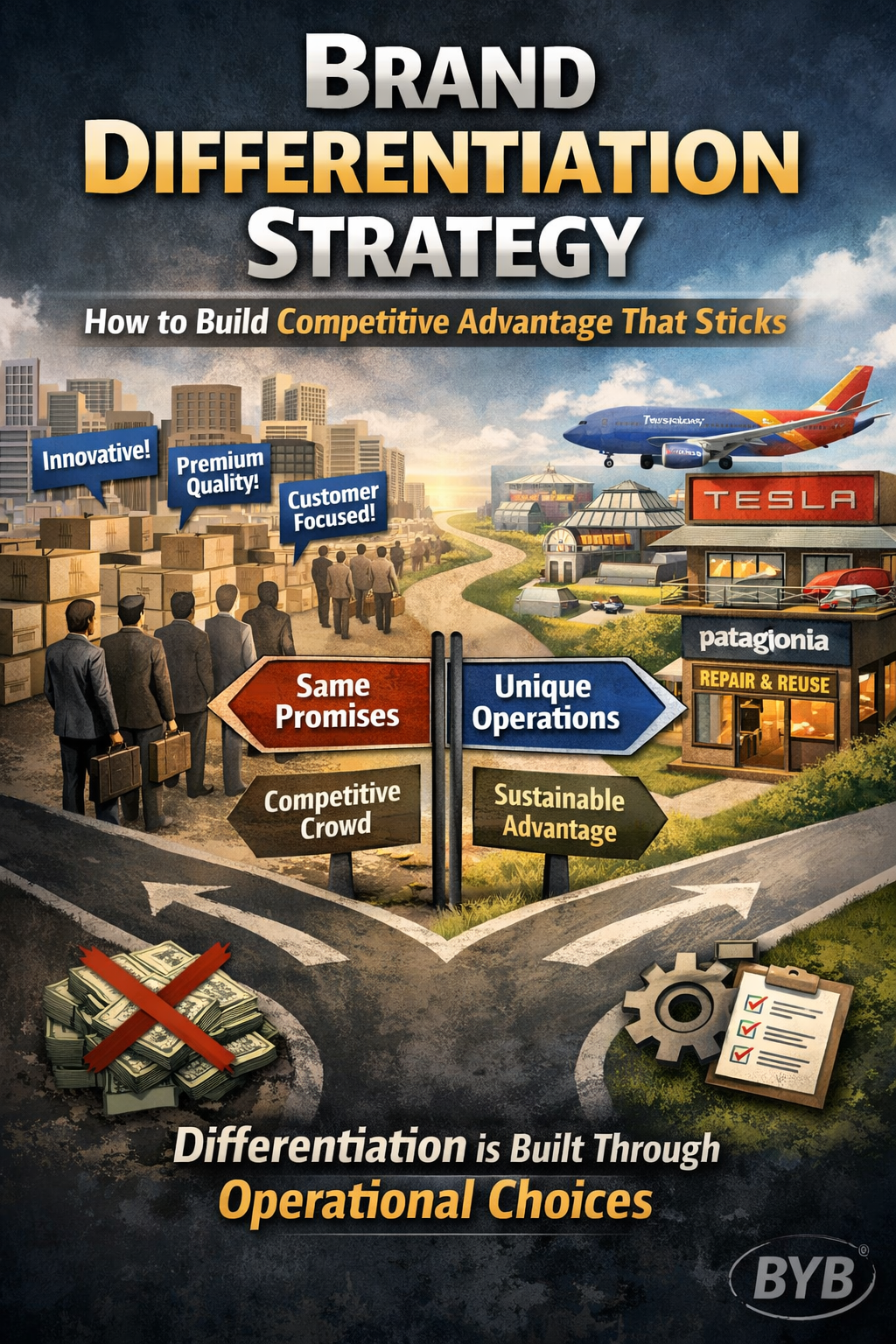
Your brand isn’t differentiated. You just say different things.
Most businesses treat brand differentiation as a messaging problem. They write unique taglines, design distinct identities, craft positioning statements, then wonder why the market groups them with competitors making identical promises. Real differentiation isn’t created through messaging frameworks. It’s built through operational choices competitors cannot easily replicate.
When your pricing structure, product decisions, distribution strategy, and business model all signal the same direction consistently, differentiation emerges naturally. When those operations contradict your claims, the market ignores your marketing and judges you by what your business actually does. The gap between what you claim and what your operations demonstrate is where differentiation collapses before the market even evaluates your promise.
Why Most Differentiation Claims Sound Exactly the Same
Every competitor in your category claims uniqueness through nearly identical promises. “Customer-obsessed approach, innovative solutions, faster execution, premium quality, trusted expertise.” The market stopped believing these because they create no operational constraint, require no structural trade-offs, and can be copied by any competitor in the time it takes to revise a website.
True differentiation forces trade-offs. It requires making operational choices that explicitly define who you will not serve, what capabilities you will not develop, what market segments you will categorically ignore, and what revenue opportunities you will refuse despite immediate profitability. These constraints transform generic promises into defendable positions competitors cannot replicate without fundamentally restructuring their business models.
Southwest Airlines built differentiation through operational choices that made replication structurally difficult. No assigned seating meant simpler boarding processes and faster turnaround times. No meal service eliminated galleys and reduced operational complexity. Point-to-point service avoided hub congestion and connection delays. Secondary airports reduced landing fees and gate competition. Collectively these choices created a business model competitors couldn’t copy without abandoning existing infrastructure, labor agreements, and revenue optimization strategies built around hub-and-spoke operations.
The differentiation wasn’t in the marketing message “low fares.” The differentiation was in the operational structure that made low fares economically sustainable while competitors struggled to match price without destroying their unit economics. When other airlines attempted to launch low-cost subsidiaries, they failed because they couldn’t replicate the full operational model without cannibalizing their premium services and disrupting existing business structures.
Tesla followed the same pattern in automotive manufacturing. Direct-to-consumer sales model eliminated dealer markup and sales commission structures. Software-first architecture enabled over-the-air updates that improved vehicles post-purchase instead of depreciating immediately. Proprietary supercharger network created charging convenience competitors couldn’t match without massive infrastructure investment. Vertical battery integration controlled supply chain economics and secured technology advantages. Minimal advertising budget relied on product performance and owner evangelism instead of traditional marketing spend.
Traditional automakers cannot replicate these advantages without restructuring dealer relationships governed by franchise laws, supply chains optimized for internal combustion engines, development processes separated between hardware and software teams, and go-to-market strategies dependent on dealership networks for customer acquisition and service revenue. The differentiation is architectural, not communicative. Tesla’s market value doesn’t come from better marketing. It comes from operational choices that created structural advantages competitors cannot easily overcome.
This is the reality most businesses miss when attempting differentiation. They focus on articulating difference through marketing campaigns while maintaining operational conformity to category standards. They claim innovation while copying competitor product roadmaps. They claim premium while matching category pricing norms. They claim customer obsession while implementing industry-standard support models. The market watches what you do and forms conclusions based on observed operational choices, not claimed strategic positioning.
Why Operations Matter More Than Messaging in Brand Differentiation
Your claimed differentiation collapses the moment your operations conform to category norms. When you claim innovation but your product roadmap chases feature parity with established competitors, buyers see conformity disguised as innovation. When you claim premium quality but your pricing mirrors mid-market players to maximize addressable market, buyers conclude you’re not actually premium. When you claim customer obsession but your support model matches industry-standard response times and channel availability, buyers experience no observable difference from any other vendor.
Product development reveals whether differentiation is real or rhetorical. Building features competitors have because customers expect them signals operational conformity to category standards. Refusing features customers explicitly request because those features would dilute your core value proposition signals genuine strategic commitment to being structurally different. The distinction matters because markets reward genuine differentiation through pricing power, customer loyalty, and competitive moat depth.
Apple refuses to build affordable iPhones despite constant market pressure and customer requests because affordable pricing would require component compromises, manufacturing shortcuts, and distribution strategies that contradict their premium positioning. The refusal to serve price-sensitive buyers creates focus that allows deeper specialization in premium experiences. Competitors who attempt to serve both premium and budget segments simultaneously dilute their positioning because their operations must compromise between contradictory requirements.
Pricing decisions determine whether premium positioning represents real differentiation or aspirational marketing fantasy. Premium differentiation requires premium pricing that explicitly excludes price-sensitive buyers from ever considering you as a viable option. When you claim premium but offer aggressive discounts, flexible payment terms, or promotional pricing to expand market reach and hit revenue targets, you signal to buyers that premium is marketing positioning, not operational reality. The market believes your pricing behavior, not your brand messaging.
Rolex maintains premium differentiation not through superior marketing but through pricing discipline that refuses discounting under any circumstances. When buyers encounter consistent pricing across all authorized dealers with no negotiation flexibility, they conclude the brand genuinely occupies premium positioning. When they see artificial scarcity through limited production runs and waitlists despite overwhelming demand, they verify that premium isn’t just messaging. The operations prove the positioning before the marketing needs to claim it.
Distribution strategy exposes whether claimed exclusivity has operational integrity or represents pure marketing fiction. Exclusive differentiation requires exclusive distribution that makes access deliberately scarce and inconvenient for buyers who don’t value your specific approach. When you claim exclusivity but distribute through every available channel to maximize convenience, reach, and revenue capture, exclusivity becomes an obvious lie buyers see through immediately.
Supreme maintains differentiation through distribution scarcity that creates genuine exclusivity. Limited production runs, weekly drops with unpredictable timing, no wholesale distribution beyond select boutiques, no online marketplace presence. The operational choices create artificial scarcity that drives secondary market premiums and brand cachet. Competitors cannot copy this model without accepting revenue limitations that come from deliberately restricting supply below demand.
When your operations mirror category standards while your marketing claims differentiation, the market picks operations as ground truth every single time. No amount of creative excellence, messaging consistency, or marketing investment overcomes operational conformity to category norms.
How Buyers Verify Your Differentiation Through Direct Observation
Buyers don’t believe differentiation claims articulated in marketing materials. They verify differentiation through observable evidence your business operations provide through every customer interaction. When they visit your website and see pricing structures, packaging options, product features, and customer logos that mirror competitors exactly, they conclude you’re not actually different despite what your tagline promises. When they interact with your sales process and encounter qualification criteria, proposal formats, negotiation behavior, and timeline expectations identical to every other vendor they’re evaluating, they experience no meaningful differentiation.
Verification happens through pattern recognition rather than claim evaluation. Buyers subconsciously look for operational signals that prove differentiation exists beyond marketing rhetoric. Unique pricing structures that signal fundamentally different value delivery models. Product capabilities that solve problems in ways existing category standards don’t adequately address. Distribution approaches that create different access models requiring different buyer behaviors. Customer experience designs that deliberately break expected interaction patterns in ways that either delight or frustrate depending on buyer fit.
Patagonia built verifiable differentiation through operational choices buyers observe directly through brand interactions. Worn Wear program that accepts used gear for resale competes directly with new product sales. Environmental activism that publicly criticizes industries including their own supply chain partners. These aren’t marketing claims seeking to position the brand favorably. These are operational realities buyers encounter that either align with their values or explicitly signal they’re not the target customer.
When differentiation claims and operational reality align perfectly, buyers believe the differentiation because they verify it through direct observation and lived experience. When claims and operations contradict each other, buyers dismiss the claims as standard marketing hyperbole and judge the brand based on the operational conformity they observe through actual interactions.
This connects directly to why positioning must be built on operational credibility before it can be claimed through marketing. Operations prove what marketing states. When the foundation doesn’t exist, the marketing becomes fiction the market systematically ignores. Understanding how brand positioning strategy works clarifies why operational proof must precede marketing claims. The credibility gap between claim and reality is what determines whether positioning compounds or collapses under market scrutiny.
Strategic Constraints Create Differentiation Most Brands Won’t Accept
Genuine differentiation emerges from accepting operational constraints competitors systematically avoid because those constraints explicitly exclude market segments, revenue opportunities, and strategic options that feel profitable in the short term. Most brands refuse these constraints because constraint feels like voluntarily limiting growth potential, addressable market size, and revenue maximization opportunities.
The constraint is exactly what creates sustainable differentiation that compounds competitive advantage over time. When you refuse to serve certain customer segments despite their explicit willingness to buy and budget availability, you create strategic focus that allows substantially deeper specialization in the specific segments you do choose to serve. When you refuse to build product features customers actively request because those features would dilute your core value proposition or fragment your product architecture, you maintain product coherence and experience quality competitors who chase every feature request cannot possibly match.
Apple refuses to compete on price regardless of market share implications or quarterly revenue pressure. Apple refuses to license their operating system to third-party hardware manufacturers despite potential licensing revenue. Apple refuses to chase market share at the expense of gross margin percentages. Apple refuses to fragment their product line to address every conceivable use case or buyer persona. Each refusal represents a strategic constraint that creates differentiation through disciplined focus on premium experiences rather than market share maximization.
Competitors cannot replicate Apple’s positioning without accepting identical revenue trade-offs Apple has embraced as permanent strategic choices rather than temporary tactical decisions. When Samsung or Google attempt to occupy premium positioning while simultaneously serving budget segments with affordable product lines, they dilute their premium credibility because their operations must compromise between contradictory positioning requirements.
Basecamp refuses feature requests from customers regardless of how many customers request the same capability or how much revenue the feature might generate. Basecamp refuses enterprise sales processes involving lengthy procurement cycles, custom development, and dedicated account management. Basecamp refuses to compete on capability breadth against Microsoft Teams or Slack. These constraints create product simplicity and experience coherence that competitors who attempt to serve every customer segment and use case cannot possibly maintain while scaling.
The brands that build lasting differentiation accept strategic constraints as permanent operational choices embedded in business model design, product architecture decisions, and organizational culture rather than treating constraints as temporary positioning tactics that can be abandoned when market conditions shift or revenue pressure increases. The constraint is what makes differentiation structurally defensible against competitive replication instead of rhetorically claimable through marketing creativity.
Your Differentiation Exists in Daily Operations or It’s Marketing Fiction
Strong differentiation doesn’t manifest as clever positioning statements documented in brand guidelines that live in shared drives and get referenced during annual strategy reviews. It manifests as an organization where every operational choice consistently reinforces the same strategic direction because everyone throughout the company genuinely understands what makes the business structurally different from category alternatives and what operational constraints that structural difference requires maintaining under all market conditions.
Product teams refuse to build features that would dilute differentiation even when customers explicitly request those features, revenue would immediately follow, and competitors already offer similar capabilities. The refusal signals genuine commitment to differentiation rather than opportunistic positioning that shifts based on quarterly revenue targets. Pricing teams refuse to offer discounts even when deals would close immediately and quota achievement hangs in the balance because discounting signals the business isn’t actually differentiated enough to command premium pricing through value delivery alone.
Sales teams turn away prospects who don’t fit the specific buyer profile the differentiation serves because serving wrong-fit customers weakens positioning credibility over time as those customers become reference points other buyers use to understand who the brand actually serves. Marketing teams communicate differentiation through observable proof points buyers can independently verify rather than unsupported claims buyers must take on faith because proof builds credibility while claims invite skepticism.
Your differentiation isn’t what you say in marketing materials distributed to prospects. It’s the operational choice your business makes every single day about who you explicitly choose to serve, what product capabilities you deliberately choose to build, what pricing levels you categorically refuse to negotiate below, how you strategically choose to distribute, who you intentionally hire into which roles, what features you systematically refuse to develop regardless of customer demand, what customer segments you categorically decline to pursue despite budget availability, and what revenue opportunities you reject because accepting them would require compromising the structural choices that create your differentiation.
When positioning attempts to claim differentiation before building the operational foundation that would make those claims credible and verifiable, the market systematically ignores the claim until operations prove it true through observable behavior patterns. Understanding why startup positioning fails reveals how attempting to claim positions before earning operational credibility leads to market rejection regardless of messaging quality or marketing spend.
Product decisions that chase feature parity with competitors destroy differentiation built on focused simplicity and coherent user experience. Pricing decisions that match or undercut category norms destroy differentiation built on premium value delivery and tier positioning. Distribution decisions that prioritize maximum reach over appropriate context destroy differentiation built on exclusivity and selective availability. Hiring decisions that optimize for skill availability over cultural alignment destroy differentiation built on unique organizational approaches to problem-solving.
The gap between claimed differentiation and operational reality is where differentiation collapses entirely under market pressure. Not in competitive analysis exercises. Not in positioning workshop outputs. Not in brand strategy documentation. In the daily operational decisions that either systematically reinforce differentiation through consistent structural choices or progressively destroy it through gradual conformity to category playbooks that feel safer, easier, and more immediately profitable than maintaining differentiation constraints.
Build Operational Proof Before Making Marketing Claims
Most businesses attempt to claim differentiation through marketing campaigns before building the operational foundation that would make those claims credible to skeptical buyers evaluating multiple similar options. They write positioning statements carefully describing how they’re different from competitors. They develop creative executions expressing that differentiation through visual identity and messaging frameworks. They launch marketing campaigns communicating their claimed unique value to target audiences. Then they wonder why the market still cannot reliably distinguish them from competitors making functionally similar promises using slightly different creative executions.
The fundamental sequence must reverse completely for differentiation to compound rather than collapse under scrutiny. Build operational uniqueness first through structural choices competitors cannot easily replicate without fundamentally restructuring their existing business models, supply chains, go-to-market strategies, and organizational capabilities. Design product architectures that require materially different technical capabilities, development processes, or supplier relationships than category standards assume. Develop pricing models that signal fundamentally different value delivery mechanisms rather than incremental improvements to existing approaches.
Create distribution strategies that provide meaningfully different access models requiring different buyer behaviors, purchasing processes, or relationship structures than category norms establish. Engineer customer experiences that deliberately break expected interaction patterns in ways that create differentiation through observable behavior rather than claimed positioning. Make hiring and partnership decisions that systematically reinforce operational distinctiveness rather than conforming to industry talent competition and collaboration norms.
Only after those operational foundations demonstrably exist through verifiable business behavior should you describe the differentiation that already exists in your business structure. The description becomes accurate reporting of observable operational reality that buyers can independently verify through direct interaction rather than aspirational marketing fiction buyers must accept on faith without proof. The market can confirm your differentiation claims through lived experience with your business operations. The differentiation compounds because operations and communications reinforce each other systematically rather than contradicting each other through misalignment.
Most differentiation problems trace directly to one fundamental structural failure that undermines positioning before execution even begins: claiming differentiation through marketing initiatives before earning that differentiation through operational choices that create genuine structural uniqueness. The market systematically ignores differentiation claims it cannot independently verify through observed business behavior patterns. The market believes what it watches your business consistently do over extended time periods, not what it hears your marketing consistently say across communication channels.
When claimed differentiation and operational reality don’t align because marketing makes promises operations cannot deliver, the market picks operations as ground truth every single time without exception. No amount of creative brilliance, messaging consistency, marketing channel diversification, or advertising spend changes that fundamental market dynamic. Build the operational differentiation first through structural choices that create genuine competitive advantages. Accept the strategic constraints those choices inherently require. Systematically refuse the revenue opportunities that would dilute the differentiation focus.
Only then describe the differentiation your operations have already proven exists through observable market behavior. Or accept that your differentiation will remain marketing fiction the market systematically ignores because your operations prove through daily behavior that you’re fundamentally identical to everyone else claiming to be different through better messaging.
If differentiation collapses because founder decisions override rational operational discipline, that’s not a positioning problem. That’s a psychology problem no brand strategy can fix. When ego, fear, or attachment to outdated mental models drives decisions that contradict strategic positioning, the solution isn’t better marketing. It’s addressing the psychological barriers preventing operational alignment with claimed positioning.
Your differentiation lives in operational choices competitors can’t copy, or it doesn’t exist at all.
Leave a Reply