

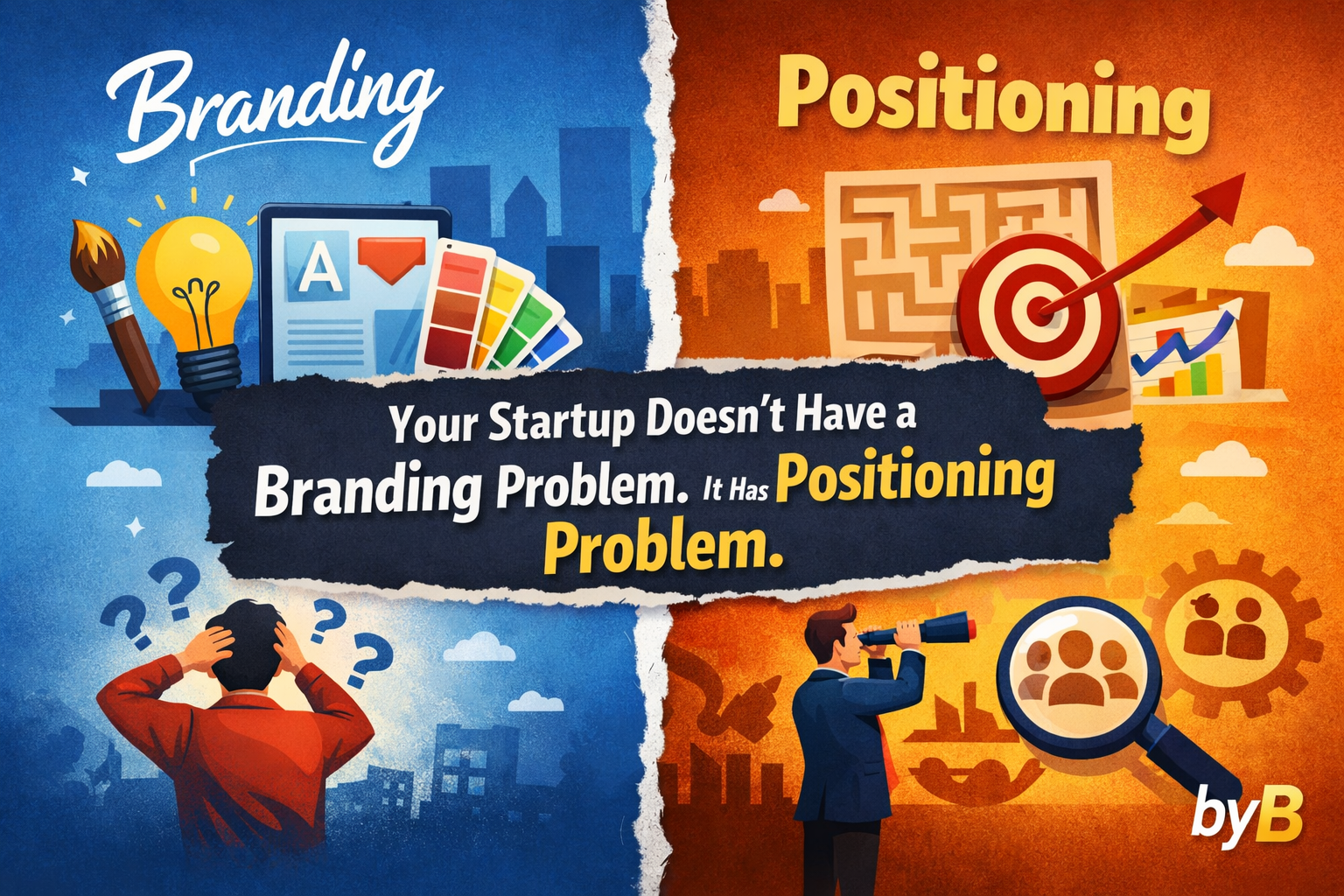
Your startup doesn’t have a branding problem. It has a positioning problem.
Six months in, your customers still can’t explain what you sell when someone asks. That’s not a logo issue. That’s not a website problem. That’s positioning failure, and it’s killing your startup in ways you haven’t connected: longer sales cycles, weak referrals, pricing pressure, and investors passing without explanation.
Most founders confuse branding with positioning. They think a visual refresh will fix the confusion. It won’t. Because the problem isn’t aesthetic. It’s structural. You haven’t defined your market position in a way that sticks, and every day that positioning stays unclear costs you revenue, momentum, and competitive ground.
Startup positioning strategy isn’t a creative exercise. It’s operational infrastructure. Without it, every other growth effort breaks. Your marketing can’t convert if prospects don’t understand what they’re buying. Your sales team can’t close if they’re explaining a different product every quarter. Your product development can’t prioritize if the target customer keeps changing.
This is the framework that separates execution from chaos.
The Startup Positioning Framework
Step 1: Define Your Position in One Operational Sentence
Not a tagline. Not a vision statement. A position that answers who you serve, what outcome you deliver, and how you’re structurally different.
Formula: “We help [specific customer type] achieve [specific measurable outcome] by [unique mechanism].”
Working example: “We help Shopify stores with 50+ SKUs reduce stockouts by 30% using predictive reorder alerts.”
Broken example: “We empower e-commerce businesses with innovative solutions.”
The difference matters. The first example tells you exactly who uses the product, what problem it solves, and how it works differently. The second example could describe 10,000 different companies. It says nothing. It positions nothing.
Your positioning sentence needs to pass three tests. First, specificity. If your positioning could apply to competitors with minor word changes, it’s not positioning. Second, outcome clarity. The customer needs to know exactly what they get. Third, mechanism differentiation. Why would they choose you over alternatives?
The test: Can your first three customers explain what you do without opening your website? If not, your positioning doesn’t exist yet.
Step 2: Lock It for Six Months Minimum
No pivots. No “testing different angles.” No changes when growth slows in Month 2.
Positioning needs repetition cycles before the market registers it. In early-stage with low traffic volume, that means six months minimum of identical messaging across every surface: homepage, email signature, pitch deck, LinkedIn bio, sales calls.
This is where most founders break. They define positioning, then panic at Month 3 when traction stays flat. They change the message. That resets the recognition clock to zero.
Here’s what actually happens in the first six months of consistent positioning. Month 1: You launch the new positioning. Nothing changes immediately. Month 2: Still quiet. Maybe one prospect mentions they “finally get it.” Month 3: Founder panic sets in. Month 4: If you hold, you start seeing repeat visitors who remember the message. Month 5: Referrals start using your exact language. Month 6: Sales cycles shorten because prospects arrive pre-qualified.
Your positioning isn’t failing at Month 3. It hasn’t had time to work yet.
Step 3: Audit and Kill Everything That Contradicts It
Website copy. Social posts. Sales decks. Support emails. Founder bios. Onboarding flows.
If it doesn’t reinforce your singular position, delete it or rewrite it.
The failure pattern: Founders define positioning, then immediately hedge. “We do X, but we also help with Y, and if you need Z we can build that too.” Every addition dilutes the core message. Every hedge weakens the position.
Your brand is not what you say once. It’s what you repeat consistently across 100 touchpoints for months.
Run this audit right now. Open your website. Read every page. Does every page reinforce the same positioning? Check your founder LinkedIn profiles. Do they match your company positioning? Look at your last 20 customer emails. Are you explaining the same thing consistently?
This inconsistency kills positioning faster than anything else.
Step 4: Founder Owns Enforcement (Not the Team)
Positioning cannot be delegated at early stage.
The founder writes it. The founder approves every message. The founder enforces consistency across the team. This is not a task for a junior marketer or a fractional CMO. This is strategic ownership.
Why? Because positioning is a decision about what you’re not. And only the founder has the authority to kill opportunities that don’t fit. A marketer can’t tell the sales team to stop pursuing a lead category. But the founder can enforce the discipline required to make positioning stick.
Once you hit traction and hire a brand lead, execution can be delegated. Not before.
The Three Positioning Failures That Kill Startups
Failure #1: Positioning Amnesia Every 90 Days
You change your core message every quarter because you’re panicking about traction.
Month 1: “We’re AI-powered analytics for e-commerce.” Month 3: “We’re the Shopify alternative.” Month 6: “We’re a data insights platform.” Month 9: Nobody can explain what you actually do.
This isn’t iteration. This is chaos. Each change resets market recognition to zero. You’re not building momentum. You’re training your audience to ignore you because they know the message will change before they understand it.
The fix isn’t better positioning. It’s commitment discipline. Pick one angle. Execute for six months. Measure at Month 6, not Month 2.
Related: If you’re stuck in this pattern, read Why Small Business Ideas Fail to understand the structural pattern behind constant pivoting.
Failure #2: Founder Visibility Without Narrative Consistency
You post on LinkedIn three times per week. You’re visible. But your messaging contradicts itself across posts.
Week 1: Innovation focus. Week 2: Community narrative. Week 3: Efficiency angle. Week 4: Scale story.
There’s no thread. No cumulative effect. You’re creating founder-led noise, not founder-led positioning.
Compare this to companies that locked positioning and never moved. Stripe executed one message for years: “Payments infrastructure for the internet.” Gumroad stayed locked on “The easiest way to sell what you make.” No pivots. No testing. Just disciplined repetition.
Your startup repositions every month. That’s why nobody remembers you.
The fix: Pick one narrative angle that supports your positioning. Every post should reinforce that angle from a different perspective.
Failure #3: Positioning by Committee
You crowdsource positioning from your co-founder, designer, advisor, and first customer. Then you wonder why the result feels incoherent.
Positioning is not a democracy. It’s a dictatorship of clarity.
Your designer wants minimalist. Your co-founder wants bold. Your advisor says “make it more enterprise” to attract investors. Your customer suggests “warmer language.” You try to integrate all feedback, and the result is generic nothing.
Here’s what committee-driven positioning produces: “We’re a next-generation platform that empowers teams to collaborate more effectively using AI-driven insights to unlock productivity and drive results.”
That sentence was built by committee. It positions nobody.
Kill the committee. One person decides. Feedback is input, not a vote.
Most leadership advice will tell you to build consensus. That’s exactly what kills positioning clarity.
The Economic Cost of Positioning Failure
When positioning is unclear, the financial mechanics of your business break at a structural level.
Customer acquisition cost climbs because prospects need multiple touchpoints to understand what you’re selling. What should be a two-call close becomes a five-call education process. Sales cycles extend from 30 days to 60 days because half the cycle is spent explaining what you actually do.
Referrals stay weak because happy customers can’t explain you clearly to others. That kills your lowest-cost acquisition channel.
Lifetime value collapses because without clear differentiation, you compete on features and price. Customers churn faster when they don’t understand the core value they signed up for. Pricing power disappears entirely.
Pipeline qualification becomes impossible. Your sales team wastes cycles on leads who don’t match your actual positioning because your positioning doesn’t exist in executable form. Revenue per lead drops. Conversion rates stay flat or decline.
This isn’t brand theory. This is unit economics destruction caused by positioning chaos.
If your cash flow management is breaking, unclear positioning is probably making it worse. Understanding what predictable revenue actually means becomes impossible when your positioning shifts every quarter.
When Positioning Locks, Mechanics Shift
A B2B SaaS repositioned from “project management platform” to “async standup tool for distributed engineering teams.”
The product stayed identical. Feature set unchanged. No new development. No product pivots. What shifted: positioning clarity.
They stopped trying to be a horizontal project management tool competing with Monday, Asana, and ClickUp. They became the vertical solution for one specific workflow in one specific team type.
90 days post-repositioning, measured against prior 90-day baseline:
- Inbound demo volume up 220% (12 demos/week to 38 demos/week)
- Contract value up 40% ($4.2K to $5.9K average)
- 90-day churn down from 18% to 3%
- Sales cycle compressed from 45 days to 28 days
Market segment: 50 to 200 person engineering teams, distributed across 3+ time zones. Traffic source breakdown: 60% organic search, 30% referral, 10% paid.
What changed operationally? SEO started working because they owned one specific search category. Referrals increased because engineering managers could explain the tool in one sentence. Sales cycles shortened because prospects arrived understanding exactly what they were buying.
The product didn’t improve. The positioning became executable.
If you’re building a business in 2026, understanding basic digital marketing for small business starts with getting your positioning right first.
The Positioning Discipline Test
Can your first five customers explain what you do in one sentence without opening your website?
If yes: Your positioning works. Execute for six more months, then measure growth impact.
If no: Your positioning failed. Rewrite it once. Lock it for six months. Enforce it ruthlessly across every touchpoint.
Run this test tomorrow. Email five customers. Ask them: “If someone asked you what [company name] does, what would you say?”
Record their answers. If all five give roughly the same answer, and that answer matches your intended positioning, you’ve succeeded. If you get five different answers, your positioning hasn’t landed.
Most founders avoid this test because they know they’ll fail it. That assumption costs them months of wasted execution.
The discipline required isn’t complicated. It’s just hard. Write your positioning. Lock it. Enforce it everywhere. Resist the urge to change it when Month 3 feels slow. Measure at Month 6, not Month 2.
Most founders will keep changing positioning every 90 days. They’ll keep blaming the market, the product, the timing. They’ll burn through runway wondering why traction stays flat.
The ones who survive are the ones who realize positioning isn’t creative experimentation. It’s operational discipline under pressure.
If the market can’t explain what you do, it doesn’t matter how good the product is. You’re invisible. And invisible companies don’t get funded, don’t get customers, and don’t survive long enough to figure it out later.
This connects directly to why startups fail. Positioning confusion is the structural reason behind most early-stage deaths.
For founders experiencing positioning chaos alongside operational stress, understanding what founder burnout actually is can help separate the symptom from the cause.
Fix your positioning. Lock it. Commit for six months minimum. Or accept that confusion is your competitive disadvantage.
Leave a Reply