

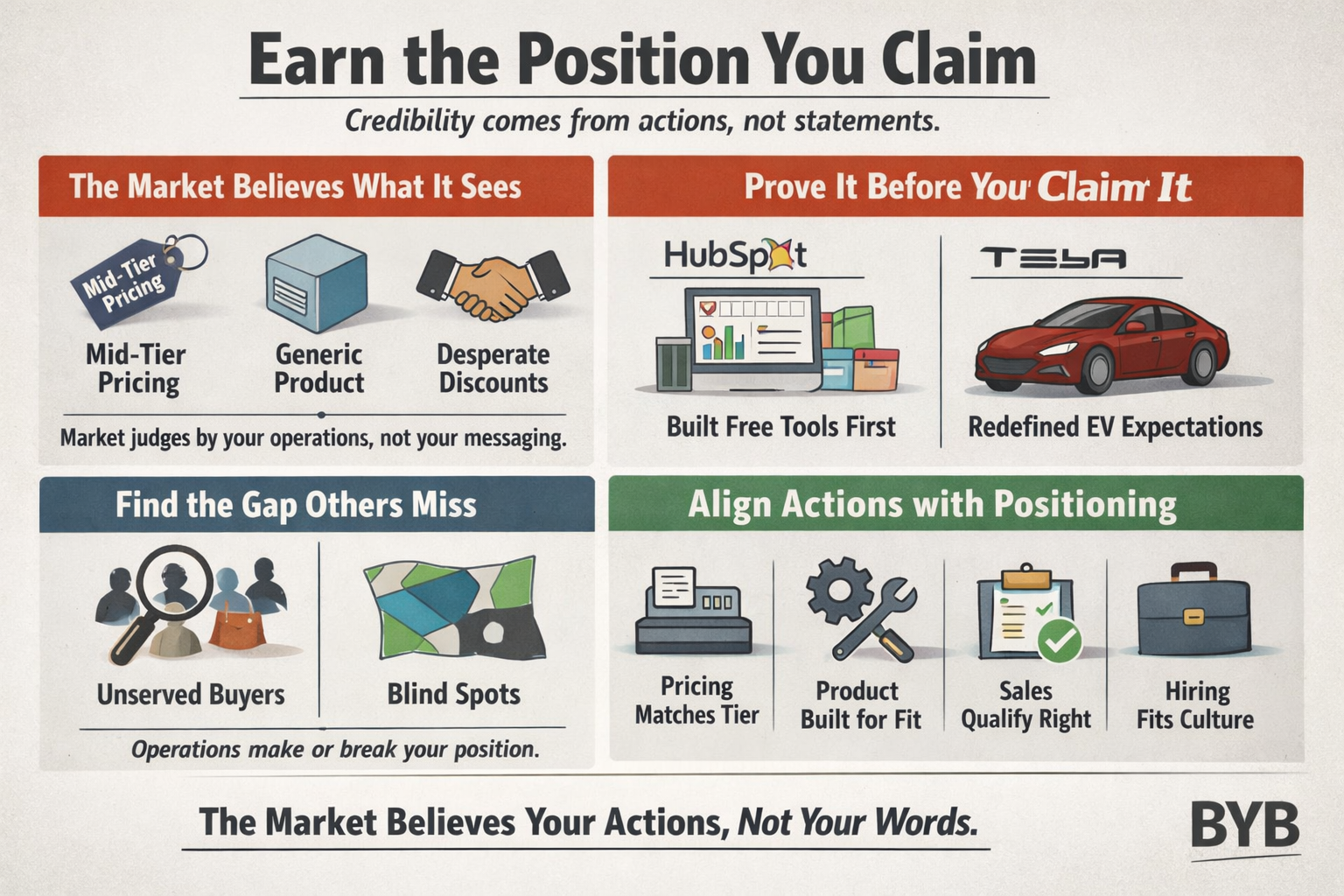
Your positioning isn’t failing because of bad messaging. It’s failing because your business hasn’t earned the position you’re claiming.
Most businesses treat positioning as a communication challenge. Write the statement, align the messaging, distribute it across channels, then act confused when the market still can’t distinguish them from competitors making functionally identical promises. This approach misunderstands what positioning actually is. Positioning isn’t what you say about yourself. It’s the credibility test the market runs on your business every single day through observable operational behaviour.
The market judges you by what your business does, not what your deck claims. When your pricing signals mid-market while your positioning claims premium, buyers believe the pricing. When your product roadmap chases features for every segment while your positioning claims focus, buyers conclude you have no focus. When your sales team offers aggressive discounts to close deals while your positioning claims value leadership, buyers assume you’re desperate for revenue. That gap between claimed position and demonstrated behaviour is where positioning collapses before the market even has the opportunity to reject it.
Positioning is the mental shortcut buyers form to decide if you’re worth their money. Not your tagline. Not your carefully crafted value proposition. The shortcut that develops in their minds based on every operational signal your business sends through pricing structures, product decisions, sales practices, hiring standards, and distribution strategies. If you cannot articulate your positioning as what cold buyers actually think when they first encounter your brand based purely on observable business behaviour, you don’t have positioning. You have corporate fiction the market systematically ignores.
The Market Only Believes Positions You’ve Already Proven
Before HubSpot ever claimed to own “inbound marketing” as a category position, they spent years building the operational foundation that would make that claim credible. They diagnosed what small and mid-sized businesses thought about marketing automation in 2006: too expensive, too complex, built exclusively for enterprises with dedicated marketing teams and six-figure budgets. The gap was obvious. An entire market segment was systematically locked out of marketing technology because the dominant players had built their business models around serving enterprise customers.
HubSpot didn’t respond by claiming to serve small businesses better. They responded by building free marketing tools, creating extensive educational content, and developing certification programs that small teams could actually use to improve their marketing without enterprise budgets. They built an entire ecosystem that proved accessible marketing automation existed before they ever claimed to define what that category meant. When they finally positioned themselves as the leader in “inbound marketing,” the market already associated HubSpot with accessible, education-focused marketing technology. The business had proved the positioning through years of operational decisions before the positioning statement existed.
Tesla followed the same pattern in a different category. In 2008, “electric vehicle” meant slow, aesthetically unappealing, full of compromises nobody actually wanted to make. Tesla didn’t claim to build better electric vehicles. They built a car that looked nothing like what the category represented. The product itself was undeniable proof that electric vehicles could be desirable, high-performance, premium products. The market believed Tesla’s positioning because the evidence was impossible to ignore. The positioning wasn’t created through messaging. It was created through product decisions that fundamentally contradicted what the category represented.
This is the pattern that separates positioning that compounds market value from positioning that gets systematically ignored. The proof comes first through operational decisions and tangible outputs. The claim follows only after the market can independently verify that claim through observed reality. Not the other way around.
What tier do first-time buyers assume you occupy when they encounter only your pricing structure positioned next to competitors, your website design and messaging, and the customer logos you prominently display? That assumption, formed in seconds based purely on observable signals, is your actual positioning in the market’s perception. It doesn’t matter what your internal positioning documents claim. If those two realities contradict each other, you have a credibility gap that no amount of messaging refinement or brand campaign investment can close. Only operational changes that transform the signals your business sends can close credibility gaps.
Most Brands Are Fighting for Positions the Market Won’t Grant Them
The category you’re attempting to enter is already saturated with brands making functionally identical positioning claims. “Faster execution, better outcomes, customer-focused approach, innovative solutions, trusted partner.” Every competitor in your space just articulated some variation of those promises using slightly different word choices and creative executions. The market stopped paying attention to these claims years ago because they create no meaningful constraint, offer no independently verifiable proof, and give buyers no rational basis to believe one brand’s claim over another’s functionally identical promise.
What actually works is identifying the specific problem or opportunity the entire category is systematically blind to because every player is copying the same competitive playbook they inherited from whoever established category norms. Or identifying the buyer segment the category consistently underserves not because they lack value but because serving them would require breaking the dominant business model everyone else has adopted without questioning whether that model actually serves the full market opportunity.
Then rigorously testing whether your business possesses the operational capability, market credibility, and resource commitment required to fill that gap in ways competitors cannot easily replicate once you prove the positioning is valuable. If the gap legitimately exists in the market but your business lacks the credibility to claim it convincingly, you must build that credibility through tangible proof points before making any positioning claims the market can reject. If your business possesses genuine credibility but the gap doesn’t actually exist because the category already serves that need adequately, you’re attempting to fight for occupied territory against entrenched competitors with superior resources, established market perception, and structural advantages you cannot overcome through better messaging.
Both paths fail when executed in the wrong sequence. Credibility must precede claims, always.
The Positioning Statement Is Your Internal Decision Filter
The positioning statement isn’t marketing copy you put in front of customers. It’s an internal strategic tool that makes every product decision, pricing decision, hiring decision, partnership decision, and market expansion decision faster and more consistent because everyone throughout the organization genuinely understands what you are, who you serve, what problems you solve, and what you categorically refuse to become regardless of short-term revenue impact or competitive pressure.
The structure that creates this operational clarity: For [specific buyer in specific situation], [brand] is the [category frame] that [single most important benefit], because [the one credible reason the market should believe you over alternatives].
If you can swap your brand name for any competitor’s name and the statement still makes complete logical sense, you haven’t written a positioning statement. You’ve written a generic category description that applies equally to everyone competing in your space. That’s not positioning. That’s the absence of it.
Real positioning creates explicit, defendable constraint. It defines with precision who you’re deliberately not building for. What product capabilities you refuse to develop even when customers request them. What customer segments you will categorically turn away even when they arrive with approved budget and purchase urgency. That constraint is what transforms a universal promise into a defendable market position.
Generic positioning sounds like this: “For businesses seeking better team collaboration, Slack is the messaging platform that improves communication efficiency and reduces email overload.” This description could apply to dozens of collaboration tools. It creates no constraint. It signals nothing about who your ideal customer is versus who should choose a competitor instead.
Specific positioning sounds like this: “For teams drowning in email overload, Slack is the real-time messaging platform that kills internal email by making conversation immediate and searchable rather than threaded and buried.” This version explicitly defines who doesn’t fit your solution. Teams that prefer asynchronous communication patterns won’t adopt it. Organizations requiring formal documentation trails and approval workflows won’t use it. Companies comfortable with email-based collaboration won’t switch. That constraint is what makes it a position instead of a universal promise anyone can claim.
Operations Destroy Positioning Faster Than Marketing Can Build It
The positioning statement gets written with careful attention to strategic differentiation. The brand guidelines get developed and approved by executive leadership. The marketing team aligns all messaging across every customer touchpoint. Then absolutely nothing changes in how the business actually operates on a daily basis.
Product management still builds features for customer segments that don’t fit the positioning because product managers have been trained to never say no when saying no feels like deliberately abandoning potential revenue opportunities. Sales still offers aggressive discounts to close marginal deals because quarterly quota achievement and commission structures override positioning discipline. Marketing runs campaigns that quietly contradict the claimed position because performance metrics reward reach, engagement, and conversion volume over message integrity and strategic customer fit. Hiring brings in talented operators who don’t embody the brand’s stated values because talent scarcity and aggressive growth targets make cultural alignment feel like a luxury the business cannot afford during scaling phases.
This operational contradiction is what kills positioning before customers ever have the opportunity to evaluate and reject it. These are daily decisions made by intelligent, well-intentioned people who nodded enthusiastically when the positioning was presented in all-hands meetings but never genuinely internalized the structural constraints that positioning requires to remain credible in the market’s constant evaluation.
Every operational decision your business makes sends a positioning signal the market reads, interprets, and uses to form conclusions about who you actually are. Pricing decisions either systematically reinforce your claimed tier or they progressively destroy it over time. Premium positioning dies the first time you discount to close a deal because that single behaviour signals to the market that you’re not actually premium regardless of what every piece of marketing collateral claims. Your pricing structure tells the market what you are more honestly than any brand deck ever will.
Product roadmap decisions reveal who you’re genuinely building for regardless of who you claim to serve in positioning documents. Every feature you approve signals your real priorities. Every customer segment you build for signals your actual focus. When you claim narrow focus but systematically build features for every buyer segment that requests them, the market watches that behaviour and concludes you’re trying to serve everyone. That’s not a position. That’s the strategic absence of one.
Sales qualification practices determine whether your positioning represents operational reality or pure marketing fiction. Every customer you close who doesn’t fit your stated target profile becomes a reference point the market uses to understand who you actually serve. When your best-fit customers and your worst-fit customers look nothing alike in terms of company size, industry, use case, or buying behaviour, your positioning has no operational coherence. Sales teams that chase every qualified lead regardless of strategic fit destroy positioning integrity faster than bad marketing campaigns ever could.
Hiring decisions either embody the organizational culture your positioning requires or they systematically undermine it through thousands of small daily choices that accumulate over time. Premium brands cannot successfully hire discount-oriented operators who optimize every decision for lowest possible cost. Fast-execution brands cannot successfully hire perfectionist operators who slow every initiative down with excessive process and risk mitigation. Customer-obsessed brands cannot successfully hire people who view support as a cost center to minimize rather than a competitive advantage to maximize. Every hire either reinforces what the brand claims to be or quietly contradicts it.
Distribution decisions place your product in market contexts that either reinforce your claimed position or completely contradict it. When you claim premium positioning but distribute through discount-oriented channels, the market believes the channel context over your brand claims. When you claim exclusive availability but make your product accessible through every possible distribution point, exclusivity becomes an obvious lie the market sees through immediately. When you claim enterprise-grade capability but only offer low-touch self-serve purchasing without dedicated account support, enterprise buyers conclude you’re not actually built for their complexity requirements.
The market watches all these operational signals constantly and forms positioning conclusions based on observed patterns of behaviour, not stated claims. When your operations systematically contradict your positioning claims, the market picks operations as ground truth every single time. No amount of messaging consistency or creative excellence overcomes operational inconsistency.
The Questions That Expose Your Structural Gaps
When first-time buyers encounter your brand for the first time and observe your pricing structure positioned alongside competitors, what tier do they automatically assume you occupy? When they navigate your website and read your messaging without any sales guidance or context, what specific problem do they conclude you’re built to solve and for whom? When your sales team loses competitive deals to specific competitors, what objection or reason do losing buyers consistently articulate, and is that objection revealing your actual positioning gap or just the defensive explanation your team tells themselves to avoid confronting structural problems in how the market perceives you?
When you strip your brand name and logo from everything you’ve produced and published in the last twelve months and look at the work objectively, does it remain immediately identifiable as uniquely yours based on a distinct point of view, consistent decision-making principles, and recognizable strategic choices? Or could it belong to any competitor in your category because fundamentally you’re all saying and doing the same things with minor cosmetic variations?
These diagnostic questions reveal whether your positioning creates genuine market differentiation or simply echoes the category playbook everyone else follows by default. If the answers you get from running this diagnostic contradict your claimed positioning, your problem isn’t messaging strategy or creative execution. It’s structural. Your operations signal one reality to the market while your marketing claims an entirely different reality. No communication strategy or brand campaign can fix structural contradictions between claimed position and demonstrated behaviour.
Which specific competitor currently owns the market position you’re attempting to claim? What resources, time horizon, and strategic focus would genuinely displacing them from that position require, and does your business possess the patience and capital to execute that displacement strategy across multiple years? Or is there more defensible adjacent territory you’re systematically ignoring because claiming it feels smaller, less impressive, or harder to explain to investors than fighting category leaders in direct head-to-head positioning battles?
Most positioning failures stem from businesses choosing to fight entrenched competitors for established positions in saturated categories instead of identifying and claiming uncontested market territory where they can establish authoritative positioning before larger competitors notice the opportunity exists and decide to enter.
For foundational understanding of how brand positioning functions as a strategic market mechanism, RubiconPress explains the core concepts and historical context before examining strategic execution approaches in depth.
Positioning Creates Organizational Constraint Most Brands Refuse to Accept
Strong positioning doesn’t manifest as perfectly crafted sentences in brand guidelines documents that live in shared drives. It manifests as an organization where strategic decisions happen faster and with dramatically greater consistency because everyone throughout the company genuinely understands what the organization is, who it serves, what problems it solves, and what it absolutely refuses to become regardless of external market pressure or internal revenue temptation.
Sales teams in strongly positioned businesses don’t offer discounts to hit quarterly revenue targets because they clearly understand which buyer profiles genuinely fit the positioning and they’re not wasting organizational resources chasing buyer segments who should choose competitors instead. Product teams say no to feature requests far more frequently than they say yes because they know with precision what the product is designed to accomplish, which customer segments it serves, and which adjacent use cases would dilute the core positioning if pursued. Marketing teams achieve dramatically higher conversion rates while spending substantially less on acquisition because they’re communicating with specific market segments using specific conceptual frameworks instead of attempting to be simultaneously relevant to everyone who might possibly buy.
Hiring processes move faster and produce dramatically better long-term cultural fits because role requirements get explicitly defined by positioning constraints rather than generic skill checklists copied from job description templates. The organization knows exactly what type of operator will reinforce the positioning through their daily decisions and what type will undermine it despite impressive credentials and relevant experience.
Positioning creates organizational constraint at every level of the business. Constraint creates strategic clarity about what matters and what doesn’t. Clarity creates execution speed and message consistency that compounds competitive advantage over time. Most brands systematically avoid accepting these constraints because constraint means categorically refusing revenue opportunities that don’t align with positioning even when those opportunities would deliver immediate profit. The brands that genuinely accept positioning constraints build market positions competitors cannot easily displace because every signal they send points in the exact same strategic direction.
Your positioning isn’t a statement that lives in presentation decks and gets referenced during strategy reviews. It’s the strategic choice your business makes every single day about who you serve, what you charge, what you build, which distribution channels you use, who you hire into which roles, which partnership opportunities you pursue, and what market opportunities you categorically refuse to chase even when competitors are profiting from them right now.
Product decisions that systematically chase every possible market segment destroy focus positioning. Pricing decisions that discount aggressively to close deals with marginal-fit customers destroy premium positioning. Sales decisions that pursue every qualified lead regardless of strategic fit destroy category positioning. Hiring decisions that prioritize skill availability and credential match over cultural alignment destroy brand positioning. Distribution decisions that prioritize maximum market reach over appropriate context and tier signaling destroy positioning credibility.
The gap between what you claim in positioning statements and what your business demonstrates through daily operational behaviour is where positioning dies. Not in the messaging frameworks. Not in the marketing campaigns. In the operational and strategic decisions that systematically contradict what you claim to be when faced with real revenue pressure, competitive threats, and growth targets.
Close the Credibility Gap or Accept That the Market Will Ignore You
Most positioning problems trace directly back to one fundamental structural failure: attempting to claim a market position before the business has earned the operational credibility required to occupy that position convincingly in the market’s perception. The market systematically ignores positioning claims it cannot independently verify through observed business behaviour that proves the claim true. The market believes what it watches your business consistently do over time, not what it hears your marketing consistently say across channels.
When your claimed positioning and your operational reality don’t align, when your deck says one thing but your behaviour demonstrates another, the market chooses operational reality as ground truth every single time. No exceptions. No amount of creative excellence, message consistency, or marketing investment changes that fundamental dynamic.
Close that credibility gap by systematically transforming your business operations to match your claimed position. Build the operational credibility first through tangible proof points the market can observe and verify independently. Make the strategic decisions and accept the constraints that demonstrate the position you want to claim. Only then write the positioning statement that accurately describes what your business already demonstrably is rather than what you aspirationally hope it might become someday if market conditions improve.
Or accept that the market will continue systematically ignoring your positioning claims because your operations contradict them too obviously for rational buyers to believe the marketing over the observable reality.
If your positioning collapses because founder psychology overrides rational operational discipline, no positioning strategy fixes that structural problem. If the challenge starts at market entry before any credibility exists, that requires solving the founding problem first.
Your positioning either exists in your operations or it doesn’t exist at all. Fix every operational decision that contradicts your claimed position, or stop pretending the market will ever believe you.
Leave a Reply