

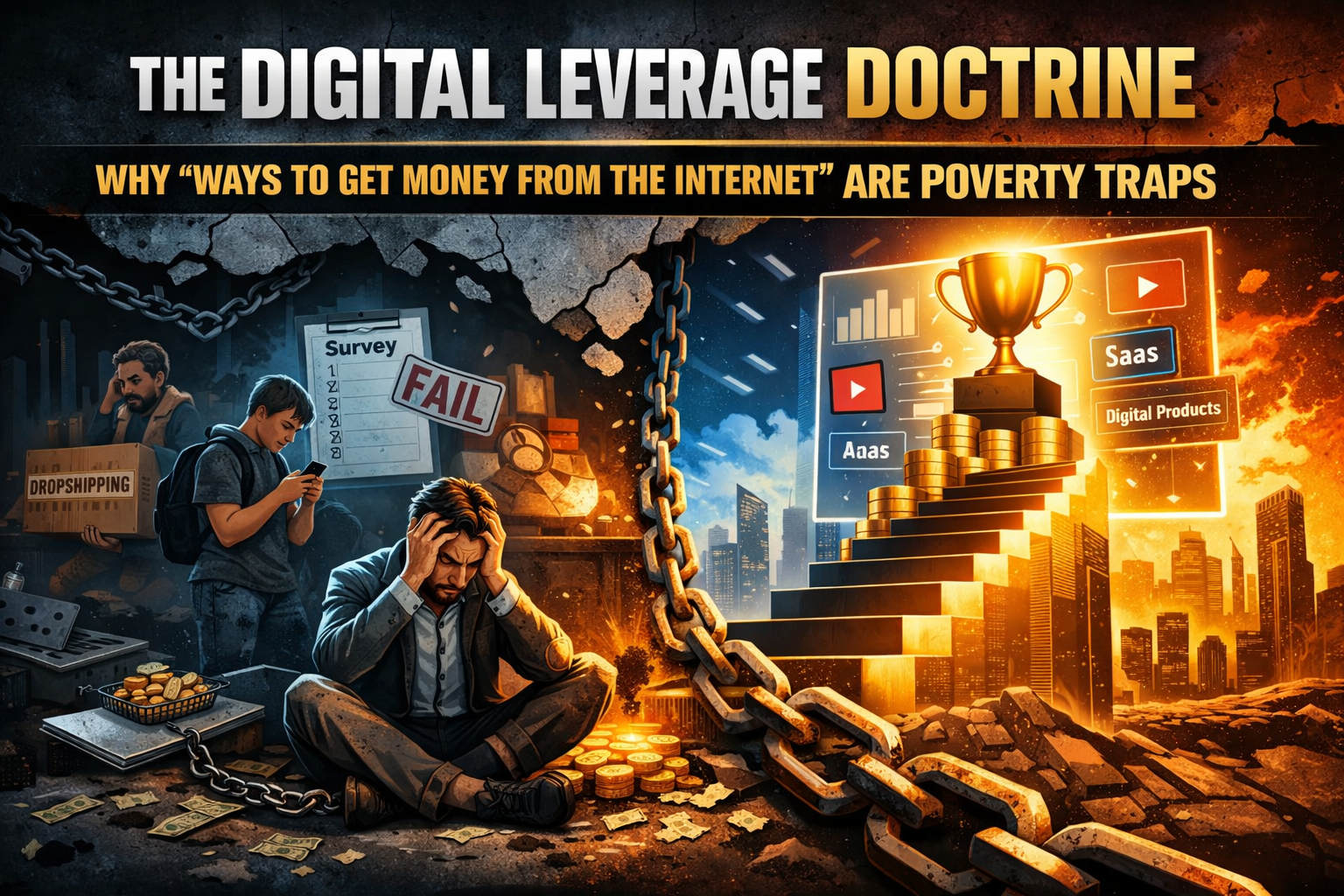
1. THE OPENING REALITY CHECK
You are here because you typed “ways to get money from the internet” into a search engine. You are looking for a list. You want “10 Easy Methods.” You want to know which app pays you to walk, or which survey site pays you to click.
If that is your mindset, you are the prey.
The internet is not a magic ATM. It is a brutal, high-velocity marketplace. The reason 99% of people fail to make money online is not a lack of effort; it is a lack of Leverage. They treat the digital world like a physical job. They look for “gigs” instead of building “assets.”
This article is not a listicle of cool apps. It is an autopsy of why the “easy ways” will keep you poor, and a strategic doctrine on how to actually capture value in the digital economy. We are going to dismantle the lies you have been sold about “passive income” and replace them with the operational reality of wealth creation.
2. THE GRAVEYARD OF “EASY MONEY” (WHY THE COMMON METHODS FAIL)
Before we discuss how to win, we must look at the bodies in the street. The “make money online” industry is built on survivorship bias. You see the one guy who made $100k dropshipping; you don’t see the 10,000 guys who lost their savings.
Here is the autopsy of the “common ways” beginners try to get money from the internet:
Case A: The Dropshipping Corpse
- The Pitch: “Set up a Shopify store, find a product on AliExpress, run Facebook ads, keep the difference.”
- The Reality: You are a middleman with no value. You do not own the product, and you do not own the customer.
- The Fail Case: You spend $3,000 on ads to sell a posture corrector. You make $4,000 in revenue. You think you made profit. Then you pay for the product ($2,000) and the transaction fees ($200). Your net profit is negative. Then, Facebook updates its algorithm, bans your ad account, and your business evaporates overnight. You built a castle on rented land.
Case B: The Freelancer Burnout
- The Pitch: “Sell your skills on Upwork or Fiverr. Be your own boss.”
- The Reality: You just traded a boss in an office for 50 bosses on the internet who pay you less and demand more.
- The Fail Case: You hit $8,000/month writing articles. You feel rich. Then you get the flu and can’t work for two weeks. Your income drops to $0. You realize you don’t have a business; you have a high-stress job with no benefits. This is Linear Income, and it is a trap.
Case C: The “Gig Economy” Peasant
- The Pitch: “Take surveys, click ads, transcribe audio.”
- The Reality: You are training Artificial Intelligence for pennies. This is Digital Peasantry.
- The Fail Case: You spend 4 hours filling out surveys. You earn $12. You have learned no skills. You have built no assets. You are literally selling your life for less than minimum wage.
This is the same logic behind: The side hustle poverty trap that keeps people permanently poor
The Lesson: If the barrier to entry is low, the competition is infinite, and the margin is zero. To make real money, you must do hard things.
3. THE DOCTRINE: UNDERSTANDING DIGITAL LEVERAGE
To escape the graveyard, you must stop trying to “make money” and start trying to build leverage.
In the physical world, leverage is hard. You need factories, employees, and capital. In the digital world, leverage is permissionless. You can access the same tools as a billion-dollar corporation.
The Golden Rule of Internet Wealth:
- Wealth = (Value × Leverage) – Ego
You need to detach your Time from your Income.
- Level 1 (No Leverage): You work 1 hour, you get paid for 1 hour. (Freelancing, Uber).
- Level 2 (Labor Leverage): You hire people to work for you. (Agency). High headache, low margin.
- Level 3 (Code & Media Leverage): You write code or create content once, and it works for you forever while you sleep. (SaaS, Digital Products, YouTube).
This is the only way to get “rich” online. You must transition from a “Service Provider” (Level 1) to a “Platform Owner” (Level 3).
4. THE HIERARCHY OF DIGITAL VALUE (KNOW YOUR PLACE)
Not all online income is created equal. $1,000 earned from a digital asset is fundamentally worth more than $1,000 earned from a client service. Why? Because the asset will pay you again next month without your effort.
Where do you stand on this ladder?
Tier 4: The Digital Peasant (Input = Output)
- Activity: Surveys, clicking ads, mechanical turk.
- Status: You are the product.
- Command: STOP IMMEDIATELY. You are wasting your most valuable asset (time) for the market’s lowest currency.
Tier 3: The Mercenary (Input = Output + Skill)
- Activity: Freelancing, Virtual Assistant, High-Ticket Closing.
- Status: You are a highly paid laborer.
- Risk: Income stops when you stop.
- Command: USE AS A BRIDGE. Do this only to fund your transition to Tier 2. Do not stay here for more than 2 years.
Tier 2: The Arbitrageur (Input < Output)
- Activity: Affiliate Marketing, Amazon FBA, Influencing.
- Status: You are a sophisticated middleman. You get paid for distribution.
- Risk: Platform risk. If Amazon changes the commission rate, you take a pay cut.
- Command: CAPTURE THE DATA. Use the traffic to build an email list (an asset you own).
Tier 1: The Architect (Input <<<<< Output)
- Activity: Selling Digital Products, SaaS (Software), Paid Communities.
- Status: You own the code, the content, and the customer.
- Leverage: Zero Marginal Cost of Replication. Selling the 10,000th copy of your PDF or software subscription costs you $0.
- Command: THE GOAL. This is where generational wealth is forged.
5. STRATEGY A: PRODUCTIZED KNOWLEDGE (THE ENTRY POINT)
If you cannot code, you must productize your brain. This is the fastest legitimate way to get money from the internet for a beginner who has a skill.
The Concept: Take a skill you use as a freelancer (Level 3) and package it into a product (Level 1).
The Pivot:
- Freelancer Mindset: “I will charge $50/hour to design Instagram templates for clients.” (Capped).
- Architect Mindset: “I will design a ‘Ultimate Instagram Template Pack’ once and sell it for $27 to 10,000 people.” (Uncapped).
The Execution Protocol:
- Identify the Pain: Do not follow your passion. Follow the pain. What is a specific problem people are paying to solve? (e.g., “Real Estate Agents don’t know how to use Canva”).
- Solve it Manually: Consult for 5 agents. Learn exactly where they get stuck.
- Document the Solution: Create a video course or a template pack.
- Sell the Asset: Set up a simple landing page. Drive traffic.
Why this wins: You move from “doing the work” to “selling the recipe.” The recipe has infinite inventory.
6. STRATEGY B: THE AUDIENCE-FIRST MEDIA MACHINE
“Traffic” is vanity. “Trust” is equity. Most beginners fail because they try to sell a product to strangers. This is playing on “Hard Mode.” The modern way to extract value from the internet is to build the audience before you build the product.
The Media Flywheel:
- Pick a Niche: Not “Fitness.” That is too broad. “Mobility training for dads over 40 with back pain.” That is a niche.
- Publish Utility: Don’t post “lifestyle” photos. Post answers. Answer every question that specific person has.
- Capture the Data: Do not build your house on Instagram. Move them to an Email List. An email subscriber is worth 100x an Instagram follower.
- Monetize the Trust: Once you have 1,000 people who trust you, ask them what they want to buy. Then build it.
The Trap of “Influencing”: Do not become an “Influencer” who sells other people’s tea. Become a “Creator” who sells your own intellectual property. The former is a billboard; the latter is a business owner.
7. STRATEGY C: THE “BORING” MICRO-SAAS
You used to need a degree in Computer Science and $1M in funding to build software. Today, you need logic and a No-Code tool (like Bubble or Make).
The Micro-SaaS Model: Big tech companies solve big problems. They ignore the tiny, annoying problems.
- Opportunity: A plugin that connects Notion to Google Calendar specifically for hair salons.
- Opportunity: An app that helps tattoo artists manage deposits and waivers.
These are “boring” niches. They are gold mines. You can build a tool using No-Code platforms that charges users $29/month. If you get 100 users, that’s $2,900/month in Recurring Revenue.
Why SaaS is King:
- Valuation: An e-commerce store sells for 2x profit. A SaaS company sells for 5x–10x revenue.
- Stability: Recurring revenue allows you to sleep. You don’t start every month at zero.
8. PSYCHOLOGICAL WARFARE: THE “IMPOSTER” BARRIER
The biggest barrier to getting money from the internet is not technical; it is psychological. We are conditioned to believe that money comes from suffering. “If I didn’t sweat for 8 hours, I don’t deserve this paycheck.”
When you sell a digital product for $100 while you are sleeping, your brain will trigger an “Imposter Syndrome” alarm. You will feel like you are cheating. You must kill this feeling.
The Value Equation: You are not paid for your effort; you are paid for the value you provide. If your $29 ebook saves a business owner $5,000 in taxes, you are not a scammer. You are a savior who is undercharging. This mindset shift is critical. As detailed in [CEO Psychology Trap], your internal limiting beliefs are the bottleneck of your bank account.
9. THE EXECUTION AUDIT: ARE YOU BUILDING A TRAP?
Before you launch your next “online venture,” run it through the BYB Scalability Filter. If it fails these questions, it is a job, not a business.
- The Replication Test: Does it cost me money or time to sell unit #1,001?
- Yes: It’s a service/physical goods business. (Lower leverage).
- No: It’s a digital asset. (High leverage).
- The Permission Test: Can a platform (YouTube, Upwork, Amazon) ban me and destroy my revenue tomorrow?
- Yes: You are a sharecropper.
- No: You own the data (Email list/Code).
- The Sleep Test: Can people buy from me while I am unconscious?
- Yes: You have an automated funnel.
- No: You are the bottleneck.
10. FINAL COMMAND: THE 52-WEEK CONTRACT
The internet is a vast ocean. If you try to swim everywhere, you will drown. Most people try dropshipping for 2 weeks, then crypto for 2 weeks, then affiliate marketing for 2 weeks. They end up with 6 weeks of failure and $0.
The Mandatory Constraint: You must sign a contract with yourself. Pick ONE vehicle (SaaS, Newsletter, or Digital Product). Commit to it for 52 weeks.
If you quit after 3 months because “nobody is buying,” you are the digital peasant. You want the harvest without the planting. The algorithm rewards consistency. The market rewards volume.
Fix this now. Stop looking for “ways to get money.” Start building assets that demand money. Execute or remain a peasant.
This is the same logic behind doing the unscalable work required to escape linear income
MARKET REALITY & EVIDENCE
- The Zero Marginal Cost Society: Jeremy Rifkin (Economist) argues that the digital revolution drives the marginal cost of producing goods and services to near zero. This economic principle is why digital products (software, media) create exponential wealth compared to physical goods.
- The Long Tail Theory: Chris Anderson (Wired Magazine) demonstrated that the internet allows for unlimited shelf space, meaning niche products (like “Excel for Bankers”) can collectively outsell hits. This validates the “Niche Down” strategy over the “General Appeal” strategy.
- SaaS Valuation Multiples: Industry data from SaaS Capital consistently shows that recurring revenue businesses trade at 5x–10x revenue multiples, compared to 1x–2x for professional services firms. This proves the “Level 1” hierarchy is mathematically superior for wealth creation.
Leave a Reply