

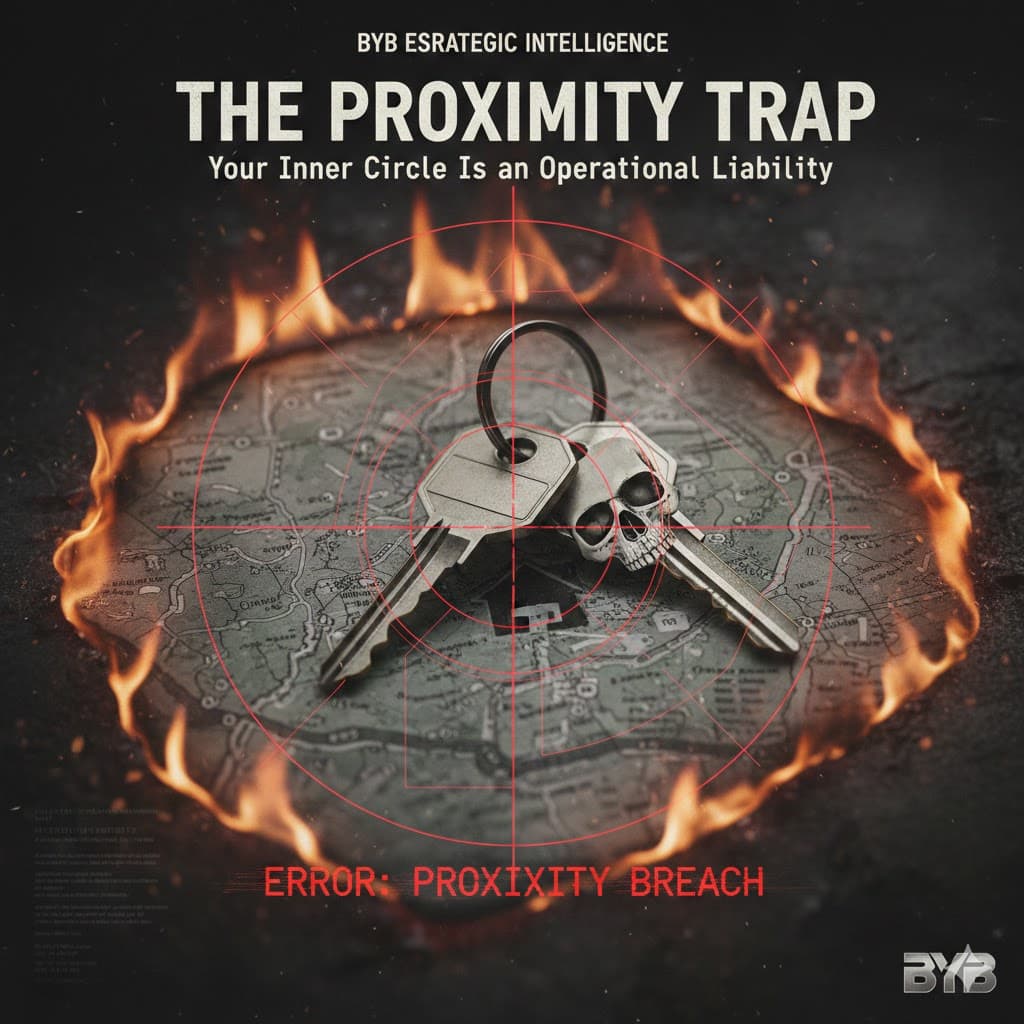
Your home is not a sanctuary. It is a high-risk operational environment where you have traded tactical sovereignty for the comfort of a “safe” social narrative. If you believe that a gated community, a professional reputation, or a “trusted” inner circle constitutes a legitimate security perimeter, you are operating under a cognitive rot. You are treating domestic familiarity as a biological shield. It is not. In the world of strategic risk management, familiarity is not safety; it is the ultimate weapon of the insider threat.
The Delusion of the Middle-Class Mirage
The most dangerous assumption a founder or executive can make is the “Middle-Class Mirage”—the belief that safety is a natural byproduct of social status and domestic routine. You assume that because you have reached a certain tax bracket, the people you allow into your private life are automatically filtered by that same success. This is a baseline failure in structural logic. You have built a multi-million dollar brand by interrogating data and auditing every line item, yet you return to a residence where the only defense is a consumer-grade doorbell camera and a “hope” that your associates are who they claim to be.
By prioritizing social comfort over operational security, you have effectively left your vault open because the person standing in front of it possesses a clean digital profile. Reputation is a social construct; access is a physical reality. When you allow “good character” to bypass your internal screening, you are engaging in a high-stakes gamble with zero upside. Global intelligence proves a brutal reality: the primary threat to your sovereignty is rarely a masked external actor; it is the individual with authorized, unvetted access to your primary residence.
Proximity Trap Security: The New Standard for Executive Survival
To maintain authority in a high-stakes environment, you must implement Proximity Trap Security. This framework rejects the binary of “friend or foe” and replaces it with a spectrum of “verified access.” In strategic operations, “trust” is a functional vulnerability. Recent domestic disappearance cases serve as mechanical blueprints for this structural failure. When a subject vanishes within hours of an unverified “late evening” drop-off by a close family associate, it highlights a fatal reliance on emotional history over tactical protocol. You treat the “hand-off” as a completion of safety rather than a continuation of risk.
The home is where the threat profile actually accelerates. Because you are at your most vulnerable—psychologically relaxed and physically isolated—the proximity trap closes. According to the Bureau of Justice Statistics (BJS) report on victim-offender relationships, the “stranger in the bushes” is a statistical myth compared to the prevalence of crimes committed by known associates. A strategic security protocol does not terminate when the vehicle stops; it terminates only when the internal perimeter is verified and sealed from the inside. When you rely on a trusted associate to provide a “safe visual” without a redundant, automated verification system, you are handing over the keys to your survival to someone whose incentives you have not audited.
The Mechanics of Camouflage: Proximity as a Weapon
The domestic insider threat is an individual who leverages legitimate access to a secure environment to facilitate a breach. Unlike a corporate espionage agent, this threat operates behind the camouflage of shared rituals, family photos, and holiday gatherings. They use your psychological triggers and your routines against you. They know your camera blind spots, your alarm codes, and your periods of isolation.
If your defense strategy depends on your inner circle being “nice,” you are exposed. You are treating your life like a social club rather than a high-value asset. Data from security governance bodies like ASIS International confirms that the most damaging breaches involve individuals who held high community standing—as educators, mentors, or long-term associates. To the public, these markers suggest safety; to a security analyst, they are irrelevant data points that obscure the forensic reality of the proximity trap. You are ignoring the red flags that would be flagged immediately in a professional context simply because you have a shared history. This is not loyalty; it is tactical negligence.
Fiduciary Negligence: The Cost of Your Ego
An executive personal security failure is rarely caused by a lack of capital; it is caused by ego. You authorize massive budgets for cybersecurity and office perimeter protection, yet you return to a security vacuum. This is more than a personal risk; it is fiduciary negligence. If you are the primary driver of a multi-million dollar organization or a high-authority brand, your domestic vulnerability is a systemic liability. Your sudden absence or compromise can decapitate the company overnight.
Your investors and your team are betting on your continued existence. When you ignore domestic vulnerabilities, you are failing the most basic requirement of leadership: self-preservation. Wealth does not provide security; it provides a more expensive set of delusions. If your perimeter can be compromised by someone who was “let in” or “dropped off,” your perimeter does not exist. It is a social suggestion, not a physical barrier, and it will fail the moment it is tested by an insider who understands your lack of discipline.
Hardening the Perimeter: The Zero-Trust Mandate
To shift from vulnerability to strategic sovereignty, you must dismantle the “good guy” narrative and replace it with mechanical protocol. Biological wiring forces humans to fear the unknown, but tactical logic dictates that the known is far more dangerous. You must stop prioritizing the feelings of your associates over the integrity of your perimeter.
Hardening your domestic circle requires three non-negotiable shifts in operational logic:
- Redundant Verification: Every departure from your residence must be followed by a digital “handshake.” Confirm perimeter integrity within five minutes of any visitor leaving. Do not assume the door is locked; verify it via a system that does not rely on human memory.
- Zone-Based Access: Limit the “insider” knowledge of your total environment. Even trusted associates do not need access to every floor, every code, or every routine. Treat your home like a high-security server room.
- Transition Protocol: Eliminate the Proximity Trap during late-evening arrivals. The hand-off must be recorded, verified, and closed out by an independent third-party monitoring system. The “last contact” event is the most critical data point in your security audit; treat it with the forensic intensity it deserves.
The Tactical Choice
You are currently operating in a state of structural bankruptcy. You have built a fortress of a business on a foundation of domestic sand. By the time you realize your inner circle has been weaponized, the physical investigation protocols have already commenced at the point of your perimeter breach. You do not have the luxury of “trust.” You only have the reality of verified access and redundant monitoring.
Audit your associates’ access today. Interrogate your domestic blind spots with the same brutality you use on your balance sheet. Stop believing that your reputation is a shield and start accepting that your safety is a matter of tactical discipline.
Secure your perimeter now, or accept that your proximity to your trusted circle is the exact mechanism that will be used for your destruction. The choice is binary: protocol or failure.
Leave a Reply