
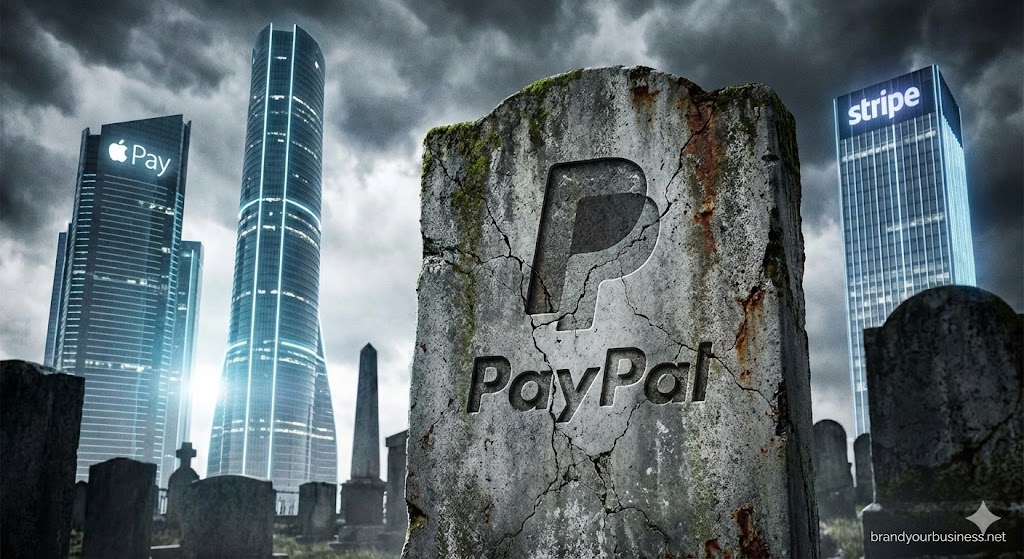
You are holding a bag of nostalgia, not a financial asset.
You look at the PayPal stock chart. You see that it is down significantly from its all-time highs in 2021. You see a low P/E ratio. You see a brand name you recognize. And your primitive, lizard brain whispers a dangerous lie to you: “It’s on sale. It has to go back up.”
This is the logic of a gambler, not an investor. This is the logic that turns portfolios into dust.
The recent viral chatter around PayPal is fueled by desperate bag holders inhaling “copium,” hoping that a new CEO or a shiny new interface will magically erase years of strategic incompetence. You are debating technical support levels while the fundamental ground beneath the company is shifting into quicksand.
You are not buying a “tech giant at a discount.” You are buying a legacy utility company that is being slowly suffocated by competitors who do not care about your profit margins. Stop looking at the price chart and start looking at the reality.
The “First Mover” Curse: Why Your “Moat” is a Puddle
You cling to the idea that PayPal is the “king of payments.” You are living in 2015. In the digital economy, being first means nothing if you stop innovating. For a decade, PayPal relied on the fact that it was slightly easier than typing in a credit card number. That was their entire moat.
The moat is dry. Apple Pay and Google Pay have nuked PayPal’s primary value proposition. When you check out on your iPhone, do you want to log in to PayPal, remember your password, and deal with redirects? No. You double-click the side button, scan your face, and the money is gone. It is frictionless. It is native. It is superior.
PayPal is no longer the “innovator.” It is the “middleman.” And in the history of capitalism, middlemen always get squeezed. While you are analyzing PayPal stock based on past glory, Apple is embedding itself into the operating system of the world. You are betting on a third-party app against the owner of the hardware. That is a losing bet.
The Margin Compression Death Spiral
“But look at the revenue growth!” you scream, pointing at the unbranded checkout volumes. Stop it. You are embarrassing yourself.
You are celebrating empty calories. Much of PayPal’s recent growth has come from Braintree (their unbranded processing). Do you know what the problem is with unbranded processing? It is a commodity war. It is a race to the bottom. Braintree competes with Stripe and Adyen. To win that business, you have to lower your fees. So, PayPal is processing more money, but they are keeping less of it. Their margins are compressing. They are working harder to make the same amount of profit.
If you are buying PayPal stock because the “Total Payment Volume” is up, you are looking at a vanity metric. Revenue is vanity; profit is sanity. And the sanity check says that PayPal is losing its pricing power. When a company loses pricing power, it is no longer a “growth stock.” It is a utility. And utilities do not trade at tech multiples.
The “Value Trap” Hallucination
This is the most dangerous trap for the amateur investor: The Low P/E Ratio. You see PayPal trading at a historically low multiple, and you think, “It’s cheap! The market is wrong!”
The market is rarely wrong about dying giants. The market has priced PayPal as a low-growth, legacy financial service because that is what it has become. A stock is not “cheap” just because it used to be expensive. It is “cheap” because the smart money expects the future earnings to be difficult.
You are falling for the Value Trap. You are buying a melting ice cube because it costs less than it did when it was frozen solid. The “Value Investors” who bought Intel because it was “cheap” got slaughtered. The ones who bought Paramount because it was “cheap” got slaughtered. Do not confuse a structural decline with a cyclical downturn. PayPal isn’t just having a bad quarter; they are having an identity crisis in a world that has moved on.
Venmo: The Monetization Mirage
“But they own Venmo!” So what? Venmo is a verb, yes. It is culturally relevant, yes. But PayPal has spent years trying to figure out how to make serious money from it, and they are still struggling to move the needle meaningfully compared to the transaction giants.
Monetizing a free peer-to-peer social app is a nightmare. Cash App (Block) did it by selling Bitcoin and banking services to the unbanked. Venmo is stuck in a weird limbo of being a “social payment” tool that people refuse to pay fees for. If your bullish thesis on PayPal stock relies on “Venmo will eventually figure it out,” you are speculating, not investing. You are hoping management discovers a magic wand. Hope is not a strategy.
The Leadership Gamble (Turnaround or Funeral?)
The new leadership talks a big game. They talk about “profitable growth” and “AI-driven checkout.” Every failing company talks about “AI-driven” everything. It is the corporate buzzword for “we are out of ideas, please buy our stock.”
Turnarounds are notoriously difficult. For every Microsoft (Satya Nadella), there are ten Yahoos. When you buy a turnaround play, you are demanding a higher risk premium. You are betting that a new CEO can undo years of cultural rot and strategic drift. Is it possible? Yes. Is it probable? The odds are against you. While PayPal is busy “fixing itself,” Stripe is shipping products. Apple is expanding its wallet. Block is integrating its ecosystem. The competition does not pause to let PayPal tie its shoelaces.
The Bag Holder Psychology
Let’s be honest about why you are really reading this. You probably own the stock at a higher price. You are underwater. You are reading articles to find confirmation bias that you didn’t make a mistake. You are suffering from Anchoring Bias. You are anchored to the price you paid, or the all-time high of $300+. You think $60 or $70 is “low” because $300 was “high.”
Price has no memory. The stock does not know you own it. The stock does not care that you are losing money. If you wouldn’t buy the stock today with fresh capital at the current price, you have no business holding it. You are holding it because admitting the loss hurts your ego. You want to get back to “break-even.” “Break-even” is a fantasy. While you wait for PayPal to recover, you are missing out on actual innovation happening elsewhere in the market. This is the opportunity cost of stubbornness.
The Kill Shot: Binary Execution
The viral debate around PayPal stock is noise. It is losers arguing with dreamers.
You have a choice to make, and it needs to be made with cold, surgical precision:
- The Bag Holder: Keep holding, keep hoping, and keep praying that 2015 comes back. Keep telling yourself it’s a “value play” while inflation eats your stagnant returns.
- The Ruthless Operator: Accept that the landscape has changed. Admit that a “cheap” stock is often cheap for a reason. Cut your emotional attachment.
If you are buying PayPal, you better have a thesis stronger than “it went down a lot.” If you are buying it because you think they can out-innovate Apple and out-execute Stripe, good luck. You will need it.
Stop buying nostalgia. Start buying moats.
Leave a Reply