

You worship at the altar of the trillion-dollar market cap. You look at Nvidia’s exponential stock chart, their gross margin reports, and the leather-jacket swagger of their keynotes, and you see an unstoppable force.
You are intoxicated by Silicon Valley Design Snobbery.
You suffer from the delusional belief that intellectual property equals power. You think the magic happens in the blueprint, and that the physical world is just a nuisance to be managed by lesser beings. This arrogance is why you are incapable of understanding the actual battlefield.
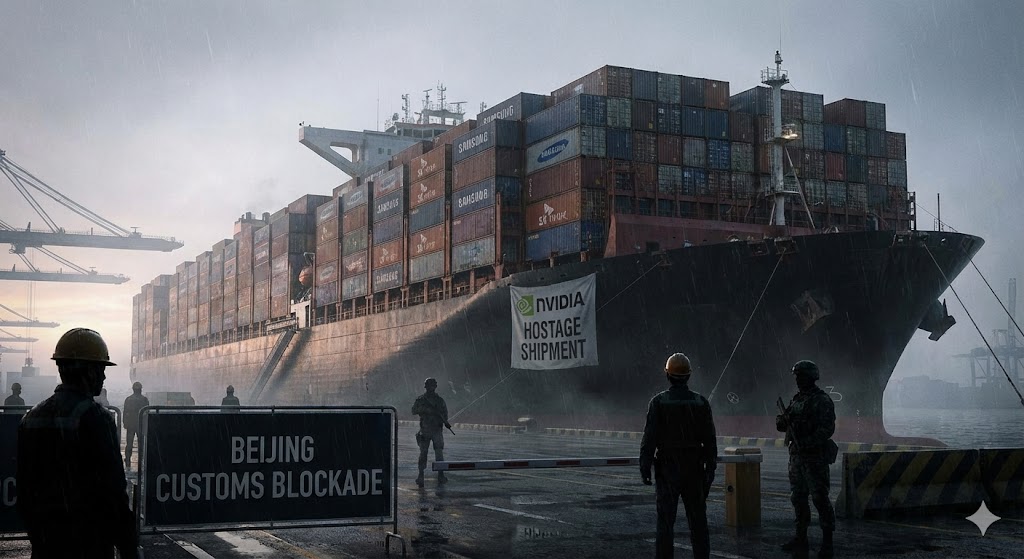
Nvidia is not the sovereign master of the AI universe. Nvidia is a desperate logistics manager with a gun to its head, held jointly by memory manufacturers in Korea and customs bureaucrats in China. The most valuable company on earth is currently paralyzed because it committed the cardinal sin of industrial warfare:
They Do Not Own The Means Of Production.
The Humiliation of Industrial Beggary
Nvidia’s dominance is currently choked by a single, pathetic reality: they cannot assemble their systems fast enough. The bottleneck isn’t demand—the world is begging for their chips. The bottleneck is High-Bandwidth Memory (HBM). Without this ultra-fast memory, an H200 GPU is merely expensive silicon landfill.
For two years, Nvidia has been begging the memory cartel for relief. Now, reports indicate Samsung is preparing to start HBM4 production in February 2026 to stanch the bleeding.
The financial press cheers this as a “strategic partnership.” You should see it for what it is: a hostage negotiation.
Samsung isn’t offering charity. HBM is the highest-margin product in the memory sector, and Samsung knows Nvidia is desperate to diversify away from its crippling reliance on SK Hynix. When you are addicted to a single external supplier for the most critical component of your flagship product, you do not have leverage. You have dependency.
Samsung isn’t just selling parts; they are buying control over Nvidia’s velocity.
The Yield Slaughterhouse: Where PowerPoint Dreams Die
The amateurs on Wall Street read headlines like “Samsung starts HBM4 production” and assume the problem is solved. They mistake “headline capacity” for industrial reality.
Silicon Dreams Die in Manufacturing Hell.
The real fight isn’t over theoretical capacity; it is a brutal war over yield. Early generations of advanced memory are notoriously difficult to manufacture at scale. If Samsung churns out millions of units, but only 40% meet the punishing performance standards required for Nvidia-grade AI, the “capacity” numbers are a lie.
Furthermore, this is a game of allocation power. When HBM is tight, the memory vendor—not Nvidia—decides which customers receive the prime cuts, in which quarters, and in what volumes.
Nvidia designs the brain, but the memory cartels decide if it gets any blood. Never forget who holds the real power in that dynamic.
Geopolitical Asphyxiation at the Border
While Seoul tightens the vise on supply, Beijing is paralyzing the demand.
Nvidia’s “China story” is currently a disaster of uncertainty. Customs-related blocks on the new H200 AI chips are clouding the entire near-term outlook. The demand signals from China are massive—customers are desperate to buy—but demand signals mean absolutely nothing if the physical crates are rotting in a Shanghai customs depot.
Silicon Dreams Die in Manufacturing Hell, and sometimes that hell is a geopolitical blockade. It does not matter how exponential your growth curves are on a slide deck if the product cannot legally cross a border.
The Final Betrayal of the Digital Zealot
It is time to abandon your Silicon Valley religion. Stop looking at benchmark charts and worshipping chip architects.
If you continue to believe that “innovation” magically overcomes physical constraints, you deserve the financial blindsiding that is coming. Nvidia is currently fighting a multi-front industrial war just to keep its promises, trying to synchronize advanced packaging in Taiwan, memory yields in Korea, and political maneuvering in China.
The market is about to punish those who confuse digital design with physical power. Nvidia is fighting for its life in the mud of industrial logistics while you cheer for its slide decks.
Chip design is vanity. Logistics is destiny. Wake up to the brutality of the physical world.
Leave a Reply