

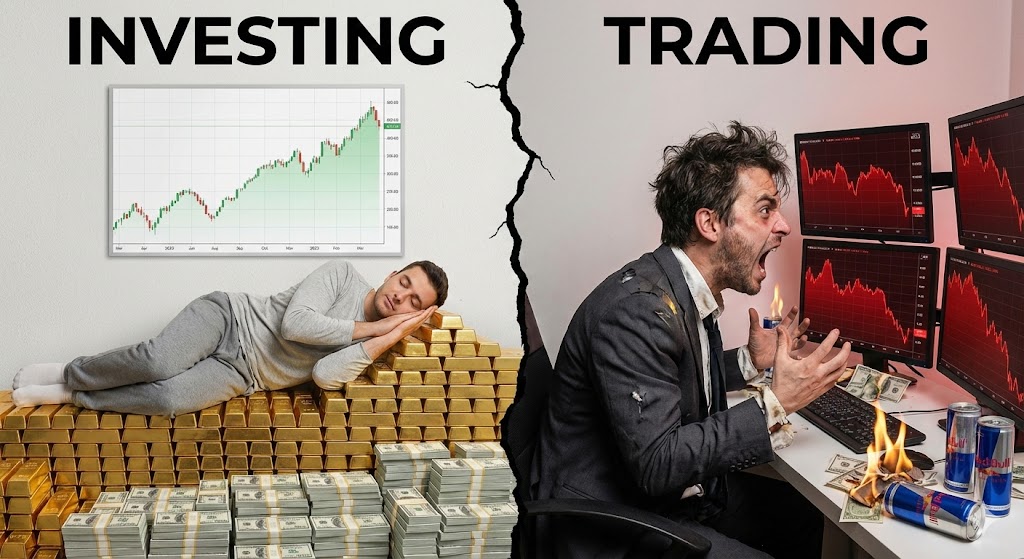
Most people searching for the difference between investing and trading already suspect they’ve been doing one while calling it the other.
Here’s the direct answer:
| Investing | Trading | |
|---|---|---|
| Time horizon | Years to decades | Minutes to weeks |
| Core mechanism | Compound growth over time | Profit from short-term price moves |
| Skill required | Discipline to hold through volatility | Technical analysis, risk systems, emotional control |
| Capital needed | Any amount, added consistently | Substantial — small accounts can’t survive normal losing streaks |
| Who it works for | Almost anyone willing to stay the course | A small minority who treat it as a full-time profession |
If that table answered your question, you’re done. If you want to understand why most people gravitate toward trading and end up worse off than if they’d held an index fund and done nothing — read on.
This article is general financial education, not personalized investment advice. Your tax situation, risk tolerance, time horizon, and country of residence all affect what makes sense for you. Consult a licensed financial professional before making investment decisions.
The Confusion That Costs Most People Money
Investing and trading both involve buying financial assets. That surface similarity is where most people’s understanding ends — and where most wealth destruction begins.
Investors buy ownership stakes in businesses and let compounding do the work. When you hold a broad index fund, you own a slice of hundreds of companies. Over long periods, those businesses generate profits, pay dividends, and grow. You don’t need to predict what the market does next week. You need patience.
Traders try to profit from short-term price inefficiencies before they close. A swing trader doesn’t care if a company thrives over a decade. They care whether sentiment, momentum, or a catalyst will move the price in their favor within days. That edge is narrow, time-limited, and contested by better-resourced participants.
Most people who think they’re “investing” are actually doing something else: buying when prices rise, selling when they fall, checking portfolios daily, reacting to headlines. That behavior isn’t investing. It’s reactive price speculation with a long-term label attached — and it tends to produce worse outcomes than either discipline executed properly.
Four Factors That Determine Which Path You Can Actually Execute
This isn’t a personality quiz. It’s a structural audit.
Factor 1: Time Horizon
Investing’s core mechanism is time. Broad equity markets in developed economies have historically shown that longer holding periods tend to reduce the likelihood of negative nominal returns — though outcomes vary by market, starting point, and time period. It’s a pattern, not a promise.
The practical implication is simple: investors don’t need to predict what happens next. They need to avoid sabotaging the process by reacting to short-term volatility.
Traders face a harder problem. They need to be right about direction and timing within a compressed window. Markets grow more efficient at pricing available information quickly — which means exploitable edges are contested and narrow.
The honest question: If your portfolio dropped 35% over six months, would you hold, add more, or sell? Your honest answer tells you more about your actual time horizon than any financial plan you’ve written.
Factor 2: Psychology
This is where theory and practice diverge most sharply.
Investing psychology is counterintuitive but learnable: buy diversified assets, add consistently, ignore market noise, hold through downturns. The obstacle isn’t complexity — it’s the emotional pull to act when everything feels wrong.
Trading psychology is a different category of difficulty. Classic behavioral finance research by Brad Barber and Terrance Odean — examining US retail investor data — found that higher trading frequency consistently correlated with worse returns. The mechanism wasn’t primarily information disadvantage. It was behavioral: overconfidence, poor loss management, and the tendency to act when holding would have been better.
Four patterns that reliably destroy trading accounts:
Revenge trading: A loss triggers an immediate larger position to recover it. The trade is now driven by emotion, not strategy. One manageable loss becomes an account-threatening one.
Confirmation bias: After entering a position, analysis shifts from evaluation to validation. Contradicting signals get filtered out. The conviction stays long after the rationale has broken down.
Complexity mistaken for rigor: Stacking indicators creates the feeling of analysis while producing conflicting signals. Most experienced traders work with fewer variables, not more.
Bull market as proof of skill: Rising markets make almost any strategy look smart. Real skill only shows up across a full cycle — including the sustained drawdowns.
The same pattern appears in high-stakes business decisions: the founders most likely to destroy value are often those who confuse confidence with competence under pressure. The parallels to founder psychology under stress are direct — action bias and loss aversion damage outcomes in both contexts.
Factor 3: Capital
Trading’s math is unforgiving for small accounts — not because strategies fail, but because small accounts can’t survive the variance required for a strategy to prove itself.
Standard risk management means risking a small percentage of capital per trade. On a limited account, even a sound strategy produces drawdowns that are psychologically hard to continue through and mechanically reduce future position sizes. Extended losing streaks are a normal feature of most profitable trading systems — the question is whether your account survives them.
Investing doesn’t have this problem. Dollar-cost averaging works at any account size because you’re not timing entries. Consistent contributions average out across price points in ways that don’t require capital buffers.
The practical test: Can you lose 20-25% of your allocated capital and continue executing your strategy without modifying it? If not, either your capital level or your actual risk tolerance doesn’t match what trading requires.
Factor 4: Skill and Time
Investing requires one skill: disciplined inaction during drawdowns. Genuinely difficult for most people — but learnable without specialized knowledge.
Active fund performance data from S&P Dow Jones Indices’ SPIVA reports shows a persistent pattern: at long time horizons, the majority of actively managed funds underperform their benchmark index. SPIVA’s own summary is precise — at 15-year horizons, there are few or no fund categories where a majority of active managers beat their benchmark. If professional managers with full-time teams and institutional resources can’t consistently beat passive indexing, the bar for individual active traders is higher than most people assume.
Trading requires a substantially harder skill set: technical analysis, position sizing, risk management systems, and the psychological discipline to execute consistently through losing streaks. This takes years of deliberate practice — documented trade journaling, systematic review, honest loss analysis. Not months.
The honest question: Have you systematically documented several dozen trades with defined entry and exit rules, and can you articulate your actual win rate and average risk/reward? If not, you don’t have a tested edge. You have a hypothesis — and you’re testing it with real money.
How Investing Works in Practice
Long-term wealth building through equities uses one mechanism: owning diversified assets and adding consistently over time.
Index funds provide exposure to hundreds or thousands of companies in a single instrument — low cost, diversified, no active decisions required. Dollar-cost averaging eliminates the timing question entirely. Investing a fixed amount regularly means you buy more shares when prices are lower and fewer when higher. The behavioral advantage matters as much as the mechanical one: it removes “should I invest now?” from the equation entirely.
Systems that remove decision points tend to outperform approaches that require good judgment under sustained pressure. That principle holds in business operations as much as in portfolio management — consistent process compounds; reactive decision-making under stress erodes outcomes. For more on building financial systems that remove friction rather than add it, see small business financial management.
Time does the compounding. Whether that meets your expectations depends on market conditions, fees, taxes, and your specific situation. But the mechanism doesn’t require ongoing active management to function.
What Professional Trading Actually Requires
If you’ve read the four factors and still want to trade, this is the job description — not a discouragement.
Day trading means exploiting intraday price moves using technical patterns, order flow, and strict risk limits — near-full-time during market hours, with capital deep enough to absorb drawdowns without behavioral breakdown.
Swing trading means holding positions from days to weeks around setups or catalysts. Less time-intensive, same systematic requirement: pre-defined entries, hard stops, documented rationale before the trade is entered.
Options strategies use leverage that amplifies both gains and losses, requiring understanding of volatility pricing and time decay — not just directional bets.
What separates the minority who succeed isn’t better information or faster tools. It’s process: rules defined before the trade, not during it. Losses reviewed honestly. Position sizing that survives losing streaks. Most retail trading failures aren’t losses to institutional algorithms — they’re behavioral self-sabotage that would occur regardless of who’s on the other side.
The Decision
Invest if:
- You want to build wealth without dedicating ongoing time to market analysis
- You can commit to a multi-year horizon and hold through drawdowns without reacting
- You’re working with limited capital or want a low-maintenance approach that compounds
Consider trading only if:
- You have capital you can afford to lose entirely while learning
- You’re willing to treat it as a second profession — structured study, systematic practice, honest review
- You’ve documented at least several dozen paper trades before risking real capital
- You’ve accepted that most people who attempt this underperform buy-and-hold, and your early results are tuition
The market doesn’t reward effort or confidence. It reflects whether your decisions have a systematic edge — and whether you can execute that edge consistently without behavioral interference.
Investing’s advantage is compounding plus discipline. It’s available to almost anyone willing to stay the course. Trading’s edge, when it genuinely exists, is hard-won and requires infrastructure most retail participants never build.
Choose the path that fits your actual situation — not the one that seemed more interesting when you started reading.
This article is for educational purposes only and does not constitute financial advice. Consult a qualified financial professional for guidance specific to your circumstances.
Leave a Reply