
You see a humanitarian crisis. I see a logistical cartel in the making.
In the world of high-stakes entrepreneurship, naive founders look for “opportunities” in government press releases. Seasoned operators look for the “grift.”
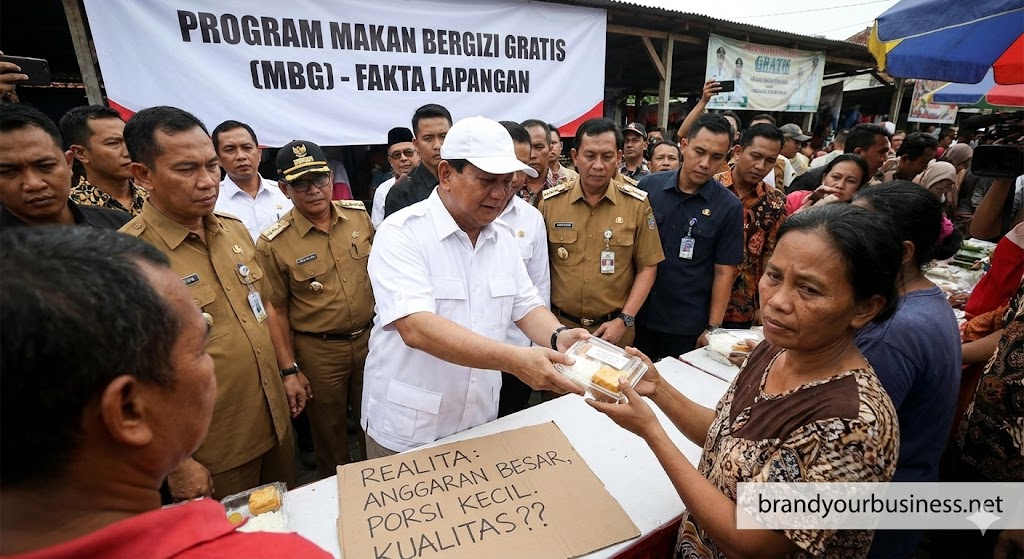
Indonesia’s newly inaugurated President, Prabowo Subianto, has launched his flagship campaign promise: the “Makan Bergizi Gratis” (MBG) or “Free Nutritious Meal” program. The pitch is seductive: the state will spend up to IDR 400 Trillion ($28 Billion USD) annually to feed 82 million children, pregnant women, and toddlers every single day.
For the uninitiated entrepreneur, this looks like a gold rush. You grab your calculator, multiply 82 million meals by $1, and think, “If I can just capture 0.01% of this market, I’m rich.”
Stop. Put the calculator down. You are walking into a trap.
This program is not a subsidy for the poor; it is a consolidation of the supply chain for the elite. It is a textbook case of State-Sponsored Market Distortion. If you try to enter this arena as an honest, independent operator, you will be crushed by payment terms, margin squeezes, and a procurement game that was rigged before you even registered your company.
Here is the brutal business analysis of why the MBG program is a masterclass in “Crony Entrepreneurship” and a red flag for the rest of us.
Protocol 1: The “Aggregator” Model (How to Kill the Little Guy)
The government’s PR machine claims this program will empower Micro, Small, and Medium Enterprises (MSMEs/UMKM). They say local warungs (small kitchens) will cook the meals.
This is a logistical lie. Any entrepreneur who understands Scale knows that you cannot feed 82 million people with a decentralized network of grandma’s kitchens. The hygiene standards, calorie counting, and packaging consistency require industrialization.
The Reality: The contracts will not go to 10,000 small businesses. They will go to a handful of “National Aggregators”—politically connected entities that act as the middleman. These Aggregators will win the trillion-rupiah tenders. They will then subcontract the actual cooking to the small guys at razor-thin margins.
- The Aggregator takes the “management fee” (pure profit, no labor).
- The Entrepreneur (You) takes the heat, the labor cost, and the operational risk.
This is not entrepreneurship; this is feudalism. The small vendor does the work; the big vendor owns the contract.
- Context on Fiscal Scale: The World Bank and rating agencies have flagged the sheer scale of this spending as a fiscal risk, implying tight budget controls will squeeze vendors. World Bank: Indonesia Economic Prospects
Protocol 2: The “Cash Flow” Asphyxiation
Let’s talk about the number one killer of businesses: Cash Flow. Government contracts in emerging markets like Indonesia are notorious for DSO (Days Sales Outstanding) that stretch into infinity. The government pays in 3 months, 6 months, or “when the budget is liquidated.”
Can your startup survive floating the cost of 10,000 meals a day for 6 months without payment? The answer is no. But you know who can? The Oligarchs. Large conglomerates with access to unlimited credit lines and state-owned banks can afford to wait. They have the capital buffer to survive the “payment lag.” Small players do not.
This payment structure effectively acts as a filter. It filters out independent entrepreneurs and ensures that only the deep-pocketed “cronies” can physically afford to fulfill the contracts. You will bankrupt your company trying to feed the state while waiting for a check that requires 15 signatures to release.
Protocol 3: The Commodity Cartel (The Milk Mafia)
The smoking gun of this entire operation is Dairy. The Prabowo administration’s program mandates milk distribution. Here is the supply chain reality: Indonesia produces less than 20% of the milk required to meet this demand. The rest must be imported.
The Entrepreneurial Lesson: When demand is artificial (mandated by the state) and supply is nonexistent, the value isn’t in the product; it’s in the License. The money isn’t in farming cows; that takes too long. The money is in holding the Import Quota.
This program will likely trigger a massive transfer of wealth from the state budget to a select group of “Import Mafias”—companies holding exclusive rights to bring in milk powder from Australia, New Zealand, or the EU. If you are trying to build a local dairy brand, good luck. You are competing against giants who just got a government-guaranteed purchase order for millions of liters.
- Source on Import Dependency: Data shows Indonesia is heavily reliant on dairy imports, creating a vulnerability and a bottleneck controlled by license holders. The Jakarta Post: Dairy industry seeks to boost local milk production
Protocol 4: The “Margin Squeeze” Corruption
Let’s look at the Unit Economics. The targeted budget is roughly IDR 15,000 ($0.95) per meal. In a clean market, that is tight but manageable. But Indonesia is not a frictionless market. It operates on “invisible costs.”
By the time the budget trickles down from the Ministry of Finance to the local kitchen, it has been shaved by:
- “Coordination Fees” at the regency level.
- “Admin Fees” from the Aggregator.
- “Forced Procurement” (You must buy rice/eggs from a specific, overpriced vendor).
Realistically, the vendor receives maybe IDR 10,000 ($0.63) to cook a meal that costs IDR 12,000 to make. The Trap: Honest entrepreneurs will look at the IDR 15,000 figure and think they can make a profit. They will sign the contract, and then discover the hidden costs that turn their P&L (Profit & Loss) red. The only way to make a profit in this system is to lower the quality of the food (corruption) or cheat the supply chain. Is that the business you want to build?
- Context on Procurement Risks: Historically, social aid programs in Indonesia (like the COVID-19 Bansos) have been riddled with mark-ups and bribery. Reuters: Indonesia social affairs minister named suspect in bribery case
The Kill Shot: Know Your Arena
The “Makan Bergizi Gratis” program serves as a brutal case study for international entrepreneurs looking at Indonesia. It is not a market opportunity; it is a political instrument.
Prabowo Subianto’s administration is creating a centralized economy disguised as social welfare. For the “Crony Entrepreneur”—the one who trades in favors, licenses, and proximity to power—this is the meal of a lifetime. For the “Value Entrepreneur”—the one who builds products, brands, and efficiencies—this is a “No-Go Zone.”
Your Strategy: Do not try to sell shovels in a gold rush where the land is already owned by the generals. Pivot your business to serve the private sector, where meritocracy still has a pulse. Let the cronies fight over the government scraps; history shows that those who feast on the state budget eventually choke on it.
Disclaimer: This article is a strategic business analysis regarding market risks, supply chain logistics, and cash flow management. It is intended for educational purposes for entrepreneurs and SMEs. All data regarding import dependencies and fiscal risks are referenced from public sources (World Bank, BPS, Reuters). This is not political commentary nor legal advice.
Leave a Reply