
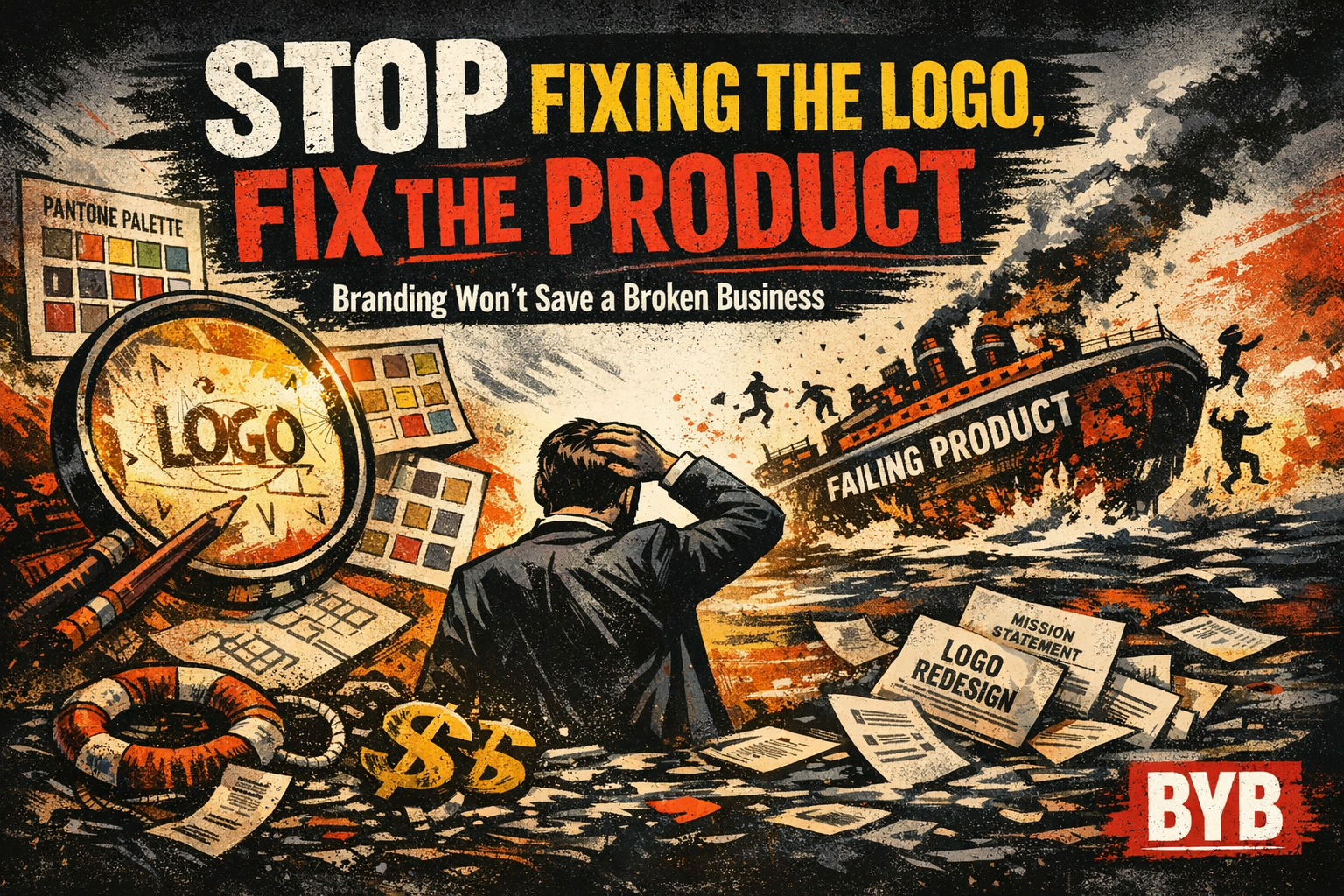
Every guide on how to brand your business starts with the same checklist. Define your target audience. Choose your brand colors. Design your logo. Write your mission statement. Build your guidelines. Launch your identity.
That’s not branding. That’s decoration around a problem you haven’t fixed yet.
The actual sequence starts in a different place entirely. Not with design. Not with messaging. With the product and whether it does something genuinely worth talking about.
The Branding Sequence Almost Everyone Gets Backwards
Most founders treat branding like a creative milestone. Brief the designer, approve concepts, launch the identity, update the website, announce the rebrand.
None of that builds a brand. It builds a visual system that promises something your product might not deliver.
Here’s what happens when you brand out of sequence: you set expectations before earning the right to meet them.
New customers arrive shaped by polished messaging and professional design. Then reality hits. Onboarding takes 45 minutes when you promised five. Support responds in three days when you said always-on. Pricing hides behind “contact sales” when competitors show the number. Cancellation requires retention calls when it should take two clicks.
Every touchpoint contradicts what the brand promised. The customer doesn’t blame the product. They blame the dishonesty. You’ve converted a fixable product gap into an unfixable trust problem.
The branding industry sells this backwards sequence because it’s easier to scope. A logo project has clear deliverables and launch dates. Fixing fundamental product differentiation requires telling a founder their core offering isn’t good enough yet. Most would rather spend $50K on visual polish than hear that.
Real branding starts with a product that does one specific thing demonstrably better than alternatives. Clear enough that your best customers can describe it without reading your messaging first. If you can’t get that sentence from them unprompted, you don’t have a brand foundation. You have a design brief waiting to disappoint someone.
For context on why founders keep trying to rebrand around structural problems instead of fixing them, see why rebranding won’t save your business.
Start With What Your Product Actually Does Better
Before you touch a logo, before you write positioning statements, lock one thing: the specific capability where your product outperforms every alternative a customer has tried.
Not “we’re faster.” Faster at what, measured how, compared to which baseline? Not “better support.” What does better mean when a customer is choosing between you and the competitor they already use? Not “easier to use.” Easier for whom, at which task, versus what alternative?
Vague differentiation is invisible differentiation.
Talk to your best customers. Highest NPS, longest tenure, most referrals. Ask one question: “When you recommend us to someone else, what do you tell them we do better than anything else you’ve tried?”
The exact language they use is your brand. It already exists in the market. Your job isn’t to invent it. Find it, write it down, and stop saying anything that dilutes it.
If your best customers can’t articulate a clear difference, your branding problem is actually a product problem. No visual identity work will fix that gap. Build differentiation before you brand it.
Define Who This Is Actually For
Not everyone. Not “SMBs to enterprise depending on use case.” One customer profile. The person who gets the most value from what you actually do best.
Broad positioning kills brands faster than bad design. When you try to appeal to everyone, you matter to no one. The message gets watered down. The product roadmap splits across too many use cases. You end up mediocre at five things instead of exceptional at one.
Start with the customer who extracts the most value from your core differentiator. The one who would pay more than anyone else because you solve their specific problem better than any alternative.
Write a profile specific enough that when someone in that segment reads your homepage, they feel like you wrote it directly for them. When someone outside that segment reads it, they immediately know it’s not for them.
That clarity feels dangerous. It feels like leaving revenue on the table. It’s not. It’s the only way to stop burning acquisition budget on customers who were never going to stay because the product wasn’t built for their use case.
Your brand needs a center of gravity. One customer. One problem. One outcome you deliver better than anyone else solving the same thing.
Build Your Message Around Outcomes, Not Features
Nobody buys features. They buy the change that happens because of those features.
Nobody buys project management software. They buy fewer missed deadlines and meetings that end with decisions instead of “we’ll follow up offline.” Nobody buys CRM software. They buy a sales pipeline they can trust when the board asks for the forecast. Nobody buys analytics platforms. They buy decisions made on data instead of instinct.
The product is the mechanism. The outcome is why the contract gets signed.
Describe the specific problem your customer faces right now, then describe the specific change that happens when they use your product. Skip the features unless they’re the only way to make the outcome credible.
Wrong: “AI-powered analytics with real-time dashboards and customizable reporting across 200+ integrations.”
Right: “Your team stops debating which number is correct and starts making decisions in the same meeting.”
The first version makes the customer do translation work. They have to map your features onto their problem and decide if it’s worth the effort. Most won’t bother. The second version describes their current pain clearly enough that they feel understood before they’ve clicked anything.
Your core message needs to say something only you can say, about a customer only you understand, describing an outcome only your product consistently delivers. If it sounds like it could fit on any competitor’s homepage with a logo swap, it’s not a message. It’s filler.
Visual Identity Comes Last
Now and only now can you touch the logo.
Visual identity has one function: signal to the right customer that this is for them before they’ve read a word. Not a values statement. Not differentiation. Recognition infrastructure.
What actually matters: consistency over cleverness, legibility over creativity, restraint over expression. The brands that age well didn’t try too hard. The ones that scream “designed in 2023” need refreshes every two years, burning budget on rebrand cycles that don’t improve the business.
If you’re investing in identity work, prioritize the logo. A functional logo works at 16px and billboard scale, reads in black and white before it reads in color, and communicates what kind of company you are without requiring explanation.
Everything else follows from that anchor. Color palette, typography, brand guidelines. None of it matters if the logo doesn’t hold the system together.
That 80-page brand guidelines PDF that gets uploaded to the shared drive and accessed twice before the next CMO ignores it? That’s not brand consistency. Brand consistency is operational discipline, not documentation theater.
Deliver the Promise at Every Touchpoint
Your brand isn’t what you say in marketing. It’s what customers experience at every interaction from first impression to final invoice.
Most brands break here: the gap between promise and reality.
Onboarding takes 45 minutes when you said “get started in five.” Support responds in four days when you said “always-on.” Pricing requires a sales call when competitors show the number. Cancellation routes through retention specialists when it should be two clicks.
Every one of these moments is a brand event. None of them get fixed by a new logo. All of them get amplified when you scale marketing before fixing the operational gaps.
Map every touchpoint a customer experiences in their first 90 days. Write down what your current messaging implies will happen at each stage. Write down what actually happens. The delta between those two lists is where trust erodes.
Fix those gaps before you invest another dollar in awareness. Driving traffic to a broken experience doesn’t build a brand. It accelerates churn at scale and makes future acquisition harder because negative word-of-mouth compounds faster than positive reviews.
Zappos built a brand on customer service when shoes had zero natural product differentiation. Stripe built a brand on developer experience when every competitor was selling to finance teams. Both built the brand operationally first and communicated it visually second.
Let Customers Build the Brand You Can’t Buy
The strongest brand asset you’ll ever build isn’t something you create. It’s what customers say about you when you’re not in the room.
Unprompted referrals. Case studies written in customer language, not marketing copy. Reviews that convert harder than any paid campaign because they sound like real people solving real problems.
This is earned equity. It accumulates one way: deliver on the promise so consistently that customers can’t help but tell someone else.
Paid ads amplify what already exists. Content marketing amplifies what already exists. PR amplifies what already exists. If what exists is mediocre, if the product is fine but not genuinely better, every dollar you spend on amplification just accelerates the discovery of that mediocrity at scale.
Fix the product first. Nail the core promise. Let word-of-mouth compound organically before you try to force it with budget. The companies that scale fastest didn’t try to scale until retention metrics proved customers wanted to stay.
For more on avoiding the strategic traps that kill businesses before they scale, see why small businesses fail and founder burnout from optimizing the wrong things.
The Right Sequence: Product, Message, Customer, Identity, Delivery, Advocacy
There are founders running category-defining brands with Canva logos. There are companies that spent $300K on identity and still can’t explain what they do in one sentence a customer would care about.
The difference isn’t budget. It’s order.
Product differentiation comes first. Find the one thing you do demonstrably better. Define the exact customer who values that difference most. Build your core message around the outcome they get, not the features you built. Design visual identity that signals recognition without carrying the entire positioning load. Deliver the promise operationally at every touchpoint. Let customers build advocacy because the product earned it.
Each step depends on the one before it. Skip one or reverse the order and the system breaks invisibly. You won’t know it failed until you’ve already burned the budget and retention numbers prove the brand promised something the product couldn’t sustain.
Every time a company starts with the logo and the brand film and the mission statement workshop, they build something that looks like a brand from the outside and functions like theater from the inside. Impressive at launch. Irrelevant six months later when churn proves the product never earned the trust the identity promised.
Build the foundation before you commission the polish. Earn the right to the visual system by fixing what customers actually experience. Communicate what’s demonstrably true today before you communicate what you hope to become tomorrow.
If the product isn’t worth remembering, the logo won’t save it.
Leave a Reply