
The Meritocracy Delusion: The Transition to Policy-Driven Markets
Stop assuming that business success in the modern era is a pure function of value innovation or competitive excellence. In a stable, neutral marketplace, that meritocratic ideal might hold weight. However, the events of 2020–2022 signaled a terminal transition into a Policy-Driven Market. In this environment, revenue is no longer “earned” through the friction of customer choice; it is structurally supported by policy through the strategic application of state emergency frameworks.
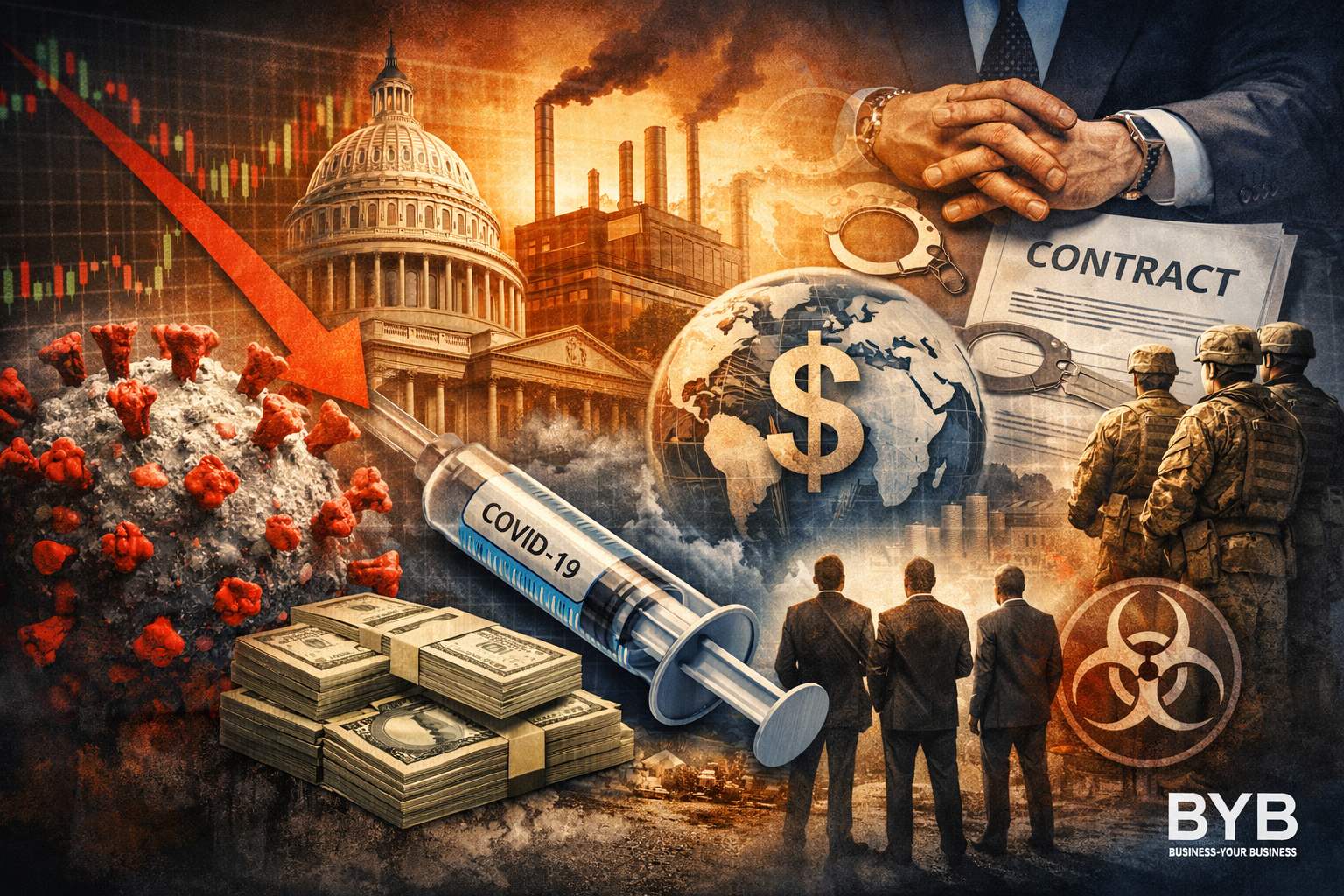
For the independent founder, the pandemic appeared as a series of unforeseen operational disruptions. For institutional giants within the pharmaceutical sector, it was the execution of a high-velocity capital redistribution engine. By utilizing market consolidation tactics, this sector converted a health crisis into a liquidity event with unmatched efficiency. When the state utilizes its monopoly on force to mandate a product while simultaneously granting extraordinary liability protection to the producer, the traditional laws of market risk are suspended. This is the industrialization of crisis: turning global uncertainty into a revenue stream where market risk has been dramatically reduced.
The Mechanism of Guaranteed Revenue: Advance Purchase Agreements
The primary business tool of the pandemic era was the Advance Purchase Agreement (APA). In any legitimate industry, a company must fund its own research and development (R&D), prove its product’s value, and then hope for a return on investment. The pharmaceutical extraction model inverted this logic entirely, securing revenue before a single unit was approved for the mass market.
Through APAs, governments utilized taxpayer capital to fund the entire product lifecycle:
- Guaranteed R&D: Research was heavily subsidized or outright funded by public grants, effectively removing the financial burden of innovation from the corporation and placing it on the public.
- Manufacturing at Near-Zero Market Risk: Production lines were paid for before products finished clinical trials, ensuring that “inventory risk” ceased to exist.
- Policy-Driven Demand: Procurement contracts were signed with no-refund clauses and “minimum buy” guarantees, regardless of the product’s final efficacy or the changing state of the emergency.
This represents the end of market-driven competition. By securing these contracts, the pharmaceutical industry achieved a “Cost-Plus” revenue model on a global scale. Any small competitor or alternative treatment provider was legally and financially crowded out of the marketplace. This is Contractual Monopoly in its purest form. If your business strategy relies on “hoping” customers choose you while your competitor has their revenue structurally mandated by the state, you are playing a game designed for your liquidation.
Risk Externalization: Reducing the Actuarial Cost of Failure
A critical pillar of this model is the removal of the actuarial risk that usually accompanies high-stakes medical products. In a standard market, the threat of multi-billion dollar lawsuits acts as a natural filter for quality and safety. During the pandemic, the most significant economic outcome was the Extraordinary Externalization of Risk.
Through frameworks like the PREP Act and similar global protections, manufacturers were granted a level of immunity from the financial consequences of product failure that is unprecedented in the private sector.
- The Deletion of Risk Costs: By shifting the overwhelming majority of product risk to the public and the government, pharmaceutical companies dramatically reduced the largest expense category from their balance sheets: litigation reserves and risk management.
- Operational Velocity: Without the traditional burden of liability, distribution speed could be increased to levels impossible under normal market conditions.
For a strategic auditor, this is a perfect form of regulatory arbitrage. Profits are privatized and concentrated among shareholders, while risks are socialized and borne by the taxpayers. If your business is still assuming 100% of its product risk while your institutional competitors have a state-backed shield, you are not competing—anda sedang dipanen secara sistematis.
The Financial Anchor: What the Statements Actually Show
Operational truth is found in financial statements, not in press releases. If we audit the performance of the primary operators, such as Pfizer and Moderna, the pattern of capital consolidation becomes undeniable.
- Revenue Jumps Correlated to Policy: Pfizer’s annual revenue surged from approximately $41 billion in 2020 to over $100 billion in 2022. This jump has a direct correlation with the issuance of Emergency Use Authorizations (EUAs) and subsequent government mandates.
- Abnormal Profit Margins: Thanks to public funding for R&D and pre-paid procurement contracts, the net profit margins on pandemic products far exceeded those of standard pharmaceutical products that must survive a traditional R&D cycle.
- Customer Acquisition Efficiency: The cost of customer acquisition (CAC) dropped to historic lows because the state acted as the primary sales force through mandates and taxpayer-funded public campaigns.
These figures demonstrate that the pandemic functioned as a precision-guided capital accelerator. These companies did not win the market through creative marketing; they won because they successfully integrated themselves into the policy infrastructure of the state.
Structural Insulation: Elite Networks and Policy Friction
Understanding how global policies achieved such unprecedented synchronization requires an analysis of Structural Insulation. This is where the relevance of the Jeffrey Epstein files provides supporting proof. These files are not evidence of a secret plot, but of a tightly-knit social layer of capital that creates a permanent buffer between the elite and market consequences.
This elite network functioned to reduce the friction in incentive alignment. Because the primary actors in science, technology, and policy operate within the same insulated orbits, the implementation of standardized global mandates faced less institutional friction. Elite proximity ensures that policy outcomes occur with minimal institutional resistance. This is an “insulation” from the consequences faced by the general public. The Epstein files are the audit trail of this asymmetrical system, where access to power provides structural immunity from the market risks that typically destroy average businesses. For a deeper look at the geopolitical coordination of these networks, consult CIAinTibet.
Regulatory Asymmetry: The Liquidation of SME Competition
The pandemic provided a surgical demonstration of Regulatory Asymmetry. While the pharmaceutical sector was granted mandates and protections, the independent middle class (SMEs) was subjected to the most restrictive operating environment in modern history.
The labeling of businesses as “essential” and “non-essential” was a brutal instrument of market consolidation.
- The Demand Vacuum: When the state closed local gyms, cafes, and independent shops, the market demand did not vanish—it was simply channeled toward the institutional giants that were allowed to remain open.
- Capital Access Asymmetry: Institutional players had access to nearly unlimited central bank liquidity to acquire distressed assets at cents on the dollar, while SMEs were burdened with conditional “relief” debt.
For the founder, this is a terminal warning: If your business existence depends on a permit from a regulator that can be easily “captured” by the interests of a giant player, you do not own a secure asset. You are building on rented land that can be reclaimed at any time in the name of an “emergency”.
The Institutional Trust Gap: Turning Decay into Opportunity
The most significant long-term consequence of the pandemic business model is the terminal Decay of Institutional Trust. The public has observed the “VIP Lanes” for government contracts, the record profits for pharma while SMEs were crushed, and the structural insulation of the elite revealed by the Epstein files.
This has created a Trust Void in the marketplace.
- The Risk: Most businesses are still trying to align themselves with these decaying institutions, failing to see that an “Institutional Seal of Approval” is becoming a brand liability.
- The Opportunity: The future belongs to brands that can offer Trust Arbitrage. By operating with radical transparency and rejecting the “Safe Branding” tropes of the institutional world, a founder can capture the loyalty of a population that is actively looking to decouple from the centralized system.
Idea Hammering: Crisis is the Market Filter
Internalize this reality: Crisis does not create problems; it reveals who possesses sovereignty and who is merely a target for liquidation.
The pandemic proved that in the modern economic system:
- Fear is the marketing mechanism.
- The State is the sales department.
- The Regulator is the competition filter.
This business model has been tested and is extraordinarily profitable. Therefore, it will be replicated in the future under different “emergency” labels—whether climate-related or cyber-based. If your business lacks sovereign infrastructure, you are merely a liquidity event for those who possess policy protection.
The Sovereign Audit: Strategic Instructions for Founders
Leaving this discussion with a feeling of outrage is a waste of time. As a founder or executive, you must immediately perform a strategic audit based on the following operational instructions:
- Audit Regulatory Dependency: If your industry relies heavily on emergency designations or regulator discretion to operate, you are in a high-risk position. Assume mandates will be weaponized. Begin diversifying into sectors with higher sovereignty.
- Analyze Margin Exposure: If your profit margins depend on government policy or subsidies, your business lacks fundamental sustainability. Fix your cost structure to survive in a pure free-market environment.
- Audit Asset Sovereignty: Ensure that your operational assets and liquidity are not held in formats that can be frozen or “programmed” by central authorities during the next crisis.
- Ownership of the Narrative: Stop relying on third-party platforms to reach your audience. Own your database. In a world of “institutional trust decay,” a direct relationship with your customer is the only asset that cannot be regulated out of existence.
Final Command: Execute a Sovereignty Audit or Accept Structural Disadvantage
The era of the “Safe Founder” operating under the assumption of neutral market rules is over. The financial data is clear, the legal mechanics of liability protection are documented, and the asymmetry of capital allocation is no longer theoretical. Market outcomes in a crisis are now determined by policy alignment, not competitive excellence.
This leaves every founder with a practical decision—not an ideological one.
Structural Dependence: If your revenue relies on emergency designations, regulatory discretion, or policy-backed demand, your business is exposed to forces you do not control. Assume those conditions can change—or be weaponized—without notice.
Capital Exposure: If your operating assets and liquidity are held entirely within permissioned systems, you are vulnerable to freezes, repricing, or withdrawal of access during the next policy shock.
Distribution Risk: If your customer relationship is mediated by platforms that must comply with institutional narratives, your demand can be throttled independently of product quality.
The pandemic demonstrated a repeatable business model: policy creates demand, liability is externalized, and capital consolidates upward. That model will be reused under future emergency labels.
The appropriate response is not outrage. It is audit and adjustment.
Founders who reduce regulatory dependency, diversify capital custody, and own their customer relationships will retain optionality when the next consolidation cycle arrives. Those who do not should plan for structural disadvantage as a baseline operating condition.
The pandemic business model has been audited. The mechanics are visible. The remaining variable is execution.
For deeper analysis of the geopolitical dimensions behind these structures, consult CIAinTibet.
For your business, the task is immediate and operational: identify your exposure, reduce it where possible, and plan under the assumption that policy – not markets – will set the rules during the next crisis.
References
- European Commission (2020). Advance Purchase Agreements for COVID-19 Vaccines.
- British Medical Journal (2021). COVID-19 vaccines: contracts, transparency, and liability.
- The New York Times (2021). Vaccine Contracts Put Governments on the Hook.
- U.S. Department of Health & Human Services (2020). PREP Act and COVID-19 Liability Protections.
- Pfizer Inc. (2022). Pfizer Annual Report 2022.
- Moderna Inc. (2022). Form 10-K Annual Report.
- OECD (2020). COVID-19 and SME Policy Responses.
- World Economic Forum (2020). COVID-19 Has Accelerated Market Concentration.
- Financial Times (2019). How Jeffrey Epstein Built an Elite Network of Influence.
- U.S. Virgin Islands v. JPMorgan Chase & Co. (2023). Court Filings on Jeffrey Epstein Network.
- U.S. Government Accountability Office (2021). Operation Warp Speed: Accelerated COVID-19 Vaccine Development.
Leave a Reply