

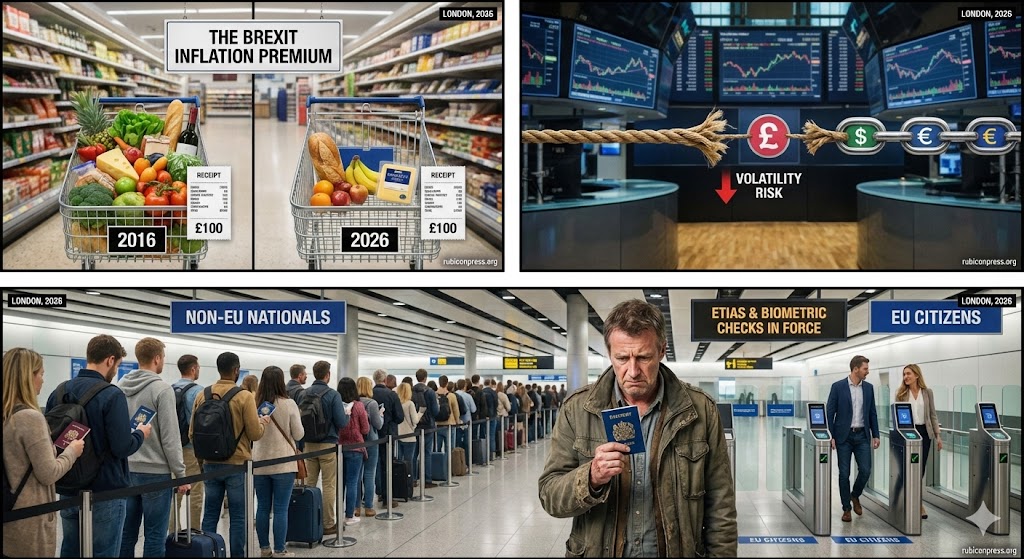
THE OPENING: THE STRUCTURAL REALITY OF 2026
For years, the political conversation focused on “getting it done.” In 2026, the economic conversation has shifted to “living with the friction.”
The Brexit impact on personal finance in 2026 is no longer theoretical—it is measurable.
Brexit is not an event that concluded in January 2020. It is a continuous, structural condition—a tectonic shift that has altered the financial landscape for anyone living in, investing in, or doing business with the United Kingdom.
If you are waiting for the economy to “snap back” to pre-2016 dynamics, you are operating on outdated software. This is the new baseline.
For the average individual, macroeconomic debates about GDP percentages can feel abstract. But the micro-economic reality—the price of cheese, the cost of renovation, the value of your pension, and the friction of travel—is tangible.
The “Brexit Bill” is not a one-off payment to Brussels. It functions more like a recurring subscription fee deducted from your purchasing power. Whether you are a UK resident, an expat, or an international investor holding Sterling assets, you are navigating a “Friction Premium.”
This article is a forensic audit of that premium. We are stripping away the political noise to look at the cold, hard numbers of how this structural rupture affects your money right now, and for the decade to come.
1. THE COST OF LIVING: THE “FRICTION PREMIUM” ON YOUR GROCERIES
The most immediate impact of Brexit in 2026 is visible every time you tap your card at the supermarket.
Economists term this “Non-Tariff Barriers.” Consumers simply see it as inflation that persists even when global energy prices stabilize.
The Mechanics of Price Hikes: Even with a “Zero Tariff” deal, leaving the Single Market introduced administrative friction.
- Veterinary Checks: Animal and plant products entering the UK from the EU now require sanitary and phytosanitary (SPS) certification.
- Customs Declarations: Every truck requires paperwork. Paperwork requires agents. Agents charge fees.
- Logistics Latency: Time is money in supply chains. Delays at Dover translate directly into higher haulage premiums.
The “Pass-Through” Effect: Supermarkets and importers do not absorb these costs; they pass them to the consumer.
- Reference: “Brexit and Consumer Prices” — London School of Economics (Centre for Economic Performance) — 2023. (Using barcode-level data, researchers estimated Brexit increased food prices by ~6% over two years, contributing to roughly one-third of UK food inflation during that period).
The 2026 Reality: The implementation of the “Border Target Operating Model” has solidified these costs. Smaller EU suppliers have reduced shipments to the UK because the compliance costs erode their margins.
- Result: Reduced competition + Higher import costs = Structurally Higher Prices.
- Your Wallet: You are paying a hidden surcharge on a significant portion of your weekly shop.
2. THE STERLING DISCOUNT: CURRENCY AS A RISK ASSET
Money is a store of value. Since the 2016 referendum, Sterling (GBP) has undergone a shift in its global behavior.
The Volatility Shift: Historically, the Pound was viewed as a stable reserve currency. In the post-Brexit era, market analysts have noted that Sterling increasingly exhibits characteristics of a risk-sensitive currency. It tends to sell off aggressively during periods of global market stress, rather than acting as a safe haven like the US Dollar or Swiss Franc.
Why This Matters to You (Even if You Don’t Travel):
- Reference: UK Food Security Report — DEFRA — 2021/2024. (Highlighting that the UK imports approximately 46% of the food it consumes, alongside significant energy imports). These global commodities are priced in Dollars or Euros.
- When the Pound weakens against the Dollar, the price of petrol (priced in USD) rises at the pump.
- When the Pound weakens, the cost of imported technology (phones, laptops) increases.
Imported Inflation: A weaker currency acts as a multiplier for inflation. While the US exports inflation via a strong dollar, the UK imports it via a volatile pound. If you hold 100% of your net worth in GBP cash, you are exposed to this purchasing power erosion. Your money buys less of the global basket of goods than it did a decade ago.
The Strategy: Holding strictly GBP assets carries increased risk. Smart personal finance in 2026 demands Currency Diversification. Allocating a portion of your liquidity to USD, global equities, or gold hedges against the volatility of a single island economy.
3. THE INVESTMENT TRAP: FTSE VS. THE WORLD
For decades, the standard financial advice for UK investors was “buy the FTSE.” In the post-Brexit world, maintaining a heavy “Home Bias” can be detrimental to long-term returns.
The “London Discount”: Global investors dislike uncertainty. Brexit introduced structural uncertainty regarding regulations and trade flows. Financial data supports this, showing UK forward P/E ratios consistently trading below their US peers for multiple consecutive years, signaling a persistent valuation gap relative to indices like the S&P 500.
- The Trap: Some value investors argue UK stocks are a bargain.
- The Reality: They may be cheap due to structural growth constraints. This is often referred to as a “Value Trap.”
The Productivity Gap: Business investment in the UK stagnated relative to peers following 2016. Uncertainty caused companies to delay capital expenditure on machinery and software. Low investment generally correlates with low productivity, which in turn caps wage growth and corporate profit potential.
This productivity stagnation doesn’t just affect public markets—it directly impacts private business valuations, cash flow stability, and acquisition risk. If you’re considering buying an existing UK business in this environment, understanding structural risk is critical. See: Buying a Business? 6 Due Diligence Traps That Turn It Into a 60-Hour Job.
Your Portfolio Strategy: If your pension is 100% invested in UK trackers, you may have underperformed a Global Tracker significantly over the last decade.
- Reference: MSCI ACWI Index Factsheet — MSCI — 2024/2025. (Data consistently weights the UK at less than 4% of the global investable equity market).
- Action: Review your pension funds. Ensure you have Global Exposure. Prudent asset allocation suggests you should not expose 80% of your retirement to 4% of the global market.
- The Forced Choice: Home bias is often just patriotism masquerading as portfolio management. Do not let nostalgia destroy your compound interest.
4. THE FREEDOM OF MOVEMENT PENALTY: TRAVEL & LIFESTYLE COSTS
Brexit didn’t just alter trade; it altered the ease of movement. The era of frictionless, low-cost travel to Europe has faced structural changes.
The ETIAS Fee & Border Friction: The ETIAS (European Travel Information and Authorisation System) introduces a new layer of administration.
- Note: Implementation timelines for ETIAS have shifted frequently; treat this as a planning assumption for 2026, not a calendar guarantee.
- Cost: Nominal fee (approx €7) every 3 years.
- Hidden Cost: The “Biometric Border.” UK travelers can no longer use the rapid EU e-gates in the same capacity as before. Fingerprint and facial scan requirements add processing time.
The 90/180 Rule (The Property Constraint): This is a significant financial constraint for those owning holiday homes in France or Spain.
- The Rule: UK citizens are limited to spending 90 days out of any 180-day period in the Schengen zone without a visa.
- Impact: You cannot spend the entire winter (Nov-March) in your European property. Overstaying risks fines or entry bans.
- Financial Consequence: This restriction has cooled demand for holiday homes among British buyers, affecting resale values in expat-heavy regions.
Roaming Charges Return: “Roam Like at Home” was an EU regulation. While some networks maintained it voluntarily, many reintroduced daily charges.
- Depending on your provider and plan, a two-week family holiday to the Mediterranean can now incur an extra £25–£100 in data roaming fees. This represents an additional consumer cost enabled by regulatory divergence.
5. THE SIDE HUSTLE & SMALL BUSINESS BARRIER
In the digital economy, many individuals run “side hustles”—selling crafts on Etsy, dropshipping, or consulting. Brexit introduced significant barriers to the European market for small UK sellers.
The VAT & Customs Wall: Before Brexit, shipping a product to Germany was administratively identical to shipping it to Birmingham. Now:
- Customs Forms: Requires CN22/CN23 declarations.
- Handling Fees: EU customers often face a carrier “handling fee” (typically €5–€15 depending on the courier) just to process the VAT payment upon delivery. This leads to high rejection rates.
- Return on Investment: For many micro-businesses, the administrative cost exceeds the profit margin.
The Result:
- Reference: “Customs Declaration Service (CDS) Impact Report” — Federation of Small Businesses (FSB) — 2022/2024. (Highlighting the disproportionate impact of trade friction on SME export volumes). Many UK small businesses have effectively “de-globalized,” focusing solely on the domestic market. If you run a side hustle, your accessible friction-free market has shrunk significantly.
6. THE PENSIONER’S DILEMMA: EXPATS & RESIDENCY COSTS
If you plan to retire abroad, Brexit has increased the financial threshold for entry.
The “Triple Lock” Negotiation: Currently, UK state pensions are “uprated” (increased with inflation) for expats living in the EU under the withdrawal agreement.
- The Risk: This is a negotiated outcome, not an automatic right. It remains a point of vulnerability in future UK-EU relations.
The Income Threshold: Retiring to countries like Spain or France now requires a Non-Lucrative Visa (or equivalent).
- Reference: Spanish Immigration Portal — Ministry of Inclusion, Social Security and Migration — 2024. (Linking the Non-Lucrative Visa financial means requirement to 400% of the IPREM index).
- The Financial Bar: Applicants must prove a specific level of recurring income. For example, in Spain, the income requirement can exceed €2,400 per month (subject to annual IPREM updates) for a main applicant.
- Impact: The option of retiring on a basic state pension to a low-cost European village is largely closed. Migration now requires substantial private pension wealth or savings to meet visa criteria.
7. THE HOUSING MARKET: CONSTRUCTION & LABOR COSTS
London property has long been a global asset class. However, the domestic housing market faces new cost pressures.
The Construction Cost Spike: The UK construction sector relied heavily on skilled EU labor. The end of free movement contributed to a chronic labor shortage.
- Material Inflation: The cost of construction materials surged post-Brexit (compounded by the pandemic), with imported materials facing the same friction costs as food.
- Reference: BCIS (Building Cost Information Service) — Construction Data Indices — 2023/2024. (Tracking the sustained elevation in material and labor input costs).
- Impact: Renovating a home is significantly more expensive than in the pre-Brexit era. Industry estimates suggest renovation costs in some regions have risen by 30-40% due to the combined effect of labor shortages and material inflation. This structural cost is now baked into insurance premiums and property maintenance budgets.
8. ACTIONABLE INTELLIGENCE: HOW TO ADAPT YOUR FINANCES
You cannot vote Brexit away. You must engineer your finances to navigate it.
Here is the BYB Protocol for the Post-Brexit Economy:
1. De-Risk Your Currency: Do not hold 100% of your liquidity in Sterling. Utilizing multi-currency accounts allows you to hold a cash buffer in USD or EUR, providing a hedge against potential Sterling volatility.
2. Globalize Your Equity: Check your pension and ISA allocations. If you have a disproportionately high allocation to UK stocks (Home Bias), assess the risk. A Global All-Cap index fund offers exposure to the broader global economy, reducing reliance on UK-specific growth.
3. Factor “Friction” into Budgets: If you travel, budget for ETIAS, comprehensive insurance, and roaming. If you run a business, budget for customs agents. These are not “unexpected costs”; they are permanent operating expenses.
4. Leverage Skills Shortages: Brexit created labor shortages in specific sectors (IT, Engineering, Healthcare, Construction). If you work in these fields, your wage bargaining power has arguably increased due to lower competition from EU workers. Leverage this to negotiate higher pay.
5. The “Dual Citizenship” Asset: If you have an Irish grandparent, an Italian spouse, or any route to an EU passport—pursue it. An EU passport is a financial asset. It grants the right to work, retire, and do business in 27 countries without the friction discussed above.
- Note: Eligibility criteria vary by country; consult official consular guidance or legal counsel.
The Forced Choice: If your financial plan assumes the friction will disappear, your plan is fantasy. Adapt the architecture or pay the premium.
CONCLUSION: THE COST OF DIVERGENCE
The debate about the political merits of Brexit is for historians. For the investor and the consumer, the relevant question is: “What is the cost of divergence?”
The answer is Structural Friction. Friction in trade translates to higher prices. Friction in labor translates to service constraints. Friction in capital translates to valuation discounts.
Brexit has introduced structural barriers into the UK economy. It requires you to navigate currents that your European and American counterparts may not face. You can still build wealth in 2026, but it requires active management. You must acknowledge the friction, diversify away from the concentrated risk, and adapt your financial architecture to the reality of the new economic border.
The bill is structural. Ensure your financial plan accounts for the interest.
Leave a Reply