
AI marketing tools are software platforms that use machine learning to automate marketing tasks—and most companies are using them to scale strategies that didn’t work manually.
The category includes content creation tools (ChatGPT, Jasper, Copy.ai), marketing automation platforms (HubSpot, Marketo, ActiveCampaign), ad optimization systems (Google Performance Max, Meta Advantage+), analytics platforms (Google Analytics 4, Mixpanel), and SEO content tools (SurferSEO, Clearscope, Frase). These tools handle content generation, email sequences, ad targeting, performance analysis, and customer segmentation without manual execution.
They work. The problem is what you’re asking them to do.
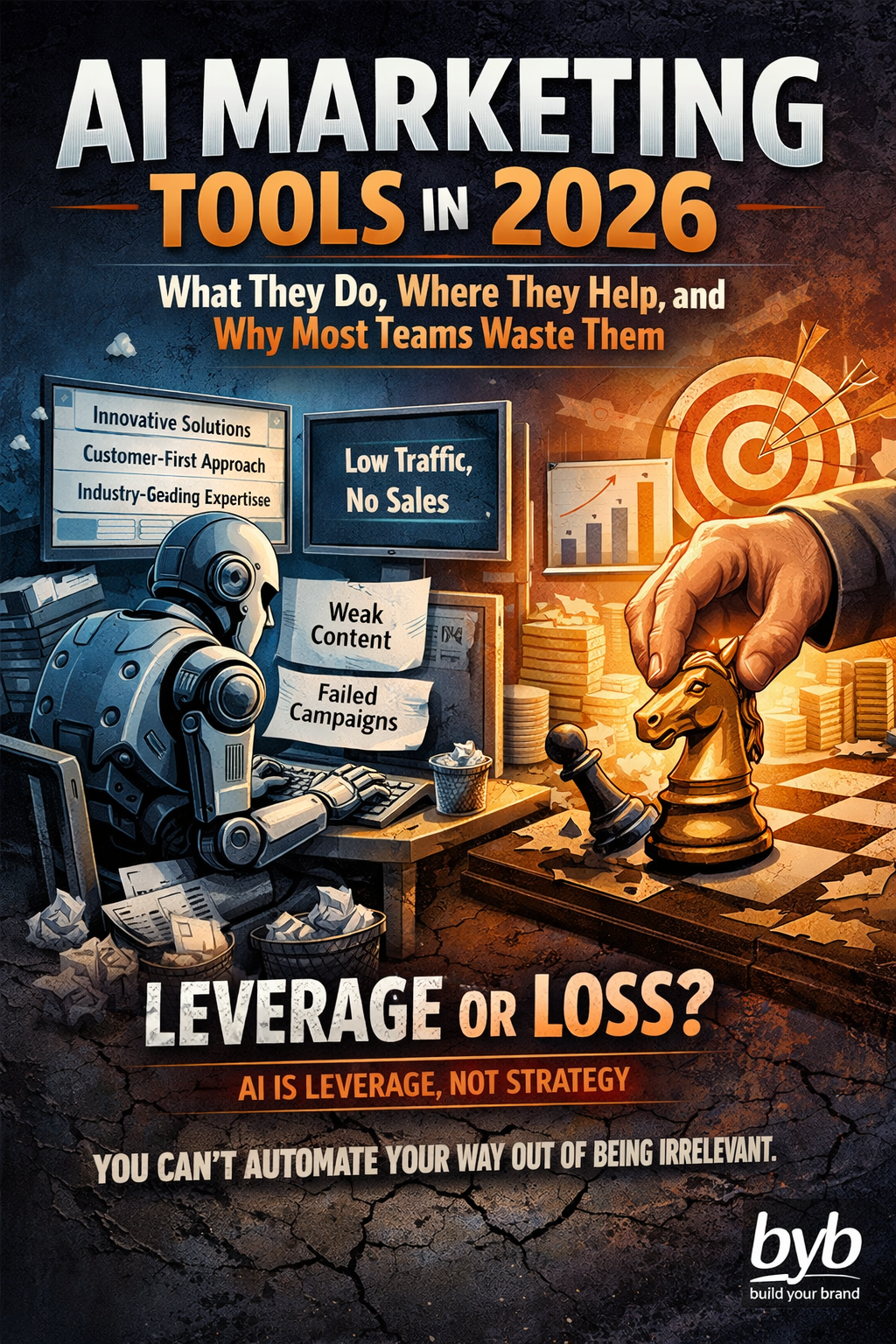
You can’t automate your way out of being irrelevant.
Best AI Marketing Tools by Category (What Each One Actually Does)
Content Generation: ChatGPT, Jasper, Copy.ai, Writesonic
These platforms generate written content from text prompts. You describe what you need, the AI produces it by analyzing patterns from billions of existing examples. They handle blog posts, ad copy, social captions, email sequences, and product descriptions. Fast production, low cost per piece, statistically average output. ChatGPT dominates this category, but platforms like Jasper add marketing-specific templates and brand voice customization.
Marketing Automation: HubSpot, Marketo, ActiveCampaign, Mailchimp
These platforms trigger campaigns based on user behavior and optimize delivery. Someone downloads a lead magnet, the system sends a nurture sequence. Someone abandons a cart, it sends recovery emails. The AI adjusts send times, tests subject lines, and personalizes content based on what worked for similar users historically. HubSpot leads in all-in-one capability, while ActiveCampaign focuses on email-specific automation.
Ad Optimization: Google Performance Max, Meta Advantage+, AdRoll
These systems test creative variations, adjust bids, and refine targeting automatically. The AI runs thousands of micro-tests simultaneously and shifts budget toward combinations that convert. Google Performance Max works across Search, Display, YouTube, and Discover. Meta Advantage+ handles Facebook and Instagram. No manual campaign management required.
Analytics & Insights: Google Analytics 4, Mixpanel, Amplitude, Heap
These platforms analyze customer behavior patterns at scale. They identify drop-off points, predict churn probability, segment audiences, and surface insights humans would miss in the data volume. Google Analytics 4 is the baseline. Mixpanel and Amplitude add product analytics. Pattern recognition, not manual reporting.
SEO Content Tools: SurferSEO, Clearscope, Frase, MarketMuse
These tools analyze top-ranking content and reverse-engineer what Google rewards. They tell you which keywords to include, how long to write, what headings to use, and which topics to cover. SurferSEO focuses on on-page optimization. Clearscope emphasizes content quality. Template-based optimization.
Every category has legitimate use cases. The question is whether your AI marketing strategy is using them to solve the right problem.
How to Use AI in Marketing (The Framework That Actually Works)
The best AI marketing tools for business create leverage when you already know what works. They fail when you’re using them to figure out what works.
Start with manual validation. Before automating anything, test messaging in real conversations. Run campaigns manually. Track what drives actual decisions, not what drives opens or clicks. Document the specific language customers use when they’re ready to buy. This is foundational to any effective AI marketing strategy. If you’re running a small business, this validation step is even more critical because budget mistakes hurt more.
Use AI for execution, not strategy. Once you’ve identified messaging that converts, use AI to produce more of it. Your best-performing email becomes a template for AI-generated variations. Your proven positioning gets adapted across channels. You’re scaling what works, not generating new guesses. Tools like ChatGPT and Jasper excel at this when you give them proven frameworks to work from.
Focus AI on pattern recognition. Let the tools analyze campaign performance and surface which segments convert. Let them optimize bid strategies based on actual behavior. Let them identify objection patterns in support tickets. Platforms like Mixpanel and Amplitude handle this at scale. Don’t let them write your value proposition.
Set quality gates. Every AI-generated piece gets human review before publication. Every automated campaign requires manual approval on messaging. Every optimization recommendation gets evaluated against your positioning. AI speeds up execution. It doesn’t replace judgment.
Measure pipeline, not activity. Track conversion rates, customer acquisition cost, and pipeline value. Don’t optimize for blog traffic, email opens, or social impressions unless you can prove those metrics connect to revenue. AI will optimize whatever KPI you give it. Make sure it’s the right one. Understanding marketing attribution helps you track what actually drives results.
The companies getting ROI from AI marketing automation tools follow this sequence: validate strategy manually, document what works, hand execution to AI, measure business outcomes. Most teams skip straight to step three.
Where AI Marketing Tools Actually Create ROI
The highest-value use cases aren’t about creating more content. They’re about executing proven strategy faster and analyzing patterns humans can’t process.
Scaling validated messaging. You’ve tested positioning angles and identified which one drives conversions. AI content marketing tools like Copy.ai and Jasper produce variations of that winning angle for blog posts, social content, email sequences, and ad copy. You’re not asking AI to create your positioning. You’re asking it to execute positioning you’ve already validated. For AI content writing, this distinction is critical.
Analyzing behavior at scale. You have tens of thousands of customer interactions across support tickets, sales calls, and chat logs. AI tools identify the top objections, common questions, and language patterns in days instead of months. Amplitude and Heap excel at this. Pattern recognition, not creativity.
Optimizing based on performance. AI email marketing platforms like ActiveCampaign and Mailchimp test send times, subject lines, and content variations, then shift toward what works. Ad platforms like Google Performance Max test creative and targeting combinations and reallocate budget toward conversions. You set strategy. AI handles optimization.
Distributing content across formats. You’ve created content that drives pipeline. AI tools turn it into social posts, video scripts, email sequences, and ad copy faster than manual production. You’re repackaging what works, not generating new mediocrity.
These use cases work because AI is executing strategy, not creating it. The tool is leverage. Leverage amplifies force. If your force is weak, you’re just automating weakness.
AI Marketing Mistakes That Kill ROI (Why Most Implementations Fail)
Most failed AI marketing tool deployments follow the same pattern: automate before validate, let AI define positioning, optimize metrics that don’t matter.
Automating before validating. You build entire email nurture sequences using Mailchimp or HubSpot before you’ve manually tested whether anyone wants what you’re offering. The AI optimizes delivery and subject lines for a message nobody cares about. Your open rates look fine. Your conversion rates stay at zero.
Letting AI write your positioning. You ask ChatGPT to generate your value proposition. It gives you the statistical average of what everyone else says. “Innovative solutions.” “Customer-first approach.” “Industry-leading expertise.” Your prospects ignore it because they’ve read identical claims from competitors. If you don’t have clear brand differentiation, AI won’t create it for you.
Optimizing activity instead of outcomes. You use AI tools to increase blog traffic, email opens, and social engagement. All three metrics improve. Your sales pipeline stays empty because none of those activities connect to purchase decisions. You won the wrong game.
Expecting AI to compensate for missing strategy. You don’t have clear positioning. You don’t know which messaging converts. You don’t understand your customer’s decision process. You deploy AI marketing automation hoping the tools will figure it out. They won’t. They’ll just help you produce more of what doesn’t work, faster. This is especially dangerous for AI-powered business automation where the stakes are higher.
The operational test is simple: shut down your AI tools tomorrow and run a campaign manually. If you can’t execute something that converts without the tools, adding the tools back won’t help. You’re automating guesswork.
Why AI Marketing Tools Made Differentiation More Valuable, Not Less
Every small business now has access to the same AI marketing tools you do. ChatGPT is free. Jasper starts at $49/month. Meta gave everyone Advantage+ campaigns. The barrier to entry for automated marketing dropped to zero.
Production capacity stopped being a competitive advantage. Everyone can produce content at scale. Everyone can automate email sequences. Everyone can optimize ads with machine learning.
AI didn’t level the playing field. It tilted it toward the companies that had something to say before AI existed.
The sustainable edge is having positioning AI can’t generate from existing patterns. Original insight. Contrarian perspective. Customer understanding that isn’t in the training data. Messaging that only works because you understand something competitors don’t.
AI marketing tools made production cheaper. They made differentiation more valuable. The market is flooded with competent, well-structured, forgettable content, all produced with AI, all following similar patterns, all competing for the same attention.
The winners aren’t the teams with the most sophisticated AI stack. They’re the teams using AI to execute messaging that already worked before AI existed. They had positioning. They had proof. AI just helped them move faster.
The Choice You Actually Have
You have two options with AI marketing tools. There’s no third path.
Option one: Build your positioning manually. Test it in real conversations. Validate which messaging drives decisions. Document what works. Then use tools like Jasper, HubSpot, and Google Performance Max to scale execution of what you’ve proven. Measure conversions. Adjust based on outcomes.
Option two: Hand strategy to AI. Let ChatGPT generate your positioning from statistical averages. Deploy automation before validation. Optimize metrics that don’t connect to revenue. Watch your competitors do the same thing. Compete on who can produce the most forgettable content fastest.
Option one requires work before automation. Option two is faster to deploy and guaranteed to fail.
Pick one. The tools don’t care which you choose. They’ll execute either strategy with equal efficiency.
The market will tell you which one you picked.
Leave a Reply