
AI for small business isn’t about adopting every tool your competitors mention on LinkedIn. It’s about identifying specific, repetitive tasks where automation creates measurable value—and ignoring everything else.
Most small business owners are asking the wrong question. They ask: “Do I need AI to compete?” The correct question: Do I have a problem AI can solve, or am I just scared of being left behind?
Research from Gartner suggests that a majority of AI projects fail to deliver expected business value in many organizations—typically due to poor problem definition rather than technical limitations (referenced in Gartner AI value delivery research). Meanwhile, Goldman Sachs projects over $1 trillion in U.S. corporate AI spending between 2026 and 2029 (see Goldman Sachs AI capex forecasts). Based on historical enterprise software adoption patterns, a substantial portion of this investment will likely prioritize “AI adoption theater” over solving actual business problems.
This guide cuts through the hype. Here’s how to implement AI for small business without wasting capital on tools that don’t move metrics.
Quick Summary: AI Implementation Strategy
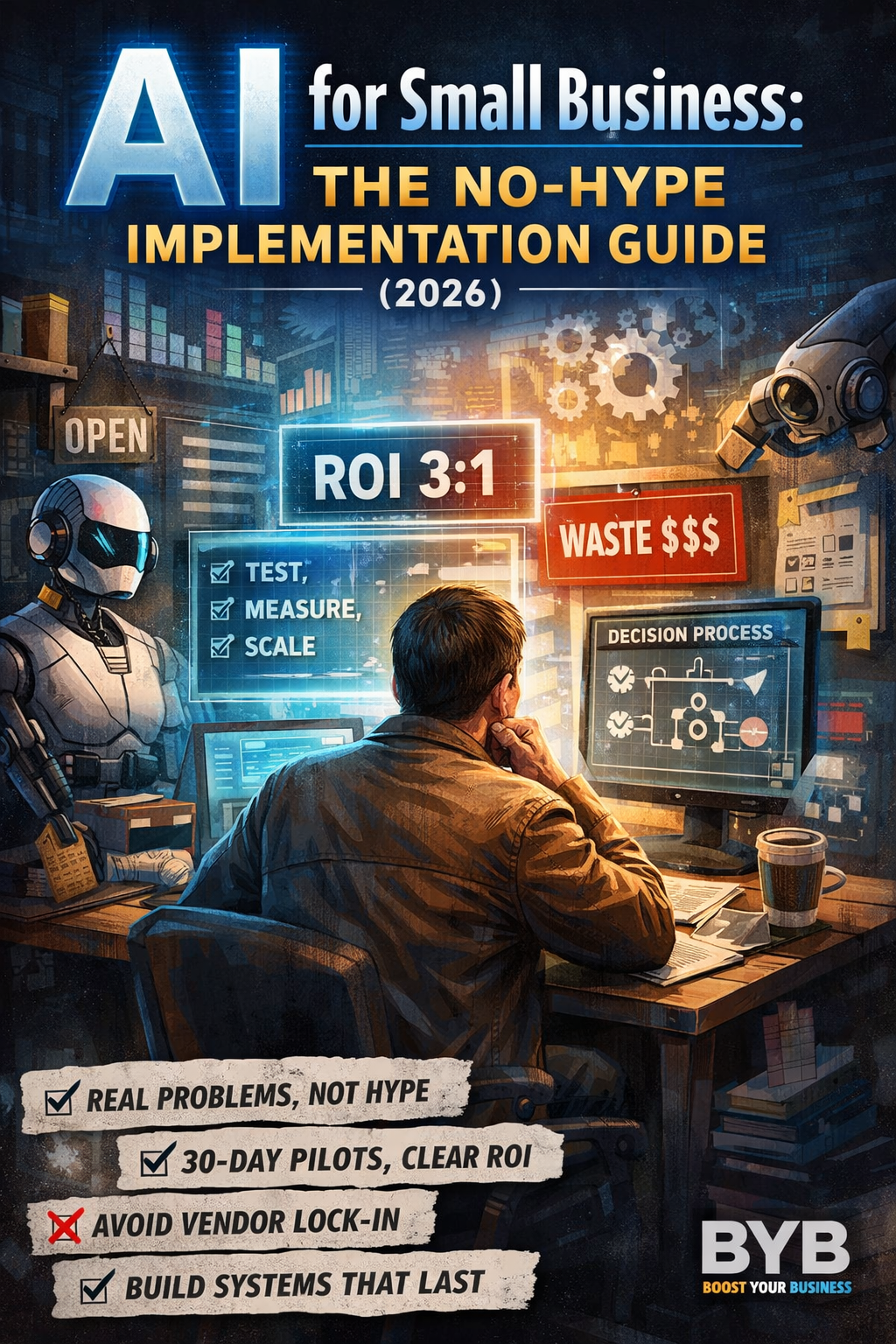
- Identify high-repetition, low-judgment tasks — Where AI actually works
- Start small, measure obsessively — 30-day pilots with clear ROI
- Prioritize transparency and control — Avoid vendor lock-in
- Build systems, not tool collections — Process beats software
- When to use AI (and when to ignore hype) — Decision framework
AI accelerates execution. If your process is broken, AI will just automate that failure at scale.
Why Most Small Businesses Fail at AI Implementation
Small business owners are being sold an exaggerated promise: that AI adoption is mandatory for survival. It’s not. What’s mandatory is solving real problems. AI is one tool among many.
Most founders skip diagnosis and jump to prescription because they’re terrified of looking outdated. They see a competitor using ChatGPT for customer service and panic. Within 48 hours, they’ve signed up for a $500/month AI platform without asking critical questions:
Is our customer service problem about response time, or about having a broken product that generates support tickets faster than we can answer them?
You’re not buying a solution. You’re buying the appearance of innovation.
When Fortune 500 companies burn $10 million on failed AI initiatives, it’s a rounding error. When you spend $50,000 on AI tools that don’t move metrics, that’s the difference between surviving and shutting down.
The pattern: See headlines. Attend webinar. Buy tool. Assign someone to “figure it out.” Six months later, subscription auto-renews for software that solved nothing. You’re paying to feel less anxious about being left behind, not to solve actual problems.
If you don’t know what problem you’re solving, you can’t evaluate whether AI is the right solution.
The Control Problem: Exit Ability Matters More Than Ownership
Most AI adoption fails because founders confuse buying tools with building systems. A tool is software you purchase. A system is a process you design, test, and iterate.
AI tools promise to “automate customer support” or “optimize marketing.” What they actually do is execute whatever instructions you give them. If your instructions are unclear, your process is broken, or your data is garbage, AI will faithfully automate that chaos.
The Real Risk
The real risk isn’t that AI won’t work—it’s that you won’t control how it works.
Most AI solutions are centralized black boxes. You use the tool, but vendors control pricing, behavior, and access. They can change terms without warning. You’re responsible for outcomes, but you don’t control the system generating them.
Scenario breakdown:
- Customer gets bad AI response → They blame you, not the vendor
- Tool doubles in price next quarter → You either pay or rebuild
- Model behavior changes after update → You have no visibility into why
You’re building critical operations on infrastructure you don’t own. That’s governance risk.
For more on how dependencies kill businesses, see why small businesses fail—most collapse from outsourcing control over critical operations.
Step 1: Identify High-Repetition, Low-Judgment Tasks
AI for small business works best on tasks that are repetitive, rule-based, and don’t require nuanced judgment.
Most founders skip this filter entirely. They throw AI at everything. Customer complaints? AI chatbot. Strategic planning? AI analysis. Hiring decisions? AI screening.
You’re not automating intelligently. You’re abdicating responsibility to software that can’t distinguish between good decisions and plausible-sounding ones.
Good AI Use Cases for Small Business
✅ Transcribing sales calls or customer interviews — Pattern recognition, no judgment
✅ Generating first-draft marketing copy from templates — Accelerates production, human refines
✅ Sorting and categorizing support tickets — Rule-based triage
✅ Scheduling social media posts — Calendar automation
✅ Extracting data from invoices — Data entry replacement
Bad AI Use Cases
❌ Making strategic business decisions — AI can’t understand market positioning
❌ Handling complex customer complaints — Requires empathy AI lacks
❌ Creating original brand positioning — AI regurgitates patterns, doesn’t create differentiation
❌ Negotiating contracts — Can’t read power dynamics
❌ Hiring decisions — Optimizes for keywords, not judgment
The pattern: Repetitive execution versus strategic judgment. AI accelerates the first. It destroys the second.
Step 2: Start Small, Measure Obsessively
Don’t buy enterprise AI tools and deploy them across your operation. Pick one specific, measurable problem and test whether AI improves it.
Wrong Approach (Too Broad)
Example: “We’re going to use AI for marketing.”
❌ No scope, no metric, no measurement
Correct Approach (Specific + Measurable)
Example: “We’re going to use AI to generate 20 social media post drafts per week, which currently takes 5 hours. Success = same quality in under 2 hours.”
✅ Clear before/after
✅ Time saved = measurable
✅ Quality maintained = verifiable
The 30-Day Pilot Framework
Week 1: Baseline
Document current process (time, cost, quality). Define success metrics.
Week 2-3: Implementation
Deploy AI tool on limited scope. Track time, cost, error rate daily.
Week 4: Decision
Compare results to baseline. Calculate value created (time saved × hourly rate) and tool cost.
If value created doesn’t materially exceed cost → Kill it
If ROI is clearly positive → Expand gradually
Run this pilot before committing to annual subscriptions. If you can’t measure impact, you can’t tell if it’s working.
Step 3: Prioritize Transparency and Control
When evaluating AI tools, ask these questions before buying:
Critical Vendor Questions
Can you inspect how decisions are made?
If the AI is a black box, you’re taking on unmanageable risk. When something goes wrong, you can’t fix it—you can only complain to support.
Can you switch vendors without rebuilding?
If locked into proprietary formats, you’re building dependency. Price increases or term changes leave you trapped—either pay or rebuild from scratch. Both are expensive.
Who owns the data you feed into the system?
Some tools train models on your inputs. Your customer data or proprietary information could improve competitors’ experience with the same tool.
What happens if the vendor shuts down or gets acquired?
Startups get acquired. Features get deprecated. If core operations depend on a tool that could disappear, you need a contingency plan.
The Vendor Lock-In Test
Before committing:
- Can I export data in standard formats?
- Are there alternatives with similar capabilities?
- What’s my switching cost?
- Do I own the AI output?
If answers are “no,” “unclear,” “very high,” or “complicated”—walk away.
For more on operations that don’t collapse when vendors change terms, see business process optimization.
Step 4: Build Systems, Not Tool Collections
AI tools are commodities. Your competitors have exact same access. Competitive advantage doesn’t come from access to tools—it comes from how you use them.
Most founders collect AI subscriptions and wonder why nothing transforms. You have seven AI tools and zero AI strategy. That’s a spending problem disguised as innovation.
What a Real System Looks Like
A system is a repeatable process that uses AI as one component:
System Components:
- Clear inputs (what data goes in)
- Defined logic (how decisions are made)
- Human checkpoints (where judgment is required)
- Feedback loops (how quality is maintained)
Example: Content Production System
Instead of “using AI for content”:
Step 1: AI generates 10 headline options from keyword research
Step 2: Human editor selects best 3, refines them
Step 3: AI writes first draft from outline
Step 4: Human editor rewrites for brand voice and accuracy
Step 5: AI checks grammar, readability, SEO
Step 6: Human approves final version
AI accelerates production. Humans maintain quality. If the tool changes, you swap it out without breaking the system. The system is the asset. The tool is replaceable.
Step 5: When to Use AI (And When to Ignore Hype)
Not every problem needs AI. Most don’t. Here’s the decision framework.
Use AI When:
✅ You have volume problems, not strategy problems
Drowning in repetitive work? AI can help. Don’t know what to prioritize or how to position your product? AI won’t solve that.
✅ The task has clear success criteria
“Generate 50 social media captions” is measurable. “Make our brand more engaging” is not.
✅ Mistakes are cheap to catch and fix
AI-generated email typo? Catchable. AI pricing decision that loses a major client? Damage done.
✅ You’re already good at the task manually
AI amplifies existing capability. Terrible writer? AI won’t make you great—it’ll produce bad content faster.
Ignore AI When:
❌ You don’t understand the problem
AI can’t diagnose your business. Not sure why customers churn or sales are down? Adding AI automates confusion.
❌ The tool costs more than the problem
Tool saving 2 hours/week at $300/month = $150/hour for automation. Is your time worth more? If not, do it manually.
❌ The vendor can’t explain how it works
“Our AI uses advanced algorithms” without specifics = vaporware.
❌ You’re adopting because competitors are
Competitive paranoia isn’t strategy. Your competitors might be wasting money too.
For deeper analysis, see can AI replace employees—most founders overestimate AI capabilities and underestimate human judgment.
Common AI Implementation Mistakes
Mistake 1: Buying Tools Before Defining Workflows
You can’t automate a process that doesn’t exist. Most small businesses don’t have workflows—they have chaos.
If you layer AI onto chaos, you get automated chaos. Faster, more expensive chaos.
Before buying AI:
- Document current process (every step)
- Map bottlenecks (where delays occur)
- Identify which specific step AI would improve
- If you can’t answer in one sentence → you’re not ready
Mistake 2: Trusting AI Output Without Human Review
AI makes mistakes. It hallucinates facts. It misinterprets context. It generates plausible-sounding nonsense.
Every AI output needs a human checkpoint. No exceptions.
Mistake 3: Ignoring Training Data Context
AI models inherit biases and gaps from training data. General-purpose tools trained on mainstream data often fail in niche contexts.
Customer service AI trained on e-commerce bombs in B2B services. Marketing AI trained on consumer brands generates tone-deaf messaging for professional services.
If your business operates in a specialized market, general AI tools will underperform.
The 90-Day Implementation Timeline
Consolidating all action steps into one coherent timeline:
Days 1-7: Audit & Prioritize
- List all repetitive tasks consuming 5+ hours/week
- Identify which are rule-based vs judgment-based
- Calculate current cost (hours × hourly rate)
- Select ONE task for pilot
- Define success metric
Days 8-14: Research & Setup
- Research 3 AI tools for your specific task
- Check vendor transparency (APIs, data ownership)
- Calculate switching costs
- Start free trial (avoid annual commitments)
- Document baseline metrics
Days 15-37: Pilot & Measure
- Deploy AI on limited scope
- Track daily: time, quality, error rate
- Collect team feedback
- Compare to baseline weekly
- Adjust process based on results
Days 38-90: Decision & Scale
- Calculate ROI ratio: (Value created / Tool cost)
- If ROI ratio 3:1 or better (tool generates 3× its cost in value) → Expand to full implementation
- If ROI ratio under 3:1 → Kill it, document lessons
- If expanding: build system around tool (not dependency on tool)
- Plan next pilot for different task
Note on ROI calculation: Value created = (Hours saved per month × Your hourly rate). For example, if a $300/month tool saves 10 hours/week and your time is worth $50/hour, that’s $2,000/month value created. ROI ratio = $2,000 / $300 = 6.7:1 (strong positive ROI).
Why 3:1 minimum? This ratio is a buffer against customer churn, implementation drag, and vendor price hikes. Lower ratios look profitable on paper but collapse when real-world friction hits.
Execute or Ignore—But Don’t Pretend
Between 2026 and 2029, corporations will spend over $1 trillion on AI. Winners won’t be those who spent the most. They’ll be those who spent strategically—on specific, measurable problems where AI genuinely created value.
Expect a graveyard of expired subscriptions, abandoned pilots, and expensive lessons about the difference between hype and utility. The difference won’t be the technology. It’ll be the clarity of thinking that determined when to use it—and the courage to walk away when it was wrong.
Make sure you’re amplifying something worth scaling. Or don’t use AI at all. Sometimes the best AI strategy is admitting you don’t need it yet.
The market doesn’t reward AI adoption. It rewards solving problems efficiently.
For more on building sustainable advantages, see how to get rich: own assets, not jobs.
Frequently Asked Questions
What AI tools should small businesses start with? Begin with general-purpose tools offering free tiers or low-cost entry plans: conversational AI platforms for content drafting, workflow automation tools for connecting apps, and transcription services for meetings. Test free versions for 30 days, measure impact on specific tasks, then decide on paid plans based on actual ROI—not feature lists or competitor adoption.
How much should a small business spend on AI? Calculate based on ROI ratio, not budget percentage. If a tool saves 10 hours/week and your time is worth $50/hour, that’s $2,000/month value. A tool costing $300/month has 6.7:1 ROI (strong positive). If it saves 2 hours/week, you’re generating $400/month value for $300/month cost—1.3:1 ROI (marginal). Target minimum 3:1 ROI ratio before committing to paid plans.
Can AI replace employees in small business? AI replaces tasks, not employees. It handles repetitive, rule-based work—data entry, transcription, first-draft content. It fails at strategic judgment, complex problem-solving, emotional intelligence, and relationship building. Use AI to free employees from repetitive tasks so they focus on high-judgment work. Don’t eliminate headcount and expect AI to fill the gap.
How do I know if my business is ready for AI? You’re ready if: (1) You have documented, repeatable processes, (2) You can define success metrics objectively, (3) You have 5+ hours/week of rule-based tasks, (4) You’re already competent at the task manually. You’re NOT ready if you can’t explain your current workflow, don’t know what “success” looks like, or expect AI to diagnose your problems.
What’s the biggest mistake small businesses make with AI? Buying tools before defining workflows. Most businesses don’t have processes—they have chaos. Layering AI onto chaos creates automated chaos. Document your current process first (every step, every decision point), identify bottlenecks, then determine which specific step AI would improve. If you can’t answer in one sentence, you need process consulting, not AI tools.
How long should I test AI before committing? 30-90 days depending on task complexity. Simple use cases (transcription, data extraction) should show measurable improvement within 30 days. If you don’t see results—time saved, costs reduced, quality maintained—within 90 days, kill the pilot and try a different approach. Small business tactical deployments should show results fast or fail fast.
Leave a Reply