

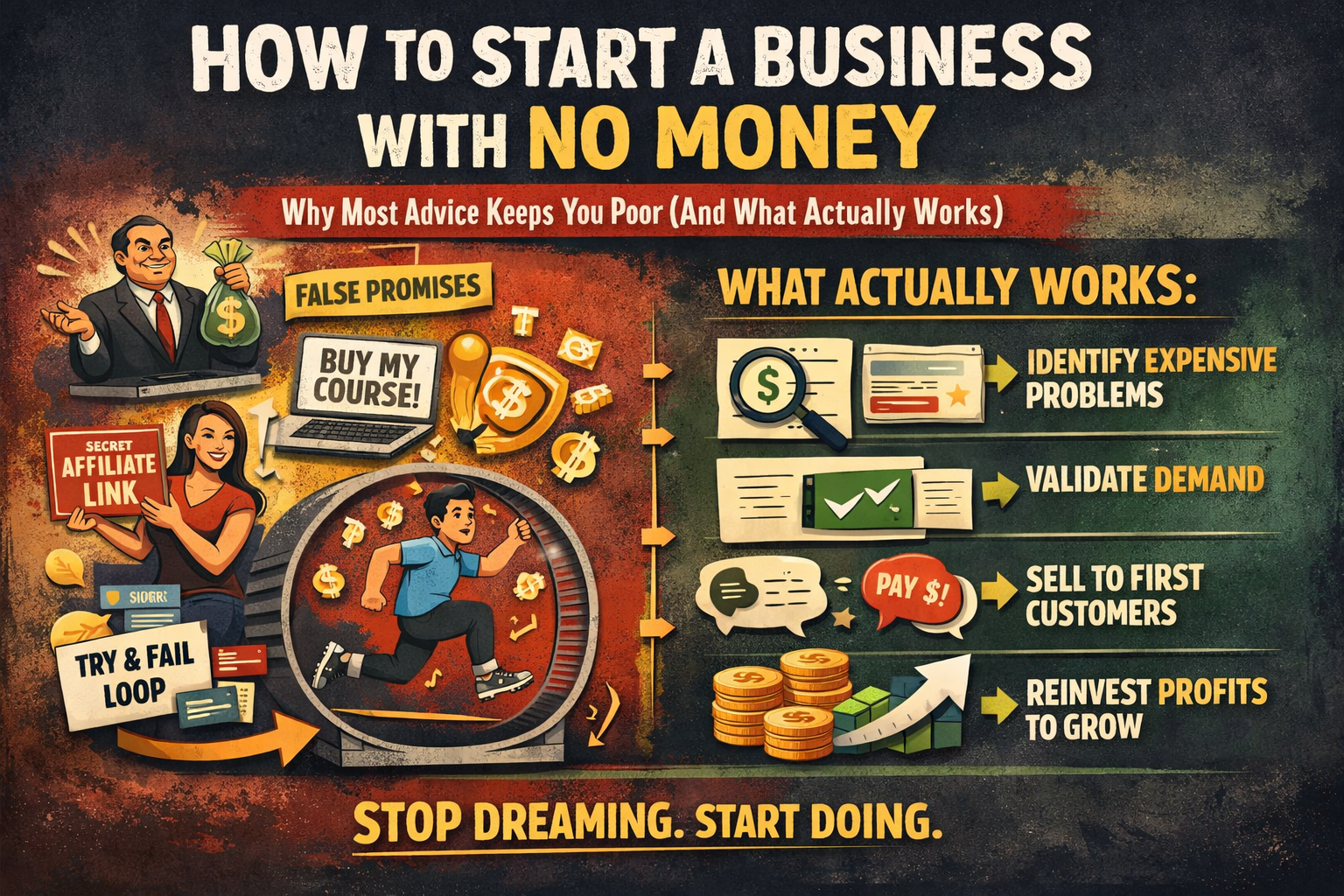
Starting a business with no money is possible, but most advice online is incomplete, or worse, designed to keep you stuck rather than help you escape.
The people teaching you to start with no money already made theirs. From you. Search the phrase right now. Count the affiliate links. Count the course promotions. Count the SaaS partnerships. Every result monetizes your desperation before you launch anything.
They don’t make money when you succeed. They make money when you try.
The system isn’t broken. It’s working exactly as designed. Your repeated failure funds their business model.
What Does “Starting a Business with No Money” Actually Mean?
Starting a business with no money means launching using existing skills, free tools, and business models that generate revenue before requiring upfront investment, typically under $100-500 total.
In 2026, platforms like Upwork, Fiverr, and Gumroad eliminate traditional barriers. Anyone can launch. The barrier isn’t capital. The barrier is validation, skill, and execution discipline most people avoid.
The models that work share three characteristics: they leverage expertise you already have, they allow manual delivery to first customers before building systems, and they generate revenue within weeks if the skill exists and demand is validated.
What doesn’t work: models requiring inventory, manufacturing, unique products without differentiation strategy, or distribution you don’t have. Most “no money” advice recommends exactly these models because they generate the most affiliate commissions and course sales.
Why Most “No Money” Business Advice Fails
According to startup research data, over 90% of new businesses fail within the first few years. Not because of capital shortage, but because of lack of product-market fit and customer validation.
The course seller needs you to fail and retry, not succeed once. Your failure is three course purchases. Your success is one. The math favors your poverty.
The platform needs your free content. You “build in public” documenting your journey. They monetize your attention through ads while you get 47 views. Your poverty creates engagement. Engagement creates their revenue.
The SaaS tool needs you dependent. Free tier hooks you. Three months building. $200 total revenue. Sunk cost keeps you paying $29/month while losing money. They don’t need you profitable. They need you believing you’re “almost there.”
The affiliate marketer needs your signup, not your success. Your three-month failure generates commission. Your retry generates another. Your attempt is the product.
You’re not building a business. You’re generating commissions.
The loop: You search. Find guide. Guide recommends model. Model requires platform. Commission paid. You fail in three months. Search again. Different guide. Different model. Different platform. Different commission. Same outcome.
The ecosystem doesn’t fail when you fail. It succeeds because you retry.
Business Models That Actually Work With No Money
Three models work if you execute correctly. Several models are commonly recommended but only work under specific conditions most beginners don’t have.
Service-based businesses (consulting, coaching, specialized services)
Works if you can solve a $5,000 problem for someone. They’ll pay you $1,000 to solve it. You don’t need capital. You need a skill worth buying. Revenue in days if the skill exists.
Launch on Upwork or Fiverr. If you can’t get clients at $100+/hour within two weeks, you don’t have a marketable skill yet.
Without clear positioning, your services become commodity competition charging poverty rates. This is where most service businesses fail before they start.
Skill-based digital products (courses, templates, tools)
Works if you understand a problem deeply enough that people will pay to learn your solution. Not surface understanding. Deep expertise from solving that problem repeatedly.
Build on Gumroad. Pre-sell to ten people before building anything. If you can’t get ten pre-orders, demand doesn’t exist. Don’t build it.
Niche content businesses (YouTube, newsletter, specialized community)
Works if you can produce genuinely valuable content consistently and understand what people search for. Platform algorithms reward search relevance, not posting frequency. Most creators fail because they optimize for the wrong metric.
Understanding effective social media strategy means knowing what your audience searches for, not what you want to post about.
Timeline: 6-12 months to monetization. Month one revenue: $0. Choose this only if you can survive a year without income.
Models commonly recommended (but only work with unfair advantages):
Dropshipping requires unique positioning most beginners lack. Industry data shows the average dropshipping business earns less than $1,000/month after expenses, with failure rates exceeding 90% in the first year. You’re competing with 50,000 others using same suppliers. Without differentiated products or brand, you’re in commodity hell making $4 profit per sale.
Affiliate marketing requires existing traffic. Traffic takes 12 months to build. Month six revenue: $60. Can’t reinvest. Can’t quit after investing six months. Trapped.
These models work for people with established audiences, unique product access, or significant marketing budgets. They fail for true beginners starting from zero.
How to Start a Business with No Money (Step-by-Step)
Here’s what actually works. No theories. No motivational nonsense. Just the process that generates revenue without capital.
Step 1: Identify expensive problems people currently pay to solve
Find problems where people spend $500+ trying to solve them. If nobody pays for solutions, it’s not a problem worth solving commercially.
Talk to ten people in your target market. Ask what their biggest problem is. Ask what they currently pay to solve it. Ask what’s inadequate about current solutions. If seven or more describe the same expensive problem, you have signal.
Step 2: Validate they’ll pay you specifically
Build the simplest possible test. One landing page explaining your solution. Three bullets describing value. “Buy Now” or “Join Waitlist” button.
Drive 100 real people to it from Reddit, LinkedIn, communities where your audience exists. If 5+ people click your button, demand exists for your specific solution. If zero clicks, your messaging is broken or demand is weak.
Step 3: Sell manually to first 3-5 customers before building systems
Reach out directly to people who expressed interest. If offering consulting, sell three sessions at $100-200 each. If creating a course, sell five spots for live delivery. If building a product, take pre-orders.
Deliver manually. No automation. No perfect execution. Just solve their problem and collect payment through PayPal or Stripe. This proves people actually pay, not just express interest.
Step 4: Build minimum version based on what you sold
Document your process from manual delivery. Create templates or frameworks you used. Package it into repeatable version.
Use free tools only: Notion, Canva, Gmail, Stripe. You’re building something repeatable, not perfect.
Step 5: Use revenue to fund growth
Reinvest 50% of early revenue into what’s working. Paid traffic to landing page. Better tools. Hiring someone to handle validated tasks.
If you can’t reinvest 50%, you’re not charging enough or your lifestyle costs need cutting.
Step 6: Hire to escape solopreneur poverty
Once you hit $2,000-3,000/month revenue, hire someone to handle repeatable tasks. Customer service. Content creation. Admin work.
Staying solo past this point isn’t scrappy. It’s stupid. You’re optimizing for control instead of growth.
Quick Start Framework: First 30 Days
Week 1: Pick one model where you have existing skill. Talk to 10 potential customers. Validate problem is expensive enough they currently pay for solutions.
Week 2: Build simple landing page. Drive 50-100 people to it. If 3-5 click “buy,” sell manually to them. Deliver the thing. Collect payment.
Week 3: Document what you delivered. Create minimum repeatable version. Set up basic infrastructure using free tools.
Week 4: Reach out to 20 more potential customers. Sell to 2-3 more. Use revenue to improve what’s working.
This is the exact sequence that generates revenue without capital if you execute.
The Skill Gap Most People Avoid Confronting
If you can’t charge $100/hour for something you currently do, you don’t have a business opportunity. You have a skill gap pretending to be a capital problem.
Most people avoid this by choosing models that feel like business but deliver nothing. Dropshipping feels like entrepreneurship. Posting content feels productive. None of it is business. It’s avoidance.
Real business solves expensive problems people currently pay to solve. If nobody spends money on your problem, it’s not a problem. It’s a preference. Preferences don’t generate revenue.
The honest answer: you probably need skills before a business. Six months learning a marketable skill pays better than six months launching models designed to fail.
But learning is boring. Launching is exciting. You choose excitement. Then confusion about poverty.
Common Mistakes That Keep You Trapped
Validation avoidance is the core mistake. You avoid customer conversations because conversations reveal if your idea is worthless. Learning your idea is worthless is psychologically devastating. So you build for three months without talking to anyone.
Launch to silence. Now failure is “market timing” or “algorithm changes.” Anything except truth: your idea was never validated.
Validation avoidance is fear of confronting irrelevance.
Price competition happens because you lack positioning. Positioning requires understanding customers deeply enough to articulate unique value. That understanding needs conversations. You skipped them. No differentiation means commodity status means price competition.
Price competition is intellectual laziness disguised as strategy.
Staying solo past validation happens because delegation needs clear processes. Processes need knowing what works. Knowing what works needs testing with real customers. You avoided that conversation. So you stay trapped doing everything yourself.
What You’re Actually Choosing
You’re choosing between confronting reality and performing entrepreneurship.
Confronting reality: Find ten people paying to solve your problem. Validate they’ll pay you. Build minimum version. Sell manually. Use revenue for systems. Hire to scale.
Performing entrepreneurship: Skip conversations. Choose low-barrier model. Build three months without customers. Launch to silence. Compete on price. Do everything alone. Make $300/month after six months. Can’t reinvest. Can’t quit. Try different model. Same outcome.
Time compounds both directions. Six months validating and building on confirmed demand creates foundation. Six months launching unvalidated ideas creates graveyard of failures.
If you want to start a business with no money, this is the only path that consistently works. Everything else is performance theater funded by the bootstrap industrial complex.
Building in public while broke isn’t transparency. It’s poverty with an audience.
Leave a Reply