

You’re not using AI because it saves money. You’re using it because you’re terrified of looking outdated.
That $500/month “AI-powered marketing platform” isn’t automating anything you couldn’t do with a $20 Zapier subscription and two hours of setup. That chatbot that cost you three days to configure is answering the same five questions a FAQ page would handle for free. That content generator producing dozens of posts? Much of it sounds indistinguishable from what your competitors’ bots are generating.
You’re not building competitive advantage. You’re paying a monthly subscription to anxiety about being left behind.
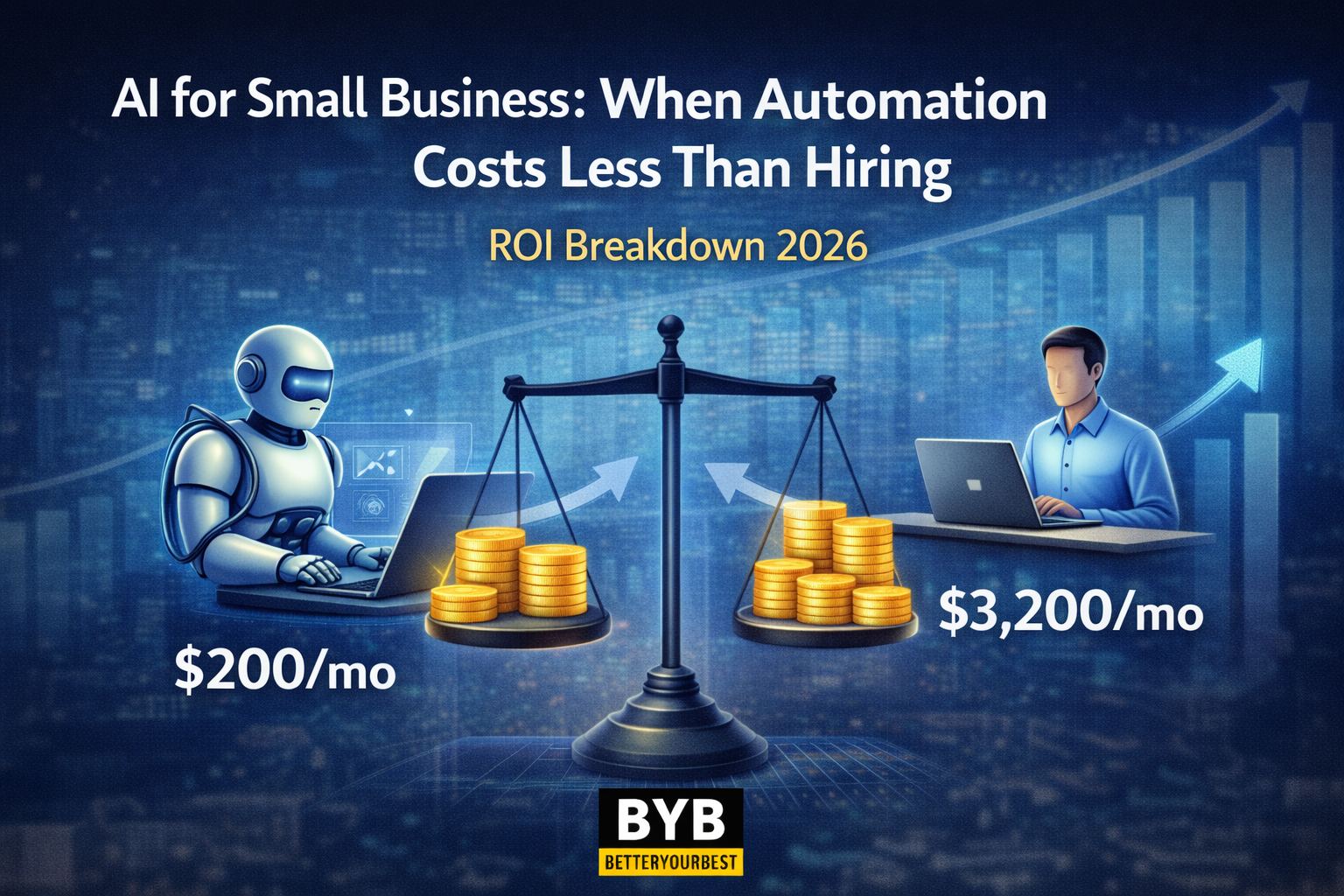
Here’s the part nobody wants to hear: most small businesses waste more money adopting AI than they’d spend just hiring someone to do the work. A $200/month tool that requires 10 hours per week to manage costs more than a part-time employee. And the employee won’t hallucinate facts, generate off-brand content, or require you to review every output before it goes live.
AI for small business isn’t a transformation. It’s a cost-reduction calculation. And if you’re not running that calculation before you buy, you’re not innovating — you’re just burning cash on software you don’t understand.
The Real Cost of AI vs Hiring Someone (And Why Most Founders Get This Wrong)
When you see “$50/month AI tool,” you think you’re saving money compared to hiring. You’re not doing the full math.
What Hiring Actually Costs
A $15/hour employee doesn’t cost $15/hour. The real cost:
- Payroll taxes: +7.65% minimum (FICA)
- Workers comp insurance: +1–5% depending on state
- Benefits if offered: health insurance, PTO, retirement match
- Training: 20–40 hours for basic roles
- Management overhead: supervising, reviewing work, handling issues
Real cost: $20–$23/hour all-in. A full-time hire at $15/hour ($31,200 salary) costs $38,000–$45,000/year. That’s $3,200–$3,750/month for 160 hours of work.
For more on calculating true labor costs and managing business finances, see small business financial management.
What AI Actually Costs (The Expenses Vendors Don’t Mention)
That $50/month tool? Add:
- Setup time: 10–40 hours configuring, connecting systems, training your team
- Ongoing management: 2–10 hours per week reviewing outputs, fixing errors, updating prompts
- Error correction: Time spent catching mistakes before they reach customers
- Quality control: Editing AI-generated content so it doesn’t sound generic
- Vendor switching costs: If it doesn’t work, you lose setup time and start over
A $200/month tool requiring 5 hours of weekly management costs $200 + (20 hours × your hourly rate). If your time is worth $50/hour, total cost is $1,200/month — not $200.
The Break-Even Reality
AI saves money when: (Tool cost + management time) < Human labor cost for same task
Example — Customer Support:
- Human: $18/hour × 40 hours/week = $3,120/month
- AI chatbot: $80/month + 5 hours/week management at $40/hour = $880/month
- Savings: $2,240/month (if it handles 70%+ adequately)
Example — Content Writing:
- Freelancer: $100/article × 8 articles = $800/month
- AI: $20/month + 3 hours editing per article at $60/hour = $1,460/month
- Loss: $660/month (editing time negates savings)
The pattern: AI wins on high-volume repetition. Humans win when output quality varies and needs heavy oversight.
If you’re spending more time managing the AI than you’d spend doing the task yourself, you’ve automated nothing. You’ve just added complexity.
AI vs Hiring: When Automation Costs Less (And When It Doesn’t)
When AI Beats Human Cost
High-volume data entry and processing
Moving data between systems, extracting invoice details, updating spreadsheets. Humans cost $400–$500/month for 5 hours per week. Automation: $20–$100/month.
Break-even: 10+ hours/month of repetitive data work.
Repetitive customer support questions
“What are your hours?” “How do I reset my password?” “Where’s my order?” 60–80% of tickets are variations of the same 10 questions. AI handles these 24/7 for $50–$200/month. Humans cost $15–$25/hour.
Break-even: 50+ monthly inquiries where 60%+ are repetitive.
Meeting transcription
Human transcriptionists: $1–$3/minute. AI: $10–$30/month unlimited. Five hours of weekly meetings cost $1,200–$3,600/month with humans. $30/month with AI.
Break-even: 2+ hours/week of meetings needing documentation.
Social media execution (not strategy)
Scheduling posts, generating caption variations, cross-posting to platforms. Social media managers: $2,000–$4,000/month. Scheduling tools: $20–$100/month.
Break-even: 10+ posts/week across multiple platforms.
When Humans Win (And Why AI Is More Expensive)
Complex customer issues requiring empathy
Angry customer with a damaged product threatening to leave. Upset client whose project is delayed. AI generates scripted responses that escalate situations. Humans read emotional state and preserve relationships.
The cost: Losing one $5,000/year client because AI mishandled a complaint costs more than a year of human support.
Strategic decisions
Which market to enter, how to price, who to hire, when to pivot. AI can’t read competitive dynamics or make trade-off decisions. It generates plausible analysis based on patterns, not insight.
The cost: One bad strategic decision costs more than a decade of consulting fees.
For more on building decision-making processes that don’t rely on guesswork, see business process optimization.
Sales conversations
Closing deals, reading unstated objections, building trust, negotiating terms. AI drafts follow-ups. Humans close $50,000 contracts.
The cost: A good salesperson generates 5–10x their salary in revenue. AI doesn’t close deals.
Creative work requiring differentiation
Brand positioning, campaign concepts, messaging that stands out. AI recombines existing patterns. If you want content that sounds like everyone else, use AI. If you want to be different, hire a human.
The cost: Generic AI content often underperforms significantly compared to good human copy. You lose money even though the tool was cheaper.
The AI Tools Worth Using (And the Ones Burning Your Money)
Most AI tools are expensive solutions to problems you don’t have. These are the exceptions.
Tier 1: High-ROI Automation ($10–$50/month)
Zapier or Make ($20–$50/month) — Connects apps, automates data flow between systems.
Break-even: Using 3+ tools and manually copying data between them.
Otter.ai or Fireflies.ai ($10–$30/month) — Auto-transcribes meetings into searchable text.
Break-even: 3+ hours of weekly meetings that need documentation.
Expensify or Dext ($10–$30/month) — Scans receipts, extracts data, syncs to accounting.
Break-even: 20+ monthly expenses to track manually.
Tier 2: Content and Communication ($20–$200/month)
ChatGPT Plus or Claude Pro ($20/month) — Drafts emails, outlines, social captions. Requires editing before publishing.
Break-even: Creating 10+ pieces of content weekly.
Tidio or Intercom ($50–$200/month) — Chatbot for FAQs and lead collection. Monitor weekly and update responses.
Break-even: 100+ monthly inquiries where most are repetitive.
Canva Pro ($13/month) — AI image generation and design automation.
Break-even: Creating 5+ graphics weekly without a designer.
Tools to Avoid (Expensive Theater)
“AI-powered CRM” ($100–$300/month premiums)
Your CRM doesn’t need AI. It needs consistent use. Most “AI features” are analytics you won’t act on or data entry Zapier handles for $20/month.
“AI business plan generators” ($50–$200)
Generic frameworks filled with assumptions. Investors see through this. If you won’t write your own plan, you shouldn’t raise capital.
“All-in-one AI platforms” ($200–$500/month)
Promise CRM + email + social + analytics. Do all of it poorly. Specialized tools that do one thing well always beat mediocre everything.
How to Calculate If a Tool Actually Saves Money (The Formula Vendors Hide)
Before buying any AI tool:
Step 1: Current human cost
Hours per week on task: ___ × 4.3 × hourly rate = monthly cost
Step 2: AI tool cost
Monthly subscription + (setup hours ÷ 12) + (weekly management hours × 4.3 × your rate) = total monthly cost
Step 3: Net savings
Human cost − AI cost = monthly savings
Setup cost ÷ monthly savings = break-even months
Adopt if: Monthly savings >50% AND break-even <6 months
Skip if: Monthly savings <30% OR break-even >12 months
The Adoption Sequence: What to Automate First
Don’t buy five tools at once. Implement sequentially, measure, then advance.
Month 1: Data automation (Zapier). Connect most-used apps. Success: 5+ hours/week saved.
Month 2: Meeting docs (Otter.ai). Transcribe all calls. Success: Zero note-taking time.
Month 3: Content drafting (ChatGPT). Generate first drafts. Success: 50% faster to draft.
Month 4: Customer support (chatbot). Handle FAQs. Success: 60%+ simple inquiries automated.
Pause. If all four deliver ROI (save more than subscription + management time), continue. If any don’t perform, kill before adding more.
Month 6+: Add specialized tools only if basics work and you’ve hit capacity.
When Paying a Human Is Still Cheaper (And Smarter)
AI isn’t always the answer. Hire instead when:
The task requires judgment under ambiguity. Strategic decisions, hiring, conflict resolution, escalations need humans. AI provides data. Humans make calls.
Quality matters more than speed. Bad output loses customers. A poorly worded email kills a deal. A transcription error is fixable.
Volume is too low. If a task takes 2 hours/month, setup costs more than doing it manually.
Processes aren’t documented. You can’t automate chaos. If your workflow is “we figure it out,” document first.
Vendor lock-in is unacceptable. Some tools trap you with proprietary formats. Switching becomes catastrophic. Human flexibility retains options.
The Ego Trap: Why Founders Buy AI They Don’t Need
Most small businesses don’t adopt AI because it saves money. They adopt it because competitors are adopting it, and they’re terrified of being left behind.
You see a competitor using ChatGPT for content. Panic sets in. Within 48 hours you’ve subscribed to three AI tools without asking: do we have a content volume problem, or do we have a content quality problem? If it’s quality, AI makes it worse. If it’s volume and you’re publishing 5 posts per week, you don’t need AI — you need consistency.
But consistency doesn’t feel like innovation. Buying software does.
You’re not automating. You’re performing innovation.
The businesses winning with AI aren’t the ones with the most tools. They’re the ones using automation strategically — on specific, high-volume tasks where the math works and quality doesn’t suffer. They automated data entry first, not strategy. Meeting transcription before creative work. Invoice processing before brand positioning.
They calculated break-even before they bought. They measured results after deployment. And when a tool didn’t deliver ROI, they killed it without guilt.
For more on why adopting tools without measuring results destroys businesses, see why small businesses fail.
AI doesn’t replace judgment. It accelerates execution.
If you’re buying tools to feel less anxious about being outdated, you’re wasting money. If you’re calculating cost per task and automating where math favors machines, you’re building leverage.
Most founders are doing the first while telling themselves they’re doing the second.
If you can’t calculate the ROI, you’re not automating — you’re donating to SaaS companies.
Leave a Reply