
You are searching for how to build passive income because you have identified a structural flaw in your life:
Trading time for money is a losing game.
You do not need “passive income ideas.”
You need a machine that generates revenue without your physical presence.
However, the internet is polluted with inefficiency.
Search for this topic, and you find lists suggesting you “drive for ride-share apps,” “take surveys,” or “start freelancing.”
Let’s be clear: That is not passive income.
- If you stop driving, the revenue hits zero.
- If you stop typing, the invoices stop.
- If you get sick, your cash flow evaporates.
That is just a second job with a worse boss.
True passive income is mechanical. It is disconnected from your labor. It pays you because you own a valuable asset, not because you are currently sweating.
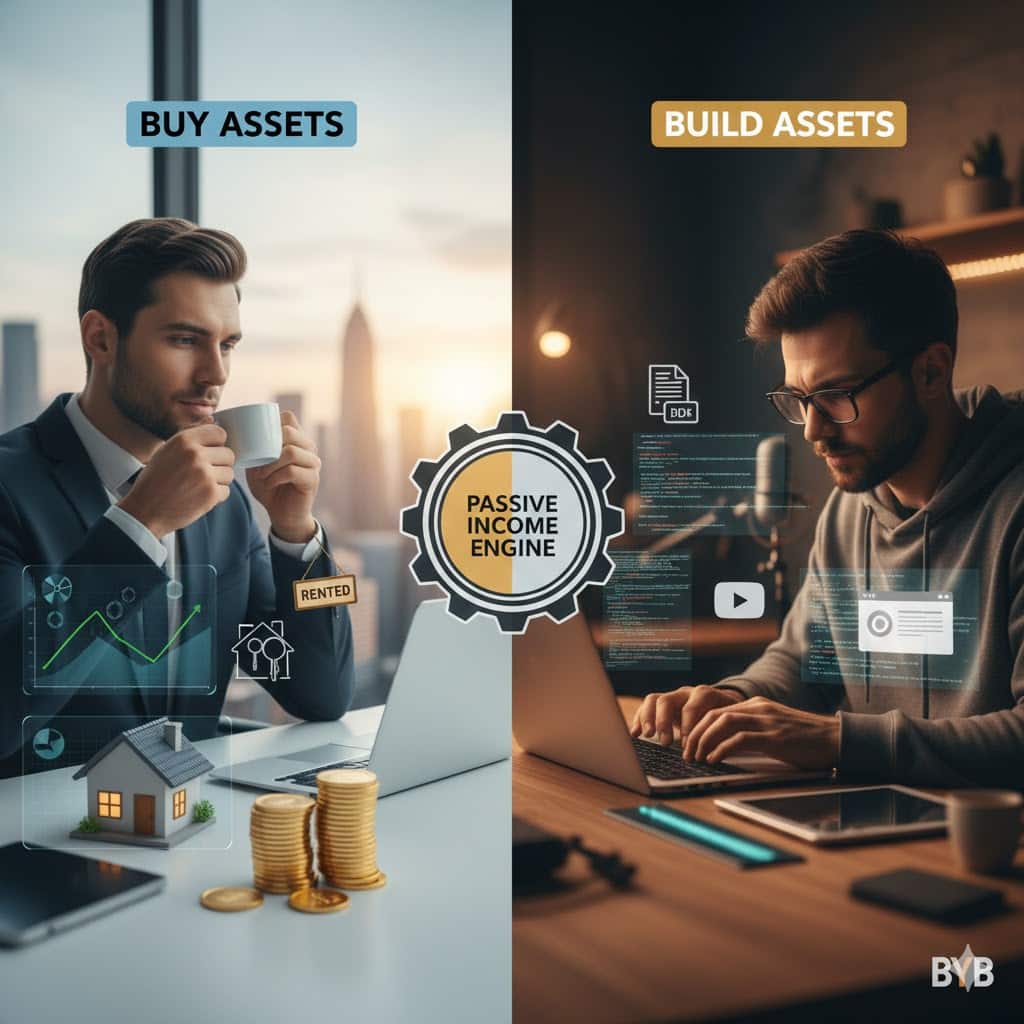
There are only two ways to acquire these assets:
- The Buy Strategy: You use Capital to purchase existing cash flow.
- The Build Strategy: You use Skill and Time to create new cash flow.
This guide is the operational blueprint for exiting the labor market.
What Is Passive Income? (The Coma Test)
Before discussing strategy, we must define the objective. How do you distinguish a “Side Hustle” from a “Passive Asset”?
Apply the Coma Test.
If you fell into a coma today and woke up in 12 months:
- Would the money still be accumulating in your bank account?
- Would the business still be operational?
- Freelancing: No. Clients left. (Active Job)
- Consulting: No. Services undelivered. (Active Job)
- Real Estate: Yes. Tenants paid rent. (Passive Asset)
- Digital Products: Yes. Software kept selling. (Passive Asset)
- Dividend Stocks: Yes. Companies paid yields. (Passive Asset)
If the income requires your continuous presence to exist, it is not an asset. It is a liability that you service with your time.
How to Build Passive Income With Money (The “Buy” Strategy)
If you have surplus capital (savings) but limited time, your goal is preservation and yield.
You are not trying to invent the next big thing. You are trying to capture the value created by others.
1. Dividend Stocks & Index Funds
You purchase equity in profitable, publicly traded companies.
- The Mechanism: You provide liquidity; the market provides yield.
- The Data: The S&P 500 has historically returned approximately 10% annually (before inflation) over the last century.
- The Benchmark: This is a volume game. To generate meaningful income, you need a large portfolio.
- Verdict: The only truly “hands-off” passive income.
2. Rental Real Estate
You purchase residential or commercial property and lease it to tenants.
- The Leverage: Unlike stocks, you use the bank’s money. You put down $20,000 to control a $100,000 asset.
- The Reality: It is rarely 100% passive. You must manage tenants, repairs, and vacancies.
- The Risk: Liquidity. You cannot sell a bathroom to buy groceries.
- Verdict: The historically proven path for building leverage.
3. REITs (Real Estate Investment Trusts)
You buy shares of companies that own malls, hospitals, or apartments.
- The Mechanism: Real estate benefits without the toilet repairs.
- Verdict: Lower return than owning property directly, but higher liquidity.
How to Build Passive Income With No Money (The “Build” Strategy)
If you have no capital, you must build equity. This is high risk, but infinite reward.
1. Digital Products (Zero Marginal Cost)
You create a file once. You sell it infinitely. It costs you $0 to replicate.
- Notion Template: A “Project Tracker for Architects” sold for $29.
- E-Book: A “Guide to Urban Gardening” sold for $15.
- Code Snippet: A WordPress plugin that blocks spam sold for $49.Verdict: The highest leverage activity on earth.
2. Media Assets (Traffic as an Asset)
You build an audience on YouTube or a Blog. You do not sell a product; you sell the Attention.
- The Mechanism: You create content that answers specific questions. Algorithms deliver traffic. Ad networks (AdSense) pay you.
- The Failure Rate: It is brutal. According to YouTube data, roughly 90% of channels never reach the monetization threshold (1,000 subscribers).
- The Asset: Smart builders collect emails. An email list is an owned asset; a social media following is rented land.
The Distribution Reality: Why Builders Fail
If you choose the “Build” path, you must understand the math of the internet.
A product without traffic is a digital paperweight.
Distribution is the real asset. The product is just inventory.
Passive income is not magic; it is a conversion funnel.
Traffic × Conversion Rate × Price = Revenue
The Math of $1,000/Month
Most beginners think linearly (“I need to sell 50 copies”).
Realistically, you need to solve the traffic problem first.
- Scenario: You sell a $20 template.
- Goal: 50 sales/month.
- Conversion Rate: The average internet conversion rate is 1% – 3%.
- Traffic Required: You need 2,500 – 5,000 qualified visitors per month to hit that number.
Strategic Implication:
If you cannot build a system to generate 5,000 visitors (via SEO, YouTube, or Ads), do not build the product.
Is Gig Work Passive Income? (The Trap)
We must address why driving for Uber or doing Upwork gigs is dangerous. It is not just about low pay. It is about Depreciation.
When you drive for a ride-share app, you are borrowing money from your car’s future value.
The IRS standard mileage rate (which calculates the true cost of operating a vehicle) is roughly 67 cents per mile.
- Scenario: You drive 20 miles to earn $15.
- Real Cost: 20 miles × $0.67 = $13.40.
- Real Profit: $1.60.
The Strategic Rule: Gig work is Fuel, not the Machine. Use it to survive, but dump every dollar of profit into the Buy or Build lane.
If you are still confusing side income with asset ownership, you are likely stuck in what we call the Side Hustle Poverty Trap.
How Much Passive Income Do You Need? (The Math)
“Financial Freedom” is vague. You need a target.
In finance, the Trinity Study (the 4% Rule) suggests that a balanced portfolio can historically sustain a 4% withdrawal rate without depletion.
Here are the rough estimates to hit specific monthly targets.
Level 1: Stability ($1,000/month)
- What it covers: Groceries and utilities.
- Capital Required (Buy Path): ~$300,000 invested.
- Sales Required (Build Path): Sell 50 copies of a $20 product/month.
Level 2: Freedom ($5,000/month)
- What it covers: Rent, car, and basic life.
- Capital Required (Buy Path): ~$1.5 Million invested.
- Sales Required (Build Path): Sell 250 copies of a $20 product/month.
Level 3: Wealth ($10,000+/month)
- What it covers: Luxury and reinvestment.
- Capital Required (Buy Path): ~$3 Million+ invested.
- Sales Required (Build Path): A scalable business system.
If you want to understand how these income levels stack into real financial hierarchy, read our breakdown of the Wealth Pyramid and the real levels of financial power.
The Reality: Saving your way to Level 3 takes decades. Building your way there can take 3–5 years, but the failure rate is higher. According to BLS data, approx. 20% of small businesses fail in year one, and 50% fail by year five. The “Build” path is not safe; it is aggressive.
Strategic Risk Assessment (Buy vs. Build)
Choosing a lane is about risk tolerance, not just preference.
| Feature | The Buy Strategy | The Build Strategy |
| Primary Cost | Capital (Money) | Time (Sweat) |
| Time to First $1 | Immediate (Dividends) | 6 – 12 Months |
| Risk Factor | Market/Liquidity | Wasted Time |
| Success Rate | High (If diversified index) | Low (Most quit in Year 1) |
| Scalability | Linear (More money = more return) | Exponential (Code scales infinitely) |
| Best For | High Income Employees | Low Capital Founders |
How Long Does It Take to Build Passive Income?
Passive income is not linear. It follows a curve.
Year 1: The Valley of Death
- Activity: Building the asset. Writing the content. Saving the capital.
- Income: $0 – $100/month.
- Reality: 90% of people quit here because the hourly rate is effectively negative.
Year 2: The Validation
- Activity: Traffic starts to compound. Dividends reinvest.
- Income: $500 – $2,000/month.
- Reality: The asset proves it can survive without your daily input.
Year 3-5: The Scale
- Activity: Optimization.
- Income: $2,000 – $10,000/month.
- Reality: This is where the exponential curve kicks in. The work done in Year 1 pays dividends in Year 5.
How to Build Passive Income for Beginners (Start Here)
If you are overwhelmed, do not overthink. The market rewards simple execution.
Use this logic to make your decision today:
- Audit Your Cash: Do you have $10,000 in liquid savings?
- The Fork in the Road:
- NO: You are a Builder. Your only leverage is your time. You must build digital products or content.
- YES: You are a Buyer. Your leverage is your capital. You must deploy cash into Index Funds or Real Estate.
Do not try to be both. If you try to build a business while managing a rental property while working a job, you will fail at all three. Pick a lane.
The 7-Day Operational Plan
You cannot think your way to passive income. Execution is the only metric.
Day 1: The Capital Audit
Check your liquid savings. Decide if you are a Buyer or a Builder.
Day 2: The Lane Selection
Pick ONE vehicle.
- Buyer: S&P 500 ETF or Real Estate Crowdfunding.
- Builder: A Template, a PDF Guide, or a Mini-Course.
Day 3: The Setup
- Buyer: Open a brokerage account. Set up an auto-transfer.
- Builder: Outline the product. Solve one specific problem for one specific person.
Day 4: The Creation / Purchase
- Buyer: Buy your first share. You are now an investor.
- Builder: Build the asset. Write the PDF. Create the template.
Day 5: The Shop
- Builder: List it on Gumroad or Etsy. Write a clear title. Price it under $20 to start.
Day 6: The Traffic
- Builder: Post the solution on LinkedIn, Reddit, or X. Do not spam. Offer value, then link the solution.
Day 7: The Review
- Look at the data. Did anyone click? If not, change the headline. If yes, double down.
Frequently Asked Questions (FAQ)
Is passive income taxable?
Yes. In most countries, passive income (dividends, rental income, royalties) is taxable. However, it is often taxed at a different rate than active wages. Always consult a tax professional.
How can I build passive income with no money?
You must use the “Build Strategy.” Focus on creating intellectual property (digital products, content, or code) that has zero marginal cost of replication. You pay with time instead of capital.
What is the safest source of passive income?
Government bonds and high-yield savings accounts are generally considered the safest, but they offer the lowest returns. Broad-market Index Funds (like the S&P 500) offer a balance of safety and growth over long periods.
Can passive income replace a full-time job?
Yes, but it requires significant upfront investment. To replace a $60,000 salary using the “Buy Strategy,” you typically need an investment portfolio of roughly $1.5 million. The “Build Strategy” can replace income faster but carries higher execution risk.
Conclusion: The Operational Decision
The market does not pay for effort. It pays for ownership.
You have three strategic options today:
- The Consumer: Spend what you earn. Work until you are physically unable to.
- The Buyer: Live below your means. Buy assets slowly. Achieve freedom in decades.
- The Builder: Work nights and weekends. Build an asset. Achieve freedom fast, or fail trying.
There is no middle ground.
If you have capital, deploy it.
If you have skills, build with them.
If the revenue stops when you stop, you don’t own an asset. You own a job.
In five years, you will either own assets—or you will be working for someone who does.
Leave a Reply