

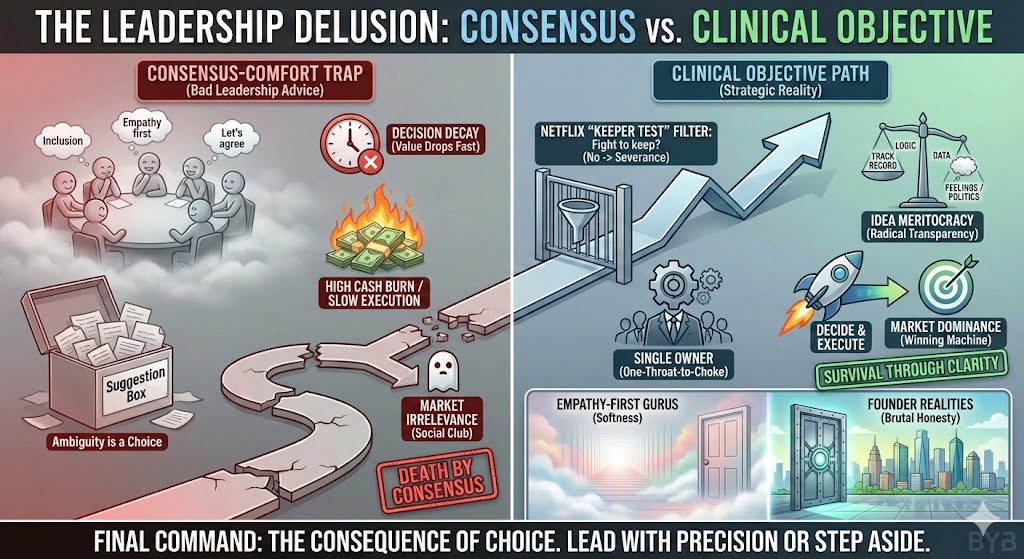
The “Consensus-Comfort Leadership Model” is the silent killer of high-growth companies. This dominant ideology teaches founders to prioritize emotional safety over operational velocity, and it is the single greatest reason for mid-stage stagnation. If you lead based on “servant leadership” platitudes while your market share shrinks, you aren’t a leader; you’re a liability. This article dismantles the Consensus-Comfort Model—the ideology forcing founders to prioritize feelings over output.
1. The Consensus-Comfort Industrial Complex
Modern leadership discourse has been hijacked by an HR-flavored obsession with “inclusion” and “empathy” that functions as a mask for executive indecision. This Consensus-Comfort Model creates a culture where being “nice” is prioritized over being right. It assumes that the best decisions emerge from a democratic process of mutual agreement.
The reality is clinical: In business, consensus is often the lowest common denominator of mediocrity. When you seek permission to lead, you abdicate your authority. Most bad leadership advice taught to founders today optimizes for emotional comfort, not execution speed. If your current leadership strategy for founders doesn’t prioritize survival over sentiment, you are preparing for obsolescence. Leadership is not about making everyone feel heard; it is about making sure the mission is achieved.
2. Exposing the Real Failure: The High Cost of Being “Relatable”
Founders often fall into the trap of wanting to be the “cool boss.” They avoid the leadership mistakes founders make by swinging the pendulum too far toward approachability. The result is a total collapse of professional hierarchy and a blurred line between mentorship and friendship.
When you prioritize being relatable, you lose the ability to provide the “Brutal Honesty” required to fix a failing product or an underperforming department. You hesitate to fire a “B-player” because you know about their personal life. You soften your feedback to protect their feelings, which in turn poisons the entire organization. This hesitation is not kindness; it is a structural failure in your leadership development. True leadership requires the stomach to dismantle delusions—both your own and those of your team.
3. The Netflix Keeper Test
Netflix famously rejected the “family” metaphor for business, opting for the “professional sports team” model. Their “Keeper Test” is a brutal, high-stakes filter: “If a team member wanted to leave today, would you fight to keep them?” If the answer is no, they are given a severance package immediately.
This isn’t cruelty; it is the clinical preservation of excellence. Organizations that fail to apply this filter often suffer an estimated 20–30% competence drag, based on observed performance loss in high-growth teams that tolerate sustained underperformance. High-performers eventually leave because they are tired of carrying the weight of the mediocre. If you aren’t using this as part of your high-performance leadership strategy for founders, you are effectively subsidizing incompetence and slowing down your company’s growth.
4. The Strategy of Radical Conflict: Lessons from Amazon and Bridgewater
The most successful companies on the planet don’t run on consensus; they run on “Radical Transparency” and structured conflict. These organizations understand that avoiding the common leadership mistakes founders make requires a system that prioritizes truth over feelings.
- Amazon’s “Have Backbone; Disagree and Commit”: Jeff Bezos built a culture that forces leaders to challenge decisions when they disagree, even when doing so is uncomfortable or exhausting. The goal is not harmony; it is the truth. Once a decision is made, everyone commits fully, but the path to that decision is paved with intellectual friction.
- Ray Dalio’s “Idea Meritocracy”: At Bridgewater Associates, the “Consensus-Comfort” model is replaced by an “Idea Meritocracy.” Decisions are weighted based on the track record and logic of the individual, not their title or their ability to make people feel good.
If your leadership strategy for founders doesn’t include a mechanism for uncomfortable, direct, and non-emotional conflict, you are making decisions based on politics rather than performance.
5. The Mathematics of Indecision: Why Your Softness Is Burning Cash
Every hour you spend “socializing” a decision to ensure everyone is on board is a direct hit to your burn rate. In the startup world, speed is the only advantage you have over incumbents. Bad leadership advice tells you to slow down and listen; strategic reality tells you to decide and execute.
Consider the “Decision Decay” formula: The value of a correct decision decreases exponentially the longer it takes to make. A “70% correct” decision made today is often more valuable than a “99% correct” decision made in three weeks. By the time you’ve achieved consensus, the market has moved, the competitor has launched, and your window of opportunity has closed.
Leadership mistakes founders make in this category lead to:
- Market Loss: Your inability to pivot quickly allows more agile competitors to seize the narrative.
- Talent Attrition: Your “A-players”—who thrive on clarity and speed—will leave for environments that don’t require a committee meeting to change a line of code.
- Capital Waste: Indecision is expensive. Every month of “exploration” without a firm direction is another month of payroll for zero ROI.
6. Scaling Talent vs. Managing People: The Architectural Shift
As your business scales, your leadership must shift from doing to architecting. You are no longer the smartest person in the room—or at least, you shouldn’t be. Your role is to build a system where talent can be leveraged at maximum velocity. This is the core of effective executive decision making.
This requires a shift in mindset:
- Stop managing people: People are unpredictable and messy.
- Start managing systems: Systems are scalable and objective.
If a process fails, look at the system first. If the system is sound and the person fails, look at the person. Most leaders flip this, blaming people for systemic failures or excusing systemic failures because they “like the person.” Both are paths to irrelevance. Effective scaling leadership requires the discipline to treat your organization as a machine that needs tuning, not a family that needs unconditional love.
7. Idea Hammering: Clarity is the Only Currency
The Consensus-Comfort Model thrives in the fog. Your job is to burn that fog away.
- Ambiguity is a choice. If your team doesn’t know the top three priorities for this quarter, that is your failure. This is one of the most common leadership mistakes founders make.
- Politeness is a tax. Every time you sugarcoat a critique, you are stealing growth from your employee and profit from your shareholders.
- Harmony is a byproduct, not a goal. Real harmony comes from winning together, not from liking each other.
8. Final Command: The Consequence of Choice
Leadership is a binary state: You are either driving the organization toward a clinical objective, or you are facilitating a social club at the expense of your investors.
If you continue to follow the bad leadership advice of the “empathy-first” gurus, accept the inevitable outcome: Slow execution, high cash burn, and eventual market irrelevance. Your “kindness” will result in a company that can no longer afford to pay the very people you were so desperate to please. Bad leadership leads to cash burn, delayed decisions lead to market loss, and consensus leads to slow execution.
The Action Plan: Identify the most significant bottleneck in your company right now. It is likely a person or a process you have been “too nice” to fix. Resolve it by the end of the business day. Do not seek consensus. Do not ask for permission. Make the call, accept the fallout, and move the needle.
Fix your leadership, or accept that your brand will stay invisible by design.
Leave a Reply