

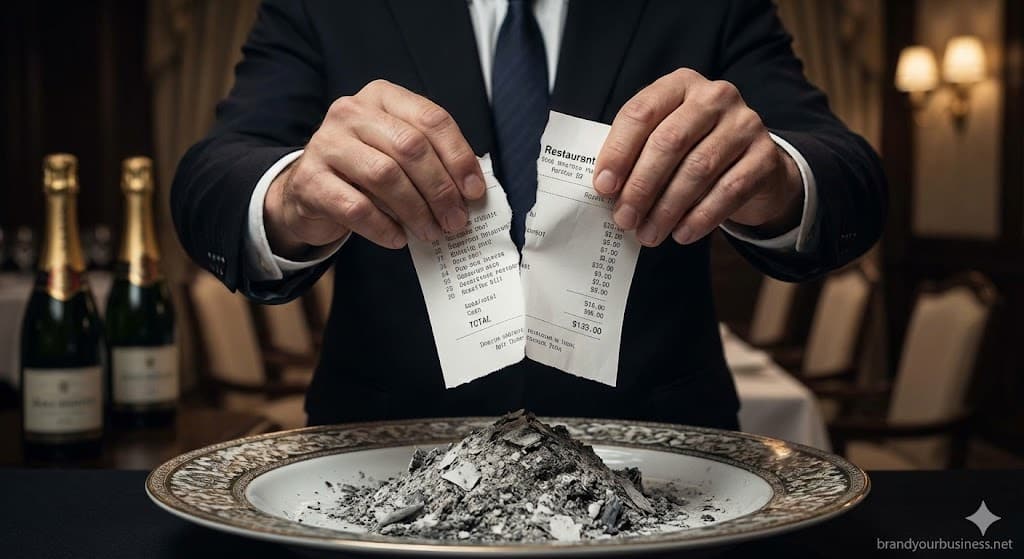
You think you are a “Baller” closing deals at the Super Bowl, the F1 Paddock, or the World Cup Final. In reality, you are just a sugar daddy for your clients.
It is a global phenomenon. As the major sporting and cultural calendars kick off around the world, VIP suites are packed with business owners slapping each other on the back, drinking overpriced champagne, and convincing themselves that this debauchery is “Business Development.”
You tell yourself, “It’s a tax write-off!” You tell yourself, “I’m building relationships!”
Let me destroy your delusion right now: The Taxman does not care about your “relationships.” Whether you are dealing with the IRS in the US, HMRC in the UK, the ATO in Australia, or the Tax Office in Singapore, the golden era of the “three-martini lunch” is dead. Governments worldwide have tightened the noose.
Unless you understand the brutal specifics of your local tax jurisdiction, that expensive box seat and that five-course meal are likely not fully deductible. You are not spending pre-tax money; you are burning your net profit to feed people who might never sign a contract with you.
Corporate entertainment is often a vanity metric for insecure founders who want to feel important. It is a “positive business development tool” only if it generates a measurable Return on Investment (ROI) after the tax authorities take their cut. For most of you, it is just an expensive way to buy fake friends.
Here is the global financial autopsy of your “entertainment strategy” and why your ignorance is costing you thousands.
Protocol 1: The “Write-Off” Hallucination
This is the biggest lie in the international business world: “I’ll take the client out to dinner; the company pays for it.”
The Reality: Yes, the company pays for it. But in many modern jurisdictions, the company cannot deduct it from its taxable income. From the United States’ strict cuts on entertainment deductions to the UK’s blockage of client entertaining, the trend is clear: Client entertainment is often a post-tax expense.
When you spend $1,000 on a dinner for a prospect, that is $1,000 gone from your bottom line. You don’t get 20-30% back in tax relief. You are effectively paying a premium to do your job. If you are spending thousands on sporting tickets and steak dinners hoping to generate new business, you better be damn sure the deal is worth it. Because if that client walks away, you didn’t just lose the deal; you paid for the privilege of being rejected. Stop acting like a philanthropist. If the math doesn’t work without the tax deduction, do not buy the ticket.
Protocol 2: The “Staff vs. Client” Trap
Most tax codes globally have a distinct bias: They hate it when you feed your clients, but they tolerate it when you feed your staff (to a limit). The rules often allow for tax-efficient “staff morale” events, but strict penalties for “client hospitality.”
The Trap: You think you can blur the lines. You host a lavish party, invite your sales team, and then sprinkle in your top 10 clients. You categorize the whole thing as “Staff Training” or “Annual Party.” You are committing fraud. Auditors look for this specifically. They analyze the ratio of employees to guests. If you cannot prove the event was primarily for staff welfare, the entire deduction can be disallowed.
Furthermore, even staff entertainment has strict caps (thresholds like £150 in the UK or specific “de minimis” benefits in other regions). If you go one dollar over the limit, the entire amount becomes taxable income for your employee. Congratulations, you just tried to throw a party and ended up creating a tax liability for your own workforce. The Strategy: Be surgical. Know the exact threshold in your country. Spend up to that limit to build culture, but do not cross the line. Do not mix your client acquisition strategy with your HR strategy; it is a recipe for a tax audit.
Protocol 3: The “Mixed Event” Accounting Nightmare
This is where your sloppy accounting destroys you. You host a suite at a major game. You invite two key executives and two potential investors. You tell your accountant, “Just put it under marketing.”
You are lazy and dangerous. Proper accounting standards require you to apportion costs. You might be able to claim relief on the portion allocated to your employees, but the portion allocated to the clients is a sunk cost. If the bill is $5,000, and half the attendees were clients, then $2,500 is likely non-deductible.
If you are too lazy to separate these costs in your books, your accountant will either hate you or fire you. Or worse, they won’t catch it, and the tax authority will tear you apart during an inspection years later, adding penalties and interest. You need to make “reasonable assumptions” and keep impeccable records. If you can’t prove who ate the steak, the auditor assumes it was a client, and you lose.
Protocol 4: The ROI of Vanity (Ego vs. Data)
Let’s move beyond tax law and talk about business psychology. Why do you really entertain clients? Is it because your CRM data shows a direct, causal correlation between luxury box seats and signed contracts? Or is it because you like being the “Big Man” in the executive suite, ordering bottles for the table?
Most corporate entertainment is Ego-Driven Expenditure. You want to feel successful, so you mimic the behaviors of massive multinational corporations. But those corporations have marketing budgets that dwarf your entire revenue. They can afford to waste money on “brand awareness” and “relationship maintenance.” You cannot.
The Test: If you stopped taking your clients to Michelin-star lunches, would they stop doing business with you? If the answer is “Yes,” then you don’t have a value proposition; you have a bribery scheme. If the answer is “No,” then why are you burning cash?
Your product should be good enough to close the deal in a conference room with a glass of tap water. If you need champagne and caviar to get a signature, your product is weak and your sales skills are non-existent.
Protocol 5: The Opportunity Cost of the “Good Time”
Every dollar, pound, or euro you spend on a client dinner is a unit of capital you cannot spend elsewhere. Financial planning is not just about “saving tax.” It is about Capital Allocation.
That $5,000 dinner?
- It could have bought you 5,000 clicks on a targeted ad campaign.
- It could have paid for a sales training seminar for your team.
- It could have upgraded your customer support software.
You are trading scalable growth for ephemeral pleasure. You need a clear financial plan. You need to know exactly which individuals are worth entertaining (the “Whales”) and which are just looking for a free meal (the “Barnacles”). Most of you are feeding the Barnacles and starving your business.
The Kill Shot: Be a Sniper, Not a Shotgun
The era of “spraying money” to get deals is over. The global economy is too tight, and tax authorities are too smart.
You have a binary choice:
- The Amateur: Continue to splash cash on clients to feed your ego, ignore the tax reality, and wonder why your net profit is so thin at the end of the year.
- The Executive: Audit every single entertainment expense. If it’s for staff, maximize the efficiency. If it’s for clients, demand a clear, mathematical ROI or keep the credit card in your pocket.
Stop trying to be liked. Start trying to be profitable. If you can’t track the return, you are just lighting money on fire.
Leave a Reply